
 Asep Darmawan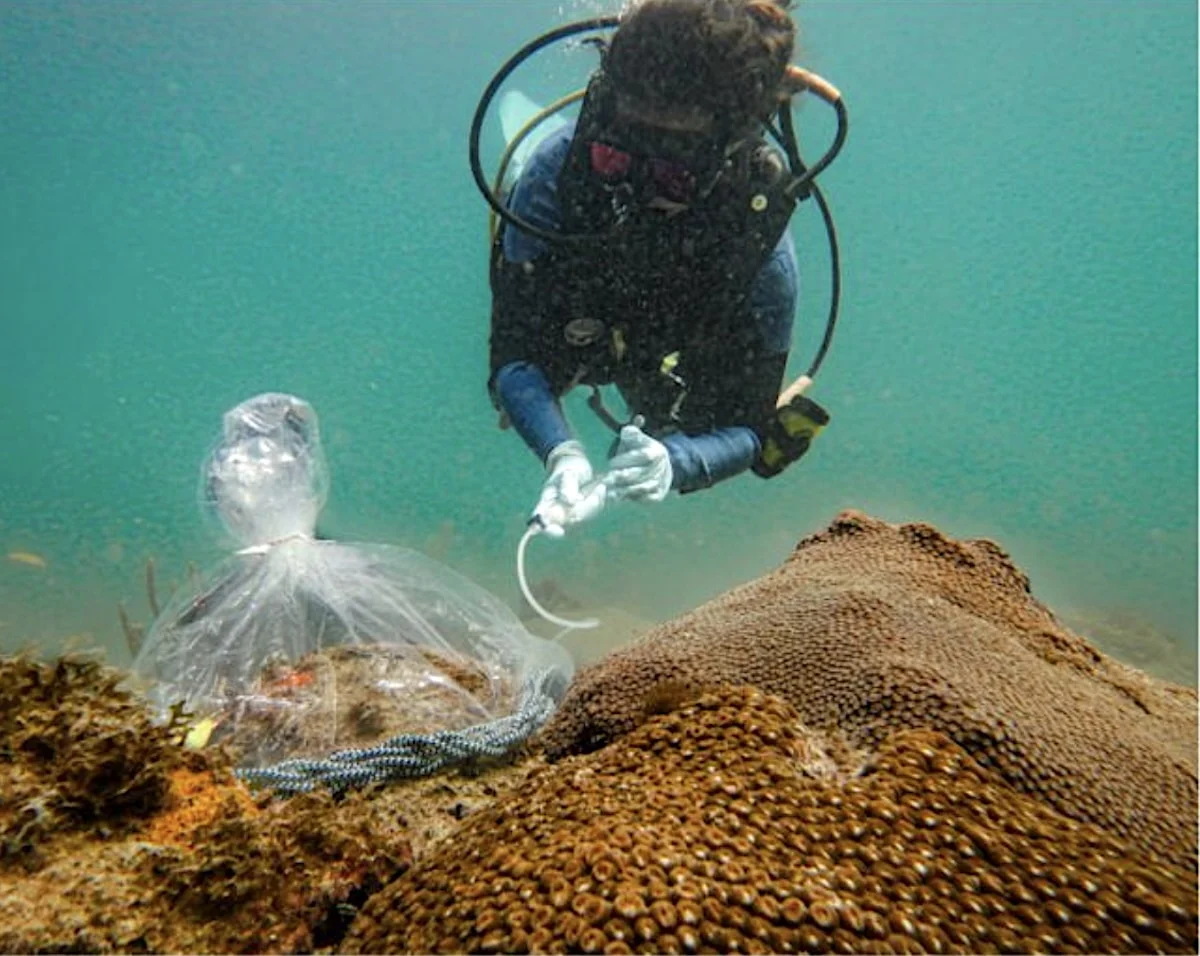
The vibrant, life-sustaining architecture of Florida’s coral reefs—a vital barrier against storm surges and a cornerstone of marine biodiversity—has been under a relentless, existential assault for the better part of a decade. Stony Coral Tissue Loss Disease (SCTLD), a virulent and rapidly spreading pathogen, has decimated reef tracts across the Caribbean and the Florida Keys, turning once-thriving colonies into skeletal white graveyards. However, a glimmer of hope has emerged from the laboratories of the Smithsonian Marine Station.
In a study recently published in the journal Frontiers in Marine Science, researchers have demonstrated that a specific probiotic bacterial strain, MCH1-7, can significantly mitigate the spread of SCTLD. By employing an innovative "whole-colony bagging" technique, scientists have successfully shielded Great Star Coral (Montastraea cavernosa) from the disease for over two years, marking a pivotal step forward in marine conservation technology.
The Crisis: Understanding Stony Coral Tissue Loss Disease
To appreciate the significance of the MCH1-7 breakthrough, one must first understand the devastation wrought by SCTLD. First identified near Miami in 2014, the disease is characterized by the rapid loss of coral tissue, leaving behind exposed, stark-white skeletons that are quickly colonized by opportunistic algae.
Unlike other coral maladies that fluctuate with seasonal water temperatures, SCTLD is highly transmissible through water currents and direct contact. It affects a wide range of boulder-building corals, which are essential for reef structural integrity. The disease moves with startling speed; a healthy, centuries-old colony can be reduced to a bare skeleton in a matter of weeks. Despite global efforts to identify the causative agent—which remains a subject of ongoing debate—mitigation efforts have largely been reactive, often involving the application of topical antibiotics that are difficult to scale and potentially disruptive to the surrounding microbial environment.
The Discovery of MCH1-7: A Natural Defense
The origin story of the MCH1-7 probiotic is a testament to the resilience of nature. In 2018, researchers at the Smithsonian Marine Station noticed something anomalous: while surrounding corals were succumbing to SCTLD, one specific colony appeared to be thriving, showing no signs of infection despite the heavy disease pressure in the area.
Upon sampling the microbes associated with this resilient colony, the team isolated the strain MCH1-7. This bacterium produces a potent compound known as tetrabromopyrrole (TBP). TBP is not merely an antimicrobial agent; it is a naturally occurring compound that serves as a settlement cue for coral larvae. Jennifer Sneed, a biologist at the Smithsonian Marine Station, notes the evolutionary elegance of this interaction: "If TBP is a natural settlement cue, and if bacteria that also produce this compound protect corals from disease, it makes sense that larvae would settle where those compounds are being produced. More of them would survive to be able to recognize the compound."
The discovery suggested that the probiotic was not just fighting the disease but perhaps creating a "shield" that allowed the coral to thrive in a hostile environment.
Chronology of the Research
The path from discovery to the recent publication involved years of rigorous, controlled field testing.
- 2018: The MCH1-7 strain is identified and isolated from a disease-resistant Montastraea cavernosa colony in Florida.
- 2019–2020: Preliminary laboratory trials confirm that the compound TBP inhibits the progression of necrotic tissue loss in infected coral samples.
- 2021: Researchers transition to field trials. They test two distinct delivery methods: a topical paste applied directly to lesions and a "whole-colony bagging" method.
- 2022–2024: A long-term monitoring phase ensues. Divers perform periodic site visits to measure tissue loss, collect samples, and assess the structural integrity of the treated reefs.
- 2025: The findings are peer-reviewed and published in Frontiers in Marine Science, confirming that the bagging method provided sustained protection for 2.5 years.
Methodology: Why Bagging Outperformed Topical Treatment
The study compared two primary methods of application. The first, a topical paste, is the traditional approach for treating coral disease; it is surgically applied to the lesion site. While this method is intuitive, the research found it to be largely ineffective for long-term SCTLD management. The paste often washes away due to wave action or fails to address the sub-clinical infections lingering elsewhere on the colony.
The second method—the whole-colony bagging technique—proved transformative. Divers place a weighted, permeable bag around the entire coral colony, effectively creating a temporary "treatment chamber." The probiotic is injected into this contained environment, ensuring that the bacteria have time to colonize the coral’s mucus layer and establish a protective microbial film.

The results were statistically profound. Corals treated with the bagging method lost only about 7% of their tissue to the disease, a stark contrast to the 35% tissue loss observed in the control group (untreated corals). Even 2.5 years post-application, the treated corals continued to show significantly higher survival rates and structural health.
Data and Implications: A Path Forward for Reef Restoration
The quantitative data provided by the Smithsonian team suggests that we have entered a new era of "microbial medicine" for reefs. By treating the colony as a holobiont—a host organism and its entire community of symbiotic microbes—scientists are moving away from the "kill the pathogen" model toward a "support the host’s immune system" model.
The environmental implications are vast. If the bagging technique can be scaled, it could preserve the genetic diversity of remnant reef populations that are currently under siege. Furthermore, because the treatment uses natural compounds (TBP), it avoids the ecological risks associated with mass-applying synthetic antibiotics to the ocean, which could otherwise lead to antibiotic-resistant pathogens or the decimation of beneficial reef microbes.
However, the authors are quick to manage expectations. Lead researcher Kelly Pitts emphasizes, "It’s important to understand that this is the very beginning. This is definitely not a cure-all, but we’re definitely moving in the right direction."
Challenges and Future Research
Despite the success of the MCH1-7 trials, significant hurdles remain. The logistical requirements of the bagging method are non-trivial. It requires trained scientific divers, substantial equipment transport, and significant time investment per colony. Scaling this from a research project to a large-scale conservation strategy will require:
- Automation and Scaling: Developing deployment methods that require less labor for divers.
- Broad-Spectrum Efficacy: Investigating whether MCH1-7 and its TBP production are effective against other coral diseases or if different probiotic cocktails are required for different coral species.
- Long-term Ecological Impact Studies: While the study confirms the treatment doesn’t disrupt local healthy coral, further long-term monitoring is required to ensure that introducing these probiotics doesn’t cause unforeseen shifts in the reef’s microbial ecology over decades.
Official Responses and Scientific Consensus
The marine biology community has reacted with cautious optimism. The Frontiers in Marine Science report has sparked discussions on how federal and state agencies, such as NOAA and the Florida Fish and Wildlife Conservation Commission, might integrate probiotic treatments into their existing coral intervention programs.
The consensus is clear: while climate change mitigation remains the primary requirement for saving coral reefs in the long term, we no longer have the luxury of waiting for global carbon policy to stabilize reef health. Localized interventions like the MCH1-7 probiotic treatment provide a critical "bridge," keeping keystone coral colonies alive long enough for other restoration and climate adaptation efforts to take hold.
Conclusion
The struggle against Stony Coral Tissue Loss Disease is a race against time, with the future of the Caribbean’s underwater ecosystems hanging in the balance. The work performed by the Smithsonian Marine Station, specifically the identification of the protective MCH1-7 strain and the successful validation of the bagging methodology, provides more than just a data point—it provides a template for intervention.
As the team continues to refine their techniques and explore the potential for broader applications, the global conservation community watches closely. We are witnessing a shift in environmental science: the transition from passive observation of decline to active, biology-based management of our oceans. While MCH1-7 is not the final word in the fight to save the reefs, it is, without question, one of the most promising chapters in the story of modern marine restoration. Through continued rigorous science and a commitment to protecting these underwater wonders, there remains a tangible path to a resilient, thriving future for our reefs.

 Laily UPN
 Lina Hope
 Iffa Jayyana
 Rifan Muazin
 Suro Senen
 Lina Irawan