
 Siti Muinah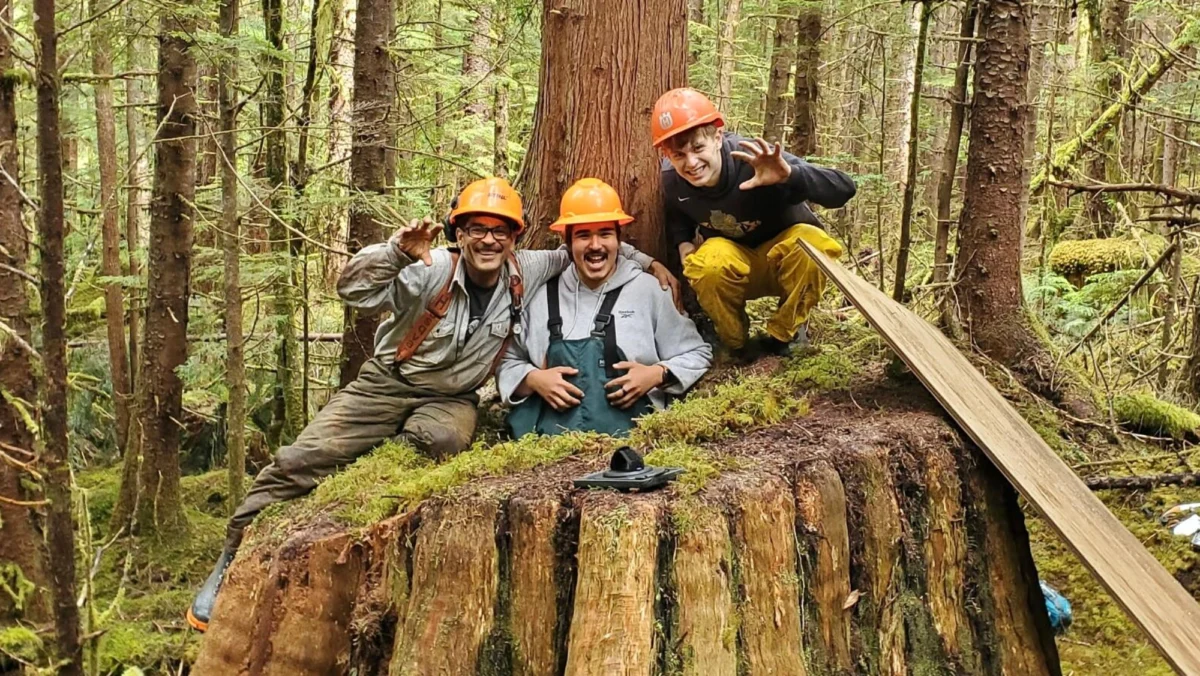
In the moss-laden forests of Haida Gwaii, off the northern coast of British Columbia, a quiet, high-stakes experiment in ecological restoration is underway. Elijah Washington, a stewardship technician with the Council of the Haida Nation, navigates through a dense thicket of ferns and industrial logging debris. He stops at a massive, hollowed-out western red cedar stump—a remnant of a bygone era of intensive clear-cutting. To the untrained eye, it is just a rotting piece of timber. To Washington and his crew, it is a lifeline.
This summer, the Haida Nation retrofitted seven such stumps, capping them with plywood, weather-resistant roofing, and a camouflage of thick green moss. These artificial dens are designed to provide a critical sanctuary for the coastal black bear (taan), a subspecies unique to this archipelago and among the largest of its kind in North America. As old-growth forests continue to vanish under the blade of the logging industry, the Haida are taking matters into their own hands, attempting to manually replicate the centuries-old natural structures that these bears require to survive the harsh winters.
The Ecological Crisis: Why Dens Matter
For the coastal black bear, a den is not merely a place to sleep; it is a nursery. Female bears give birth to cubs—often weighing as little as one pound—in these hidden chambers. For up to 100 days, the mother and her offspring remain tucked away, sheltered from the elements and protected from predators.
“The only place where bears can have babies is in a den,” explains Helen Davis, a veteran wildlife biologist who has been collaborating with the Haida Nation to restore these habitats. “These dens are absolutely critical to population sustainability.”
Historically, these bears relied on the massive, hollowed-out trunks of ancient, living cedars. These trees take centuries to develop the internal decay necessary to house a bear, while remaining alive and structurally sound. However, the industrial logging boom of the 20th century decimated much of this old-growth canopy. The second-growth forests that have since replaced them lack the structural complexity to support these denning needs. With no natural caves or hollow trees available, the bears are effectively being squeezed out of their ancestral reproductive grounds.

Chronology of a Conservation Effort
The path to this artificial den program began decades ago, born from the grim discoveries of loggers working in the region. Since the 1990s, Davis has documented numerous accounts of forestry workers inadvertently cutting into trees, only to find a hibernating bear inside.
- The Research Phase (1990s–2010s): Davis conducted a three-year provincial study alongside industry partner Canfor. By tracking radio-collared bears to 65 different dens, her research confirmed that these animals are almost entirely dependent on large, hollow old-growth structures.
- The Shift in Strategy (2019): Realizing that the provincial government was failing to preserve sufficient old-growth forests, Davis shifted her focus from advocacy to intervention. She began working with Taan Forest, the Haida-owned forestry company, to teach staff how to identify viable stumps and convert them into suitable dens.
- The Expansion (2023–2026): After successful trials where bears returned to the same modified dens annually, the program scaled up. This past summer, the Council of the Haida Nation secured funding from the Habitat Conservation Trust Foundation, enabling a dedicated crew to scout and retrofit stumps across various watersheds on Graham Island.
Supporting Data: Engineering vs. Nature
The project is a marriage of modern biology and traditional ecological knowledge. The crews do not simply build boxes; they curate the environment. They carefully measure the entrance, ensuring it is “Goldilocks-sized”—large enough for a sow to enter, but small enough to remain secure.
Furthermore, the team employs a unique biological incentive: scent. When a bear is found to have passed away naturally, the crew respectfully collects hair samples to place inside the new dens. This "baiting" technique, which Davis has tested in other field studies, helps create a sense of familiarity, encouraging local bears to investigate and eventually occupy the structures.
Preliminary data from Taan Forest shows the effectiveness of this approach. Bears have been documented using these modified sites, and in some cases, returning to them for multiple consecutive winters. Currently, there are 10 modified sites across Haida Gwaii slated for monitoring. The team uses remote cameras to track activity, ensuring they remain away from the sites during the winter to avoid disturbing the hibernating animals.
Official Responses and Ethical Tensions
The project has drawn praise for its innovation, but it has also surfaced deep-seated anxieties regarding the future of the landscape.

The logging industry in British Columbia remains a massive economic driver. In August, BC Forests Minister Ravi Parmar stated that ending old-growth harvesting entirely would effectively shutter the sector. For biologists like Davis, this political reality forced a pragmatic choice: “Since nobody seems to want to conserve old growth for them, I was like, ‘Well, fine, then let’s see if we can build them.’”
However, this pragmatic approach sits uneasily with many Haida community members. Lisa White, a councillor with the Old Massett Village Council, recalls the visceral pain of seeing the first plywood-capped stumps. “I actually cried,” she said. To her, the artificial dens serve as a haunting reminder of how severely the land has been degraded—that the forest can no longer support its own inhabitants without human intervention.
The Haida have historically managed the forest through selective harvesting, taking only what was needed and leaving the trees standing. They knew how to pull planks from living trees without killing them. The current industrial model, which clear-cuts vast tracts and leaves only "moss lawns," is viewed by many Elders as a fundamental breach of their stewardship responsibilities.
Broader Implications: A Model or a Crutch?
The most significant question hanging over the project is whether these dens represent a genuine solution or a convenient "band-aid" for the logging industry. Critics argue that by building these structures, we may be providing the government with an excuse to continue clear-cutting old-growth forests under the guise that "the bears will be fine."
Moreover, as Noel Bellis, a carver and Haida Nation member, points out, a house is only useful if there is food in the cupboard. "It’s a moss lawn between trees," he notes, describing the current state of second-growth stands where deer have overgrazed the understory. Without a robust plan to restore the food sources—such as salmonberry, fireweed, and horsetail—that bears rely on when they emerge in the spring, these dens may become isolated outposts in an ecological desert.

Taan Forest is attempting to mitigate this by opening gaps in the canopy to encourage the growth of shrubs, but the challenge remains daunting. As the climate changes and the islands face increasingly severe storms, the structural integrity of the surrounding second-growth forest is also in question. If the trees surrounding the dens blow down, the dens themselves may be destroyed or rendered inaccessible.
Looking Forward
Despite these concerns, the Haida Nation remains committed to the project. The work is deeply rooted in a worldview that sees the bears as "kin." Barney Edgars, a Haida Elder, recalls a time when humans and bears shared the landscape without fear or conflict. He worries that the loss of traditional habitat will force bears closer to human communities, rummaging through trash and creating dangerous encounters that were historically unknown.
"We were taught that everything we grew up with had a spirit," Edgars says.
For now, the project remains a controlled experiment. The team is careful not to over-populate the area, avoiding the creation of a "bear village" that would cause resource competition. Instead, they are taking a cautious, measured approach, observing the land and the animals with a humility that has characterized the Haida relationship with the islands for millennia.
The success of the Haida bear den program may eventually provide a blueprint for conservationists globally. Yet, for the people of Haida Gwaii, the ultimate goal is not to become permanent foresters of artificial homes, but to see the day when the land is healthy enough to sustain the bears on its own—when the forest is allowed to grow old, wild, and whole once again.


 Laily UPN
 Lina Hope
 Iffa Jayyana
 Rifan Muazin
 Suro Senen
 Lina Irawan