
 Lina Hope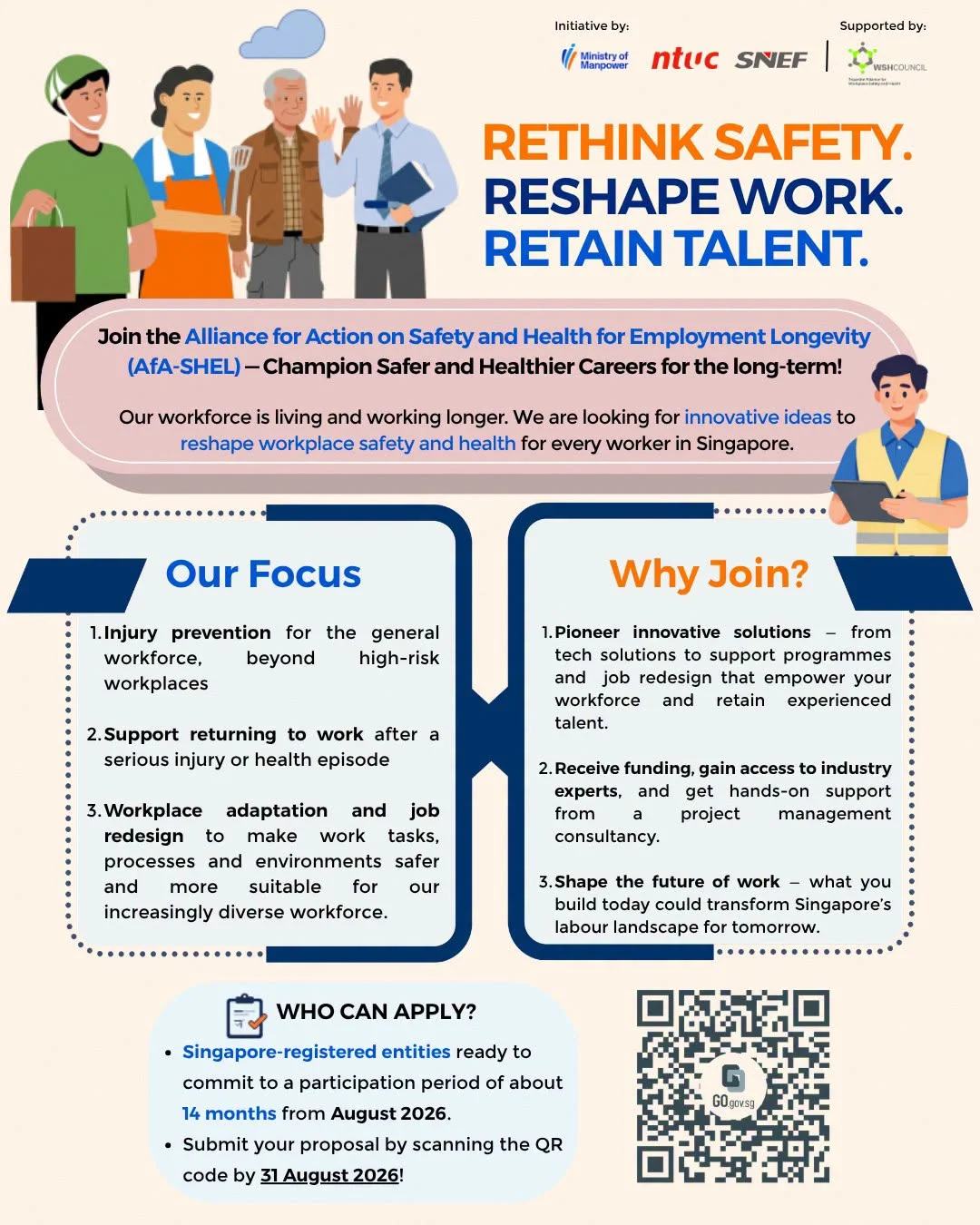
SINGAPORE – In a decisive move to address the dual challenges of an aging workforce and the evolving nature of industrial risks, the Ministry of Manpower (MOM) has officially launched the Alliance for Action on Safety and Health for Employment Longevity (AfA-SHEL). Announced during the Singapore Workplace Safety and Health (WSH) Conference 2026, held at the Marina Bay Sands, the initiative marks a significant milestone in the nation’s tripartite efforts to ensure that workers remain safe, healthy, and productive throughout their extended careers.
The conference, themed "Insight to Impact: Collective Effort for Stronger WSH Outcomes," served as the backdrop for several high-level announcements aimed at fortifying Singapore’s safety culture. As the centerpiece of these initiatives, AfA-SHEL represents a collaborative ecosystem involving the government, labor unions, and employers, specifically designed to co-create scalable solutions for injury prevention and sustainable employment.
I. Main Facts: A Tripartite Strategy for a Changing Workforce
The AfA-SHEL is not merely a policy directive but a call to arms for the private and public sectors. Jointly led by the Ministry of Manpower (MOM), the National Trades Union Congress (NTUC), and the Singapore National Employers Federation (SNEF), the alliance seeks to bridge the gap between traditional safety protocols and the modern requirements of a "silver" workforce.
The Core Objectives
The primary mandate of AfA-SHEL is to invite Singapore-registered organizations to develop, pilot, and scale solutions that address three critical pillars of employment longevity:
- Workplace Adaptation and Job Redesign: Modifying physical environments and work processes to suit workers of all ages and physical capabilities.
- Injury Prevention and Early Intervention: Utilizing technology and behavioral insights to stop accidents before they occur, particularly in routine tasks.
- Enhanced Return-to-Work (RTW) Support: Creating structured pathways for injured or ill workers to reintegrate into the workforce, preventing premature career endings.
The Open Call for Innovation
From July 23 to August 31, 2026, MOM is accepting proposals from organizations, solution providers, and healthcare institutions. The government expects to select approximately 30 organizations to participate in a 14-month innovation program. These participants will receive:
- Funding support for prototype development.
- Access to WSH experts and industry resource persons.
- Dedicated account management to guide the scaling of their solutions.
II. Chronology: From Concept to Implementation
The launch of AfA-SHEL is the culmination of a strategic roadmap laid out earlier this year. Understanding the timeline is essential for stakeholders looking to align their corporate social responsibility (CSR) and WSH goals with national objectives.
-
March 2026: The Initial Blueprint
The concept of AfA-SHEL was first introduced by Minister of State (MOS) for Manpower Dinesh Vasu Dash during the Committee of Supply (COS) 2026 debates. At the time, the government highlighted the need for "employment longevity" as a key economic priority, citing the shrinking pool of young entrants into the workforce. -
June 2026: A Wake-up Call
A series of workplace fatalities in June 2026 served as a somber reminder of the volatility of WSH outcomes. This period saw an uptick in accidents during routine operations, prompting MOM to accelerate the development of the Platform Worker Safety Workgroup and refine the focus of the upcoming AfA. -
July 23, 2026: The Official Launch
At the Singapore WSH Conference, MOS Dinesh formally opened the call for proposals. The event brought together over a thousand WSH professionals, signaling the start of a multi-sectoral collaboration. -
August 31, 2026: Application Deadline
The window for organizations to submit their digital tools, workplace initiatives, or pilot service proposals closes. -
Late 2026 – 2027: The Innovation Cycle
The selected 30 organizations will undergo a rigorous 14-month program to test their solutions in real-world environments, with the goal of creating blueprints that can be adopted by the wider industry by 2028.
III. Supporting Data: The Drivers of Change
The impetus for AfA-SHEL is rooted in shifting demographic and safety data that suggest traditional WSH approaches may no longer be sufficient.
1. The Aging Demographic and "Silver" Productivity
By 2030, one in four Singaporeans will be aged 65 and above. To maintain economic momentum, the workforce must remain "economically active" for longer. However, older workers often face different safety risks—such as longer recovery times from falls and a higher susceptibility to chronic conditions exacerbated by physical labor. AfA-SHEL focuses on these specific vulnerabilities to prevent "premature curtailing" of careers.
2. The Rise of Platform Worker Risks
One of the most alarming statistics shared at the conference was the spike in work-related traffic fatalities. In the first half of 2026 alone, Singapore recorded seven work-related traffic fatalities—a figure that already exceeds the total for the entire year of 2025. Significantly, four of these involved platform workers (delivery riders and private-hire drivers). This data has led to the formation of a specialized Platform Worker Safety Workgroup to address the unique pressures of the gig economy.
3. Complacency in Routine Tasks
MOS Dinesh pointed out that while high-risk activities (like heavy lifting or working at heights) are heavily regulated, a significant portion of recent accidents occurred during routine work. Data suggests that lapses in awareness, "shortcuts," and the omission of basic safety steps are becoming leading causes of major injuries as workers become overly familiar with their environments.

IV. Official Responses: Voices from the Tripartite Leadership
The launch was supported by powerful rhetoric from Singapore’s top labor and safety officials, emphasizing that WSH is no longer just about "not dying" at work, but about "thriving" throughout a career.
MOS Dinesh Vasu Dash: A Call for Vigilance
MOS Dinesh emphasized the psychological aspect of safety. He urged the adoption of the "I CHOOSE SAFETY" mindset and the "LOOK-THINK-DO" philosophy.
"Beyond these risks, we must also help workers remain safe, healthy and productive throughout their employment. This means designing safer work, preventing injuries, and strengthening return-to-work support, so that workers can continue contributing without injury or ill health."
Melvin Yong (NTUC): The Struggle Beyond the Injury
NTUC Secretary-General Melvin Yong took to social media to highlight the human cost of inadequate return-to-work support. He noted that for many, the physical injury is only the beginning of a downward spiral.
"For many workers, that is when the real struggle begins. The longer a worker stays away from work, the harder it becomes to return. We must pay greater attention to what happens after a worker experiences a serious injury."
Abu Bakar Mohd Nor (WSH Council): From Insight to Action
Chairman Abu Bakar Mohd Nor reminded the audience that technology like AI and robotics brings both solutions and new risks.
"Insights only matter when we put them into action. What we learn today should help us make our workplaces safer and healthier tomorrow. Workplace safety cannot be taken for granted."
V. Implications: What This Means for Businesses and HR
The launch of AfA-SHEL signals a paradigm shift in how Singaporean businesses must approach human capital management. The implications are far-reaching:
1. The Integration of HR and WSH
Traditionally, HR and WSH have operated in silos. AfA-SHEL forces these departments to merge. HR professionals must now look at job redesign not just for efficiency, but for physical sustainability. This involves analyzing the ergonomic demands of roles and using technology to assist older workers, thereby retaining institutional knowledge that would otherwise be lost to early retirement or medical leave.
2. A New Standard for "Return-to-Work"
Companies can no longer view an injured worker as a liability to be managed by insurance. The emphasis on "Return-to-Work" support implies that the government may eventually introduce stricter guidelines or incentives for companies that successfully reintegrate workers. Businesses that develop robust RTW frameworks now will be ahead of the regulatory curve.
3. Investment in Scalable Technology
The "open call" specifically mentions digital tools. We are likely to see a surge in the adoption of wearable sensors that monitor heat stress (a rising risk highlighted by MOS Dinesh), AI-driven fatigue detection for drivers, and exoskeleton suits for manual labor. For solution providers, this is a massive commercial opportunity backed by government funding.
4. Accountability in the Gig Economy
For platform operators, the focus on platform worker safety suggests that the "hands-off" approach to contractor safety is ending. The Platform Worker Safety Workgroup is expected to recommend targeted measures that may include mandatory safety training, better insurance coverage, and algorithmic adjustments to reduce the pressure on riders to speed.
5. Cultivating a "Reporting Culture"
The government’s push for "early reporting" of near-misses suggests a move toward a No-Blame Culture. Organizations that punish workers for reporting hazards will find themselves at odds with national policy. Instead, businesses must reward "early reporting" to prevent minor issues from escalating into fatal accidents.
Conclusion: A Sustainable Future
The launch of the Alliance for Action on Safety and Health for Employment Longevity is a clear indicator that Singapore is preparing for a future where the traditional retirement age is a moving target. By focusing on the intersection of safety, health, and longevity, the tripartite partners are attempting to build a resilient economy where every worker—regardless of age—can contribute safely.
As the open call for proposals continues through August, the eyes of the region will be on Singapore to see if this collaborative, ground-up approach can indeed provide the "scalable solutions" needed to protect the workforce of tomorrow. Organizations that participate in this 14-month journey are not just improving their safety records; they are helping to define the future of work in an aging world.


 Ammar Sabilarrohman
 Pevita Pearce
 Lina Irawan
 Nana Wu

 Suro Senen
 Jia Lissa