Laily UPN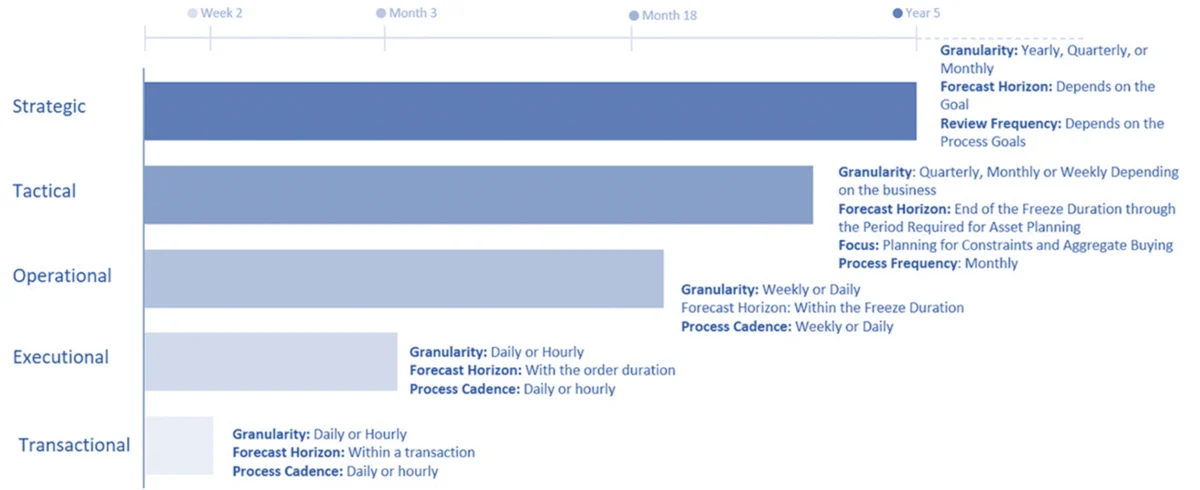
In the high-stakes world of global commerce, supply chain management has become a theater of "shiny objects." Industry experts and technology vendors alike are increasingly captivated by the promise of autonomous supply chains, generative AI, and agentic workflows. Yet, beneath this veneer of digital transformation, a persistent and troubling reality remains: global multi-nationals are struggling to scale performance. Despite massive investments in software and data infrastructure, many organizations are failing to achieve the economies of scale that were promised decades ago.
The culprit is not a lack of technological horsepower, but a fundamental erosion of supply chain discipline. As organizations rush to deploy AI on top of legacy architectures—a practice often described as "AI Stupid"—they are ignoring the foundational inconsistencies that make those systems brittle in the first place.
Main Facts: The Crisis of Complexity and Entropy
The core challenge facing modern supply chains is not just unpredictability; it is entropy. In the physical sciences, entropy represents the progression toward disorder. In a supply chain context, it manifests as the accumulation of uncertainty, inefficient processes, and disconnected data silos.
When organizations attempt to implement AI without first cleaning their internal house, they are merely automating inefficiency. The "Supply Chains to Admire" research consistently reveals that companies often lack a clear, first-principles understanding of what their supply chain is meant to accomplish. This lack of clarity leads to a divergence between how systems are configured and how the business actually operates.

The primary objective for leaders today should be to bridge the gap between "system values"—the static numbers often plugged into legacy ERP systems—and "actuals," the real-world data points that define performance. When these two do not align, the system loses its ability to plan, predict, or respond, leading to the "broken gossamer" of lead times that plague global operations.
Chronology of a Failed Strategy: The Path to "AI Stupid"
The trajectory toward the current crisis can be mapped across three distinct phases of industrial evolution:
- The Era of Static Planning (1970s–1990s): During this period, supply chain systems were built on rigid assumptions. Organizations relied on averages and "set-it-and-forget-it" lead time values. This worked in a relatively stable, globalized environment.
- The Era of Disconnected Growth (2000s–2015): As supply chains expanded, the complexity of managing multi-tier procurement and global logistics outpaced the capabilities of legacy systems. Organizations added "band-aid" layers of software to manage specific nodes, creating the data silos and latency issues that persist today.
- The Current "Shiny Object" Trap (2016–Present): Today, we see the rise of autonomous agents and AI. However, rather than re-engineering the underlying processes, companies are attempting to "wrap" their outdated, high-entropy systems with intelligent overlays. The result is a faster, more automated version of a flawed process—a phenomenon where AI accelerates the speed of failure rather than the quality of decision-making.
Supporting Data: The Case for First-Principle Thinking
To escape the cycle of ineffective innovation, organizations must return to first principles. This requires a brutal assessment of current operations. Leaders should begin by asking a simple, plain-language question: What are we actually trying to achieve?
A comparative analysis of common supply chain operations often reveals a significant "delta" between stated goals and operational realities.
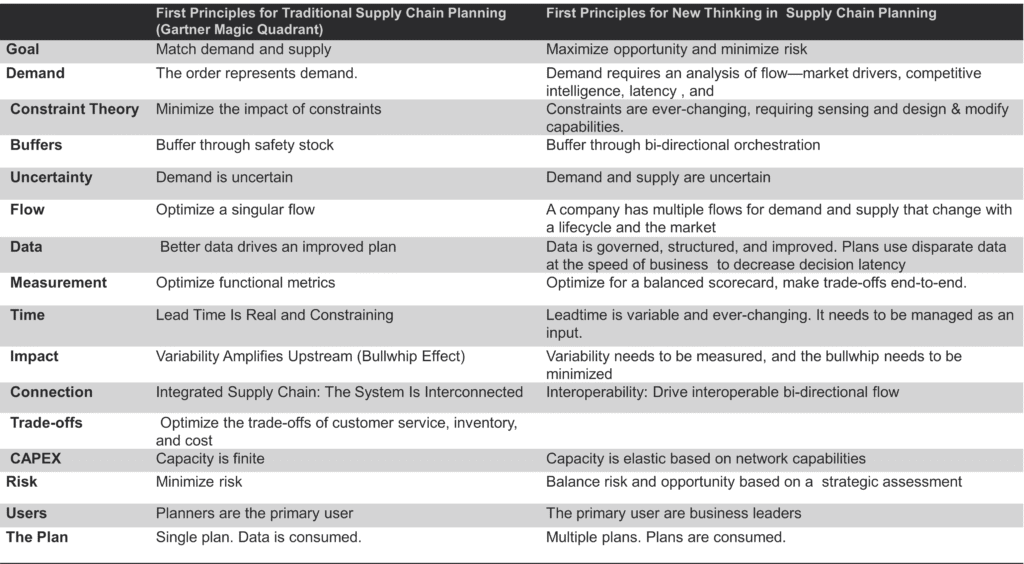
Table 1: Supply Chain First Principles
| Function | Traditional Approach | First-Principle Approach |
|---|---|---|
| Data Usage | Historical averages | Real-time, multi-modal signal integration |
| Planning Horizon | Fixed time buckets | Dynamic, event-driven horizons |
| Lead Time | Static, static input | Probabilistic, pattern-based actuals |
| Goal | Cost optimization | Value-driven resilience and agility |
If an organization finds a massive gap between these two columns, that delta is the source of its competitive disadvantage. Technology cannot solve this gap if the organization is unwilling to redefine its relationship with data. Current processes possess inherent latency that is no longer acceptable in a market-driven environment. A unified data model is no longer a luxury; it is the prerequisite for any meaningful AI deployment.
Official Perspectives: The "Faster Horses" Fallacy
In the discourse surrounding innovation, there is a famous, albeit often misattributed, quote regarding Henry Ford and the "faster horse." The core lesson for modern supply chain leaders is this: users may not always be able to articulate the technical solution, but they are living with the problem every day.
Innovation does not come from asking users to design an AI agent; it comes from deeply understanding what it feels like to be them—to experience the friction of broken lead times and the frustration of inaccurate safety stock calculations. When experts focus on the "promise" of technology rather than the "pain" of the practitioner, they lose the ability to drive real value.
"AI Stupid" occurs when leaders prioritize the form of the solution over the function of the business. By putting agents on top of existing architectures, they are attempting to solve a 21st-century problem with a 20th-century logic model, simply running it at a higher frequency.
The Role of Lead Time and the Reality of Entropy
Lead time is the "gossamer thread" that binds the supply chain. It connects procurement, manufacturing, logistics, and customer delivery. When this thread is broken—when internal systems report a two-week lead time while actuals show six—the entire planning architecture collapses.
The Mathematics of Disorder
Supply chain entropy is a measure of unpredictability. Unlike the "Bullwhip Effect," which describes demand distortion, entropy is a holistic measure of system disorder. It is calculated by analyzing the variance in lead times across procurement, manufacturing, and transportation cycles.
A critical, yet overlooked, metric is the Supply Chain Entropy (SE) score:
- SE = H × CV
- Where H is the measure of predictability (entropy) and CV is the coefficient of variation (sigma/mean).
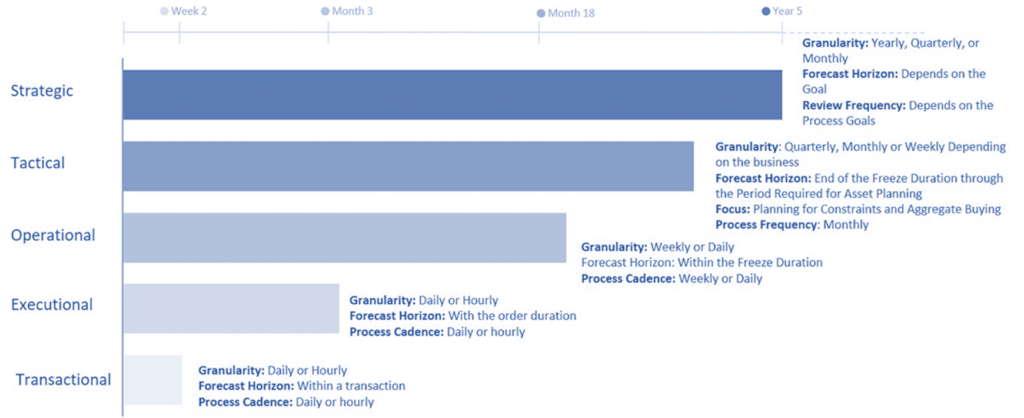
When organizations calculate this, they often find that procurement and logistics cycles are the largest contributors to high entropy. The more a company relies on outsourced manufacturing, the higher the "predicted entropy" becomes. In a world of increasing variability, leaders must transition from static averages to probabilistic engines that account for both the average lead time and the pattern of variance.
Implications: A Roadmap for Recovery
For organizations looking to break the cycle of "shiny object" chasing, the path forward is clear:
- Align on First Principles: Before investing in new AI, audit your current processes. If your "system value" for lead time is a static number, you are operating in the dark.
- Redefine the Data Relationship: Eliminate the "black holes" in your data. Build a master data layer that serves as a single source of truth, prioritizing the removal of latency over the addition of features.
- Manage Lead Time as a Dynamic Asset: Stop using set-it-and-forget-it lead times. Use probabilistic modeling to calculate safety stock, ensuring your inventory reflects the true, variable nature of your supplier performance.
Monetizing the Impact
The final step is to quantify the cost of this entropy. By inputting current entropy levels into network design simulations, organizations can model the actual dollar-value impact of their inefficiency on cost and customer service.
This analysis provides the necessary evidence to initiate a different kind of conversation—one with the CFO and the COO. Instead of discussing the latest AI trend, leaders can present a data-backed case for organizational transformation. By focusing on fundamentals, firms can move from the chaotic, reactive "dance" of the present to a proactive, disciplined future. The goal is not just to build a faster supply chain, but to build a stable, resilient, and fundamentally sound one. When the foundation is solid, the AI will finally have something meaningful to accelerate.

 Sagoh
Sagoh
 Ali Ikhwan
 Raul Delapena Setiawan
 Reynand Wu


 Azzam Bilal Chamdy