
 Layla Zulfa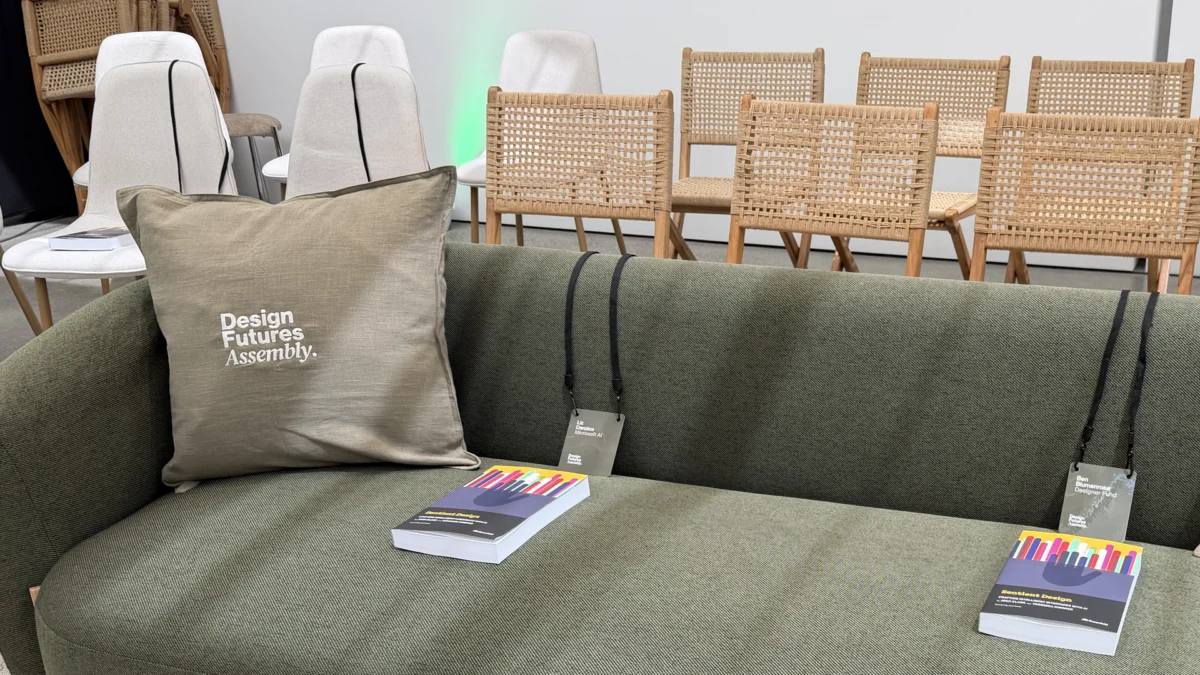
Last week, in the heart of San Francisco, a cohort of nearly 100 senior designers and industry leaders from the world’s most influential AI labs, technology giants, and agile startups gathered for the Design Futures Assembly. While the broader public discourse surrounding artificial intelligence remains stuck in a binary trap—oscillating between the utopian promise of total automation and the apocalyptic fear of societal and environmental collapse—the atmosphere inside the Assembly was markedly different.
The consensus in the room was not one of impending obsolescence, but of radical, messy, and inevitable transformation. For those at the bleeding edge of the industry, the question is no longer "Will AI change design?" but rather "How do we survive and thrive in a landscape where the traditional boundaries of our profession have been effectively erased?"
The Shifting Toolkit: From Consumers to Creators
The most immediate change documented at the assembly is the sheer velocity of tool adoption. Within the last year, the average number of AI-powered utilities in a professional designer’s toolkit has doubled. More importantly, these are no longer merely "off-the-shelf" SaaS subscriptions.
Designers are transitioning from passive users to active architects of their own workflows. During the assembly, attendees showcased custom-built agents capable of crawling massive, legacy codebases to synthesize wikis of complex user mental models. Others demonstrated workflows where custom-built tools are deployed directly into internal app stores to automate mundane tasks.
The gap between a consumer-grade tool and a bespoke internal solution is collapsing. As one attendee noted, "The distinction between the ‘tool’ and the ‘thing I built this morning’ has vanished." This shift suggests that the next generation of design excellence will not be defined by mastery of a single, industry-standard application—like the Adobe Creative Suite or Figma—but by a designer’s ability to maintain a highly dynamic, ever-evolving, and personalized stack.
Chronology of a Disrupted Workflow
To understand the scale of this change, one must look at the timeline of the "handoff." For decades, the design process followed a rigid, linear cadence: Research, Wireframe, Prototype, Handoff to Engineering, Quality Assurance.
- Phase One: The Automation of Craft (2022–2023): Designers began utilizing generative AI for rapid prototyping, image creation, and copy generation. The focus was on speed—reducing the "blank page" problem.
- Phase Two: The Integration of Execution (2023–2024): Designers moved into code generation. Data shared at the assembly revealed that nearly 50% of designers are now shipping AI-generated code directly to production. In early-stage startups, this figure is significantly higher, as the need for cross-functional speed overrides departmental silos.
- Phase Three: The Current Liminal State (Present): We are currently in a "strange in-between." Designers possess the technical agency to ship, but organizational structures remain rooted in the mid-2000s. Performance reviews, job descriptions, and project management methodologies are still calibrated for a world where designers "hand off" work, rather than execute it.
Supporting Data: The Productivity Paradox
The data presented during the sessions highlights a growing friction between capability and organizational hierarchy. In one prominent large-scale technology firm, designers empowered to push code directly to production began addressing granular, persistent customer pain points that had been ignored by the broader product roadmap.
The result was an immediate, overwhelmingly positive spike in customer satisfaction. However, this success triggered an internal crisis: these fixes were not prioritized by Product Management, leading to a clash over the "source of truth" in product development.
The numbers are clear:
- 100%: The increase in the number of AI tools in the average designer’s stack over the last 12 months.
- ~50%: The percentage of designers currently shipping AI-generated code to production.
- Inverse Correlation: As the barrier to entry for building lowers, the barrier to maintaining coherence in a product increases.
Editorial Leadership and the Quest for Coherence
When the ability to build is democratized across a design team, the risk of a fragmented, disjointed user experience skyrockets. One design leader shared a cautionary tale of a team that permitted "permissionless shipping." The result was a product that felt like a patchwork quilt of disparate ideas—functionally sound, but emotionally and visually incoherent.
This has birthed a new, critical mandate for design leadership: The Editorial Role.
"Editorial" is the term favored by many in the industry to describe the new job description for design directors. It is less about "making" and more about "curating." In a world where AI can generate a thousand variations of a UI in seconds, the designer’s primary value is no longer the generation of options, but the rigorous, discerning act of saying "no."
A founder of a prominent design tool company offered an alternative term: Coherence. In an age of algorithmic noise, a product must feel as though it speaks with a single, human voice. Achieving this requires a design leader who can curate the output of automated systems to ensure they align with a singular vision.
The Future of the Human Element
Perhaps the most haunting question posed at the assembly was: What remains beyond the reach of the machine?
For years, designers held "taste" as their safe harbor—the belief that while AI could execute, it could not discern beauty or intent. The consensus at the assembly was sobering: choosing a "good" UI or generating one is fundamentally a pattern-matching task. AI is already adept at this, and it will only improve.
However, the consensus identified a "final frontier" that is significantly harder to automate:
- Problem Framing: AI is excellent at solving problems, but it is still fundamentally incapable of determining what problem is actually worth solving.
- Empathy Synthesis: Reading between the lines of a user research session, noticing the subtle hesitation in a voice, or identifying the unspoken emotional need behind a user’s request remains a distinctly human task.
- Humanizing Technology: The designer’s ultimate responsibility is to ensure that technology serves human needs, rather than forcing humans to adapt to the constraints of the machine.
Implications: A New Professional Identity
The Design Futures Assembly concluded with a lingering, uncomfortable question: What do we call ourselves?
As boundaries blur—as designers write code, PMs build prototypes, and engineers generate UIs—the traditional "Designer" title feels increasingly antiquated. Yet, the underlying need for a human-centric advocate in the product development lifecycle has never been more urgent.
The assembly made it clear that while our tools have changed, our fundamental duty has not. We are the stewards of simplicity and the architects of coherence. But to survive this transition, the industry must move quickly to update its incentive structures. We are currently operating in a state of organizational cognitive dissonance: asking our designers to work like modern, agile, multi-disciplinary engineers while evaluating them as if they are still legacy layout artists.
Until organizational structures catch up to the reality of the AI-powered workflow, the industry will continue to experience the friction of the "in-between." For the designers at the Assembly, the path forward is clear: lean into the chaos, master the custom stack, and pivot from the role of the "maker" to the role of the "editor." The handoff is dead; long live the era of unified, human-centric creation.

 Sagoh
Sagoh
 Asep Darmawan
 Raul Delapena Setiawan
 Reynand Wu


 Azzam Bilal Chamdy
 Ali Ikhwan