
 Reynand Wu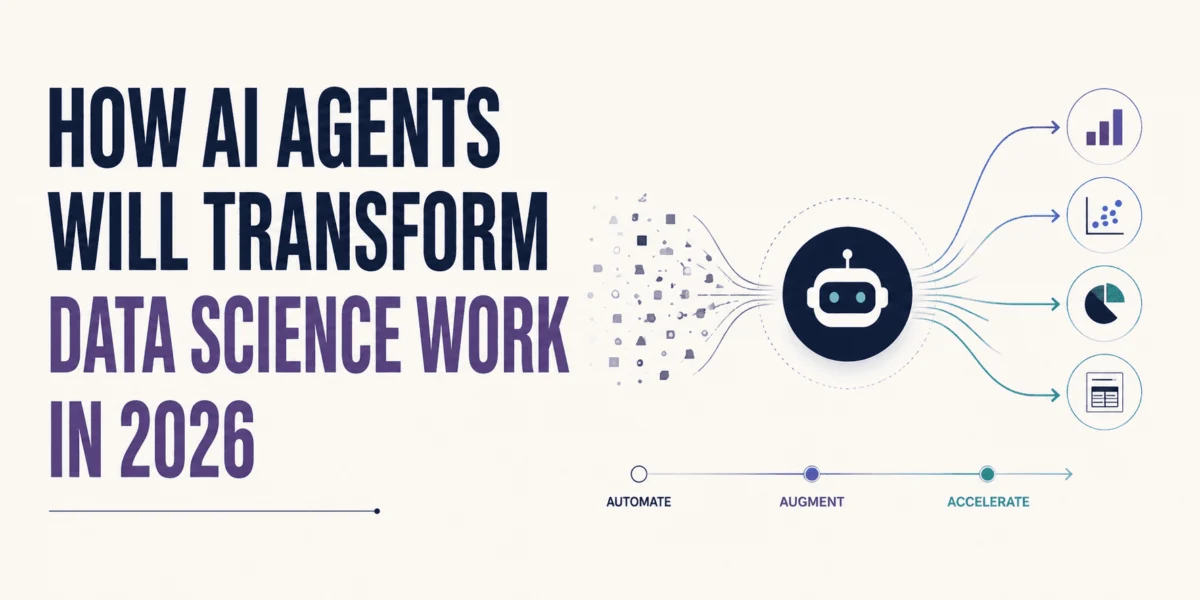
Introduction
The landscape of data science, once defined by the grueling manual labor of cleaning CSV files and debugging cryptic Python scripts, has undergone a radical transformation. By 2026, the industry has moved past the initial hype cycle of Large Language Models (LLMs) and entered the era of the "Agentic Workflow." For the modern data practitioner, the experience is no longer akin to drinking from a firehose of information; instead, it has become a collaborative orchestration between human ingenuity and autonomous AI systems.
The prevailing narrative—that AI would render the data scientist obsolete—has been debunked. In its place, a new reality has emerged: AI agents are not replacing data scientists; they are augmenting them. As we navigate the complexities of 2026, it is clear that the future of data-driven decision-making is defined by the seamless integration of human oversight and machine-led execution.
What Exactly Is an AI Agent?
To understand the paradigm shift, one must distinguish between a static tool and an agent. In 2023 and 2024, most AI tools were passive: you provided a prompt, and the system generated a response. It was a transactional relationship.
An AI agent, by contrast, is a proactive, autonomous entity. It is characterized by three core capabilities:
- Reasoning and Planning: It can decompose a high-level goal into a series of logical steps.
- Tool Use: It can interface with external systems, APIs, and software environments to execute tasks.
- Self-Correction: It can evaluate its own output, identify errors in logic or code, and refine its approach without human intervention.
In a 2026 data science environment, you do not simply ask an agent to "write code." You task it with a business objective—for example, "Optimize our churn prediction model to improve precision by 5% while maintaining a recall above 80%." The agent then autonomously navigates the feature engineering, model selection, hyperparameter tuning, and validation pipeline, presenting a final, optimized candidate for human review.
Chronology of the Shift: From Chatbots to Agents
The trajectory toward agentic workflows was not sudden; it was a deliberate evolution of machine learning capabilities:
- 2022–2023 (The Generative Era): The focus was on LLMs as text generators. Data scientists began using tools like GitHub Copilot to accelerate coding, but the human remained the primary "driver," checking every line for syntax and logic.
- 2024 (The Tool-Integration Phase): AI systems gained the ability to execute code in sandboxed environments. This allowed for rudimentary data analysis, but these tools remained largely reactive.
- 2025 (The Autonomy Threshold): The introduction of multi-agent frameworks allowed specialized AI units to communicate. A "Data Wrangling Agent" could pass cleaned results to a "Modeling Agent," which then handed off findings to a "Reporting Agent."
- 2026 (The Agentic Workflow Standard): Autonomous agents are now standard-issue in data science stacks. The focus has shifted from how to code to how to orchestrate.
Supporting Data: The Impact on Productivity
Industry metrics from 2026 indicate a profound shift in how data teams allocate their time. Historically, data scientists spent upwards of 70-80% of their time on data wrangling—cleaning, formatting, and preparing datasets.
Recent studies suggest that, with the integration of agentic workflows, this ratio has inverted. Data scientists now spend less than 20% of their time on low-level data preparation, as autonomous agents handle the "janitorial" tasks of data science. This has led to a measurable increase in:
- Project Velocity: The time from business inquiry to model deployment has decreased by approximately 65%.
- Model Complexity: Because agents can iterate through thousands of algorithm combinations in a fraction of the time, the average "best-fit" model performance has increased by 15-20%.
- Reduced Burnout: By offloading repetitive debugging and documentation tasks, data scientists report higher job satisfaction and deeper engagement with strategic business problems.
The "Director" Model: A New Professional Paradigm
The fear that AI would replace data science was based on a misunderstanding of the role. Just as spreadsheets did not end the accounting profession but instead allowed accountants to become financial strategists, AI agents are transforming data scientists into Strategic Architects.
Implications for the Workforce
In 2026, the job market rewards "Technical Leadership" over "Coding Proficiency." The most successful data scientists are those who can:
- Define the Problem: Formulate precise, business-aligned questions that agents can effectively execute.
- Contextualize Constraints: Provide agents with the nuanced knowledge of business constraints (e.g., regulatory compliance, cost-to-serve, or organizational culture) that machines lack.
- Evaluate and Govern: Act as the final gatekeeper, ensuring that agent-generated insights are ethical, explainable, and aligned with company goals.
The Rise of "Agent Orchestrators"
A new role has emerged within data teams: the AI Agent Orchestrator. This professional specializes in designing, monitoring, and debugging the workflows between multiple agents. They are the "conductors" of the data science symphony, ensuring that the agents work in harmony toward a unified analytical goal.
Official Responses and Industry Outlook
Leading technology firms and research institutions have largely embraced this transition. In a recent white paper from the Global Institute of Data Science, industry leaders noted that "the democratization of technical execution allows for a broader range of talent to enter the field."
However, they also issued a warning: "The risk of the agentic era is not the loss of jobs, but the loss of understanding." If a data scientist relies entirely on an agent to produce a result without understanding the underlying statistics, they are effectively "black-boxing" their own decision-making process. Consequently, the industry is seeing a renewed emphasis on "first-principles" education—ensuring that practitioners still possess the mathematical literacy to audit their digital teammates.
Implications: The Future of Data Science
The integration of AI agents is not merely a change in tools; it is a change in the fundamental nature of the work.
1. Shift Toward "Deep" Business Logic
With the technical barriers to entry lowered by agents, data scientists are increasingly expected to have deep domain expertise. If an agent can build a model, the data scientist must be the one to explain why that model matters to the company’s bottom line.
2. The End of "Syntax Anxiety"
The barrier of complex programming syntax is largely gone. While Python and SQL remain essential languages, the need to memorize libraries or debug minor typos is a relic of the past. The focus has moved to computational thinking—the ability to structure problems in a way that can be solved logically.
3. Ethical Oversight as a Core Competency
As agents become more autonomous, they become more susceptible to "hallucinated" logic or data biases that are harder to spot in high-speed workflows. In 2026, the data scientist’s primary responsibility is as a guardian of ethics, privacy, and model fairness.
Conclusion
As we look toward the remainder of 2026 and beyond, the narrative surrounding AI is shifting from fear to collaboration. The "Agentic Workflow" is not a threat to the data scientist; it is the ultimate realization of the field’s potential. By automating the mundane, the industry is creating space for the creative, the strategic, and the human.
For those starting their journey today, the advice is simple: do not compete with the machine. Instead, learn to lead it. The data scientists of the future are not those who can write the most code; they are those who can provide the most profound insights, ask the most difficult questions, and effectively direct their digital counterparts toward the answers that drive the world forward.
The future of data science is not human versus machine. It is human plus machine, a powerful alliance that is currently rewriting the rules of the possible.
References and Further Reading
- The State of AI Agency in 2026, Journal of Computational Strategy.
- Autonomous Workflow Patterns in Machine Learning, KDNuggets Technical Archive.
- Human-in-the-Loop: Governance in the Era of Autonomous Agents, TechEthics Quarterly.
- Managing AI Teams: A Guide for Data Science Managers, IEEE Data Systems Division.

 Neng Nana
 Evan Lee Salim
 Raul Delapena Setiawan

 Sagoh
Sagoh

 Azzam Bilal Chamdy
 Ali Ikhwan