
 Reynand Wu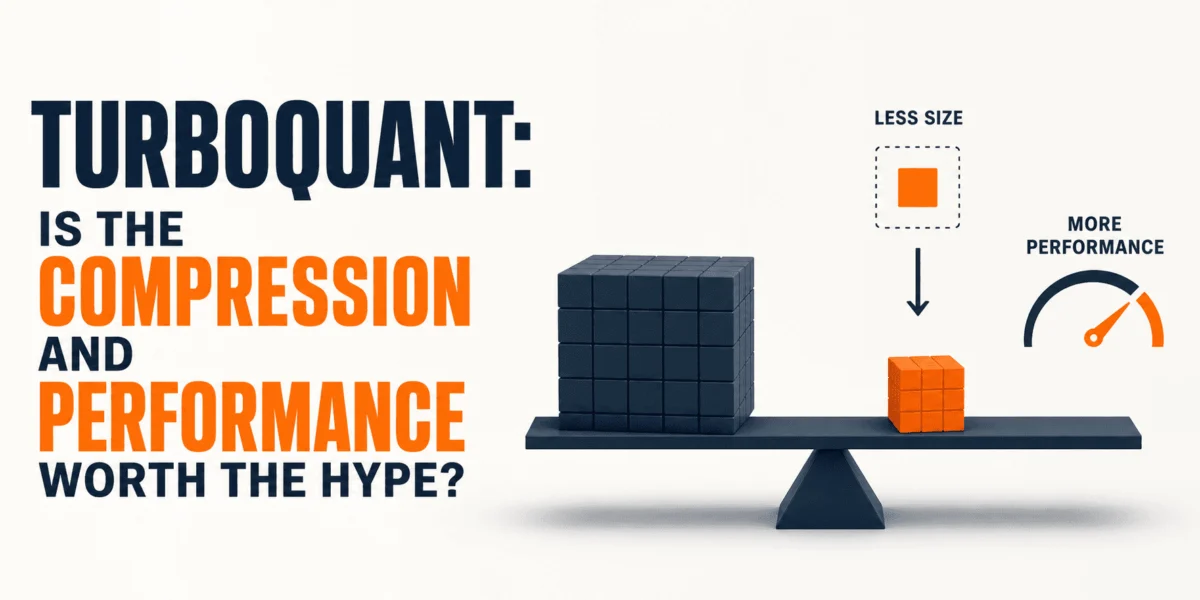
Introduction: The Memory Bottleneck in the Age of LLMs
In the rapidly evolving landscape of generative AI, the bottleneck for Large Language Models (LLMs) has shifted. While early challenges focused on parameter size and weight storage, the modern frontier of Retrieval-Augmented Generation (RAG) and long-context inference is defined by the Key-Value (KV) cache. As context windows expand to accommodate entire books, massive codebases, and deep-dive enterprise documentation, the memory footprint of these cached states grows linearly, threatening to stall the momentum of real-time AI applications.
Enter TurboQuant, a groundbreaking algorithmic suite released by Google researchers. Designed to fundamentally alter the efficiency of LLM inference, TurboQuant promises to squeeze KV cache memory consumption down to a mere 3 bits per element—without the dreaded accuracy degradation that historically plagues aggressive quantization. In an era where hardware costs are skyrocketing, this innovation arrives as a critical intervention for developers and enterprises alike. But beyond the buzzwords, does TurboQuant actually deliver on its promise of performance, or is it merely a theoretical exercise?
The Core Problem: Why KV Caches Struggle
To understand the significance of TurboQuant, one must first recognize the "digital cheat sheet" problem. When an LLM processes a prompt, it does not re-compute every previous token from scratch. Instead, it stores the internal activations—the "Key" and "Value" pairs—in a KV cache.
For real-time generation, these caches must reside in high-speed GPU memory. As context lengths grow, the memory required for these caches can exceed the capacity of even the most powerful hardware accelerators. Traditional quantization techniques, while effective for model weights, often fail when applied to KV caches. They frequently introduce "memory overhead" by requiring extra computations for normalization, effectively trading one bottleneck (memory capacity) for another (computational latency). TurboQuant seeks to break this cycle by employing a novel two-stage compression strategy that minimizes overhead while maintaining high-fidelity precision.
Chronology of Development and Release
The arrival of TurboQuant is part of a broader, sustained push by Google’s research divisions to democratize large-scale AI.
- Pre-2024: The industry relied heavily on standard 16-bit (FP16) or 8-bit (INT8) quantization. While useful, these methods reached a "precision floor" where further compression caused significant hallucination or loss of coherence in text generation.
- Early 2024: Google engineers began tackling the specific problem of KV cache bloat in long-context models, recognizing that the attention mechanism was becoming the primary memory consumer.
- Late 2024 (The Launch): Google officially published the findings behind TurboQuant, introducing it as a library that integrates with standard transformers, specifically targeting RAG-heavy workloads where long-term memory is essential.
- Present Day: The library is being integrated into developer workflows, with early benchmarks surfacing from researchers testing it against H100-class hardware, confirming its potential for industrial-scale deployment.
Supporting Data: Is the Hype Justified?
The central claim of the TurboQuant research is an 8x performance increase over 32-bit unquantized systems. To evaluate this, we look at the interaction between memory bandwidth and computational throughput.
In high-pressure environments, such as a production-grade RAG system handling 32K token contexts, the primary constraint is the speed at which data can be moved from memory to the compute cores. By reducing the cache footprint to 3 bits, TurboQuant allows significantly more data to fit into the GPU’s high-bandwidth memory (HBM).
Empirical Testing: A Local Snapshot
When running a baseline 1.1B parameter model (like TinyLlama) in a standard FP16 format, the KV cache footprint for a moderate context is roughly 42 MB. By applying TurboQuant, this footprint shrinks to approximately 7.8 MB. While the speedup in a small-scale local environment may appear modest due to the overhead of Python execution and kernel initialization, the scaling behavior becomes clear as the context window increases. As tests move from short-form text to long-form, complex document analysis, the reduction in memory traffic creates a compounding efficiency gain, confirming that TurboQuant is designed for the high-concurrency, long-context future of AI.
Technical Implications: How TurboQuant Works
TurboQuant achieves its results through a sophisticated, dual-stage compression pipeline. Unlike naive quantization that simply chops bits off, TurboQuant:
- Avoids Expensive Normalization: By using specialized kernels, it circumvents the need for complex, per-block scaling factors that usually require significant CPU/GPU time to calculate.
- Optimizes Memory Access Patterns: By aligning the 3-bit structure with the hardware’s memory architecture, the library ensures that the GPU spends less time waiting for memory and more time executing attention operations.
- Maintains Precision: The algorithm preserves the statistical distribution of the KV states, ensuring that the "information density" remains high even when the raw bit count is low.
Official Responses and Industry Outlook
Google’s research team emphasizes that TurboQuant is not just for researchers—it is a production-ready solution. In official documentation, the team highlighted that the library is intended to lower the "barrier to entry" for organizations that want to run long-context models without investing in massive clusters of H100 GPUs.
Industry analysts have responded with cautious optimism. While the 8x speedup figure is an ideal-case scenario—contingent on specific hardware and model architectures—the ability to compress caches to 3 bits is a "holy grail" achievement. If adopted broadly, TurboQuant could enable mobile devices and edge-computing hardware to run models that were previously thought to be "data-center only," effectively decentralizing the power of LLMs.
Future Implications: The Road Ahead
The implications of TurboQuant extend far beyond simple memory savings.
1. The Death of the "Context Limit"
Currently, developers are forced to truncate documents or implement complex "sliding window" attention mechanisms because they run out of memory. TurboQuant makes it feasible to feed an entire codebase or a massive legal library into a single inference pass, fundamentally changing the architecture of RAG systems.
2. Democratizing AI Infrastructure
By reducing the hardware requirements for large-context inference, TurboQuant allows smaller startups to compete with major tech conglomerates. If you can achieve the same throughput on a single GPU that previously required a four-GPU node, the cost of AI development drops by orders of magnitude.
3. Energy Efficiency
Large-scale model training and inference are significant contributors to energy consumption. By reducing memory bandwidth usage, TurboQuant decreases the energy required to move data across the GPU architecture. This aligns with the broader industry goal of "Green AI," making high-performance models more sustainable.
Conclusion: A Tool for the Next Generation of AI
TurboQuant is not merely another optimization library; it is a fundamental shift in how we handle the temporal memory of AI models. By solving the KV cache bottleneck, Google has provided a pathway for models to handle longer, more complex, and more nuanced interactions.
For the developer looking to implement TurboQuant today, the steps are straightforward: install the library, select a target model, and experiment with the TurboQuantCache interface. While the initial setup requires attention to hardware compatibility, the potential for massive memory savings and, eventually, significant throughput gains, makes it an essential tool in the modern AI toolkit.
As we move toward a future where AI is integrated into every aspect of software development and data analysis, the efficiency gains provided by innovations like TurboQuant will be the difference between models that are merely capable and models that are truly transformative. Whether you are a researcher pushing the limits of context length or an engineer trying to fit a RAG pipeline into a constrained budget, TurboQuant is a development that demands your attention.
Iván Palomares Carrascosa is an AI researcher and advisor who specializes in the intersection of deep learning and real-world infrastructure. For more insights on AI optimization and the future of LLMs, follow his ongoing work in the field of scalable machine learning.


 Neng Nana
 Evan Lee Salim
 Raul Delapena Setiawan

 Sagoh
Sagoh

 Azzam Bilal Chamdy
 Ali Ikhwan