
 Reynand Wu
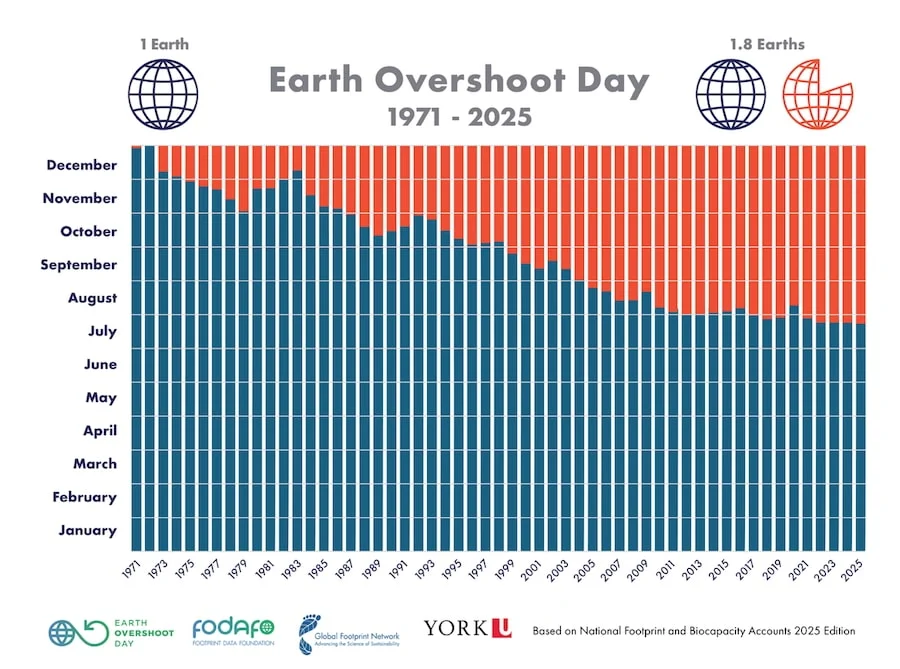
On July 24, 2025, humanity reached a sobering milestone: Earth Overshoot Day. This date marks the precise moment in the calendar year when human demand for natural resources—such as food, timber, freshwater, and carbon absorption—surpasses what the planet’s ecosystems can naturally regenerate within a 365-day period.
According to data released by the Global Footprint Network, the 2025 date is the earliest it has been since calculations began in 2006. We are currently operating at a deficit, consuming the Earth’s biological capital at a rate 1.8 times faster than it can replenish itself. This persistent state of ecological bankruptcy serves as a stark reminder that our current global economic model is fundamentally decoupled from the finite reality of our planetary boundaries.
A Chronology of Consumption: How We Drifted into Debt
To understand the severity of our current trajectory, one must look at the historical progression of resource depletion. While Earth Overshoot Day was first conceptualized in 2006 by economist Andrew Simms and the Global Footprint Network, researchers have since performed "hindcasting" to analyze historical data dating back to the early 1970s.
The data reveals a clear, alarming trend. In 1972, the world lived within its means, with the "overshoot" date falling on December 31. By 1979, the date had crept back to November 3. Throughout the 1980s, the date oscillated but generally trended earlier, reaching October 12 by 1989. The 1990s saw a rapid acceleration of resource consumption; by 1999, the date moved to September 25.
When the first official announcement was made in 2006, the date was August 22. By 2018, humanity had breached the July threshold for the first time. Aside from a brief, pandemic-induced retreat in 2020, the date has remained firmly in July, consistently setting new records. The previous record of July 25 was set in 2022 and 2023, and with this year’s date falling on July 24, the trend confirms that despite growing awareness of climate change and sustainability, the global "resource appetite" shows no sign of slowing.
The Mechanics of Overshoot: Supporting Data
The concept of Earth Overshoot Day is not merely a symbolic marker; it is a data-driven calculation that highlights the discrepancy between our ecological footprint and the planet’s biocapacity.

The primary driver of this acceleration is our reliance on fossil fuels. Humanity emits significantly more carbon dioxide than the world’s forests and oceans can sequester. This carbon surplus constitutes a massive portion of our ecological footprint. When we clear-cut forests for agriculture, deplete aquifers beyond their recharge rates, and overfish our oceans, we are essentially liquidating the planet’s savings account.
Current research indicates that humanity has now breached seven of the nine identified "planetary boundaries"—the thresholds within which we can safely operate to ensure a stable environment for human civilization. By pushing past these limits, we are triggering irreversible changes in the climate system, biodiversity loss, and ocean acidification. The cumulative effect is a thinning of the Earth’s natural safety net, making us increasingly vulnerable to environmental shocks.
Official Responses and Expert Analysis
The scientific community and those behind the Global Footprint Network are sounding the alarm with renewed urgency. The reality of the 2025 date has prompted a shift in rhetoric from mere observation to a demand for radical systemic change.
"We are stretching the limits of how much ecological damage we can get away with," said Lewis Akenji, a board member of the Global Footprint Network. "It is now a quarter into the 21st century and we owe the planet at least 22 years of ecological regeneration, even if we stop any further damage now."
Akenji emphasizes that the scale of the crisis requires a global response that transcends incremental improvements. "If we still want to call this planet home, this level of overshoot calls for a scale of ambition in adaptation and mitigation that should dwarf any previous historical investments we have made, for the sake of our common future."
Mathis Wackernagel, co-founder of the Global Footprint Network, offered a more blunt assessment regarding the inevitability of change. "Because of the nature of physics, overshoot cannot last," Wackernagel stated. "It will end either by deliberate design or dumped-on disaster. It should not be too hard to choose which one is preferable, particularly in light of so many possible choices."

The Path Forward: The Power of Possibility
Despite the grim statistics, experts stress that the trajectory is not set in stone. The Global Footprint Network’s "Power of Possibility" campaign outlines specific, actionable levers that could significantly shift the date back toward the end of the year. The strategy relies on four primary pillars of intervention:
- Energy Transition: The single most effective action would be to cut global carbon emissions by 50%. This alone would move Earth Overshoot Day back by three months. Transitioning to at least 75% renewable electricity would contribute an additional 26 days of breathing room.
- Food Systems Reform: Reducing global food waste by half is a highly achievable goal that would shift the date by 13 days. This involves improvements in supply chain efficiency, changes in retail standards, and a shift in consumer habits toward more sustainable diets.
- Policy Frameworks: The implementation of a global-scale "Green New Deal" could move the date by 42 days. Such comprehensive legislation would require international cooperation, carbon pricing, and a fundamental restructuring of how governments subsidize industrial sectors.
- Urban Planning and Infrastructure: Rethinking our cities—prioritizing public transit, energy-efficient building codes, and circular economy principles—would compound these effects, creating a multiplier for the other interventions.
Implications: The High Cost of Inaction
The implications of ignoring our current ecological trajectory are profound. When we operate in a state of overshoot, we are not just damaging nature; we are undermining the foundation of our own economy and societal stability.
Natural resources are the primary inputs for agriculture, manufacturing, and healthcare. As these resources become scarcer, the cost of living rises, social inequality deepens, and geopolitical tensions over access to water and arable land become inevitable. Furthermore, as we lose the planet’s natural ability to regulate climate, we face more frequent and severe weather events, which destroy infrastructure and further exhaust the financial reserves needed to adapt.
We are currently living in an era of "ecological debt." Just as a household cannot live indefinitely on credit cards without eventually facing bankruptcy, a civilization cannot extract more from the Earth than the Earth provides without facing a total collapse of the systems that sustain it.
Conclusion
The fact that Earth Overshoot Day 2025 arrived on July 24 is a wake-up call that cannot be ignored. We have effectively spent our annual "budget" of natural resources before the year is even two-thirds complete.
The choice before us is clear: we can continue down a path of reckless consumption that leads to environmental and societal collapse, or we can embrace the "deliberate design" mentioned by Wackernagel. By prioritizing the restoration of biodiversity, the decarbonization of our economies, and a radical reduction in waste, we still possess the tools to reverse the trend. The date is a reflection of our past choices, but our future remains unwritten—provided we act with the urgency the planet demands.

 Asro

 Evan Lee Salim

 Lina Irawan

 Asep Darmawan

 Nana Wu

 Jia Lissa
