
 Muslim
By FreightWaves Staff
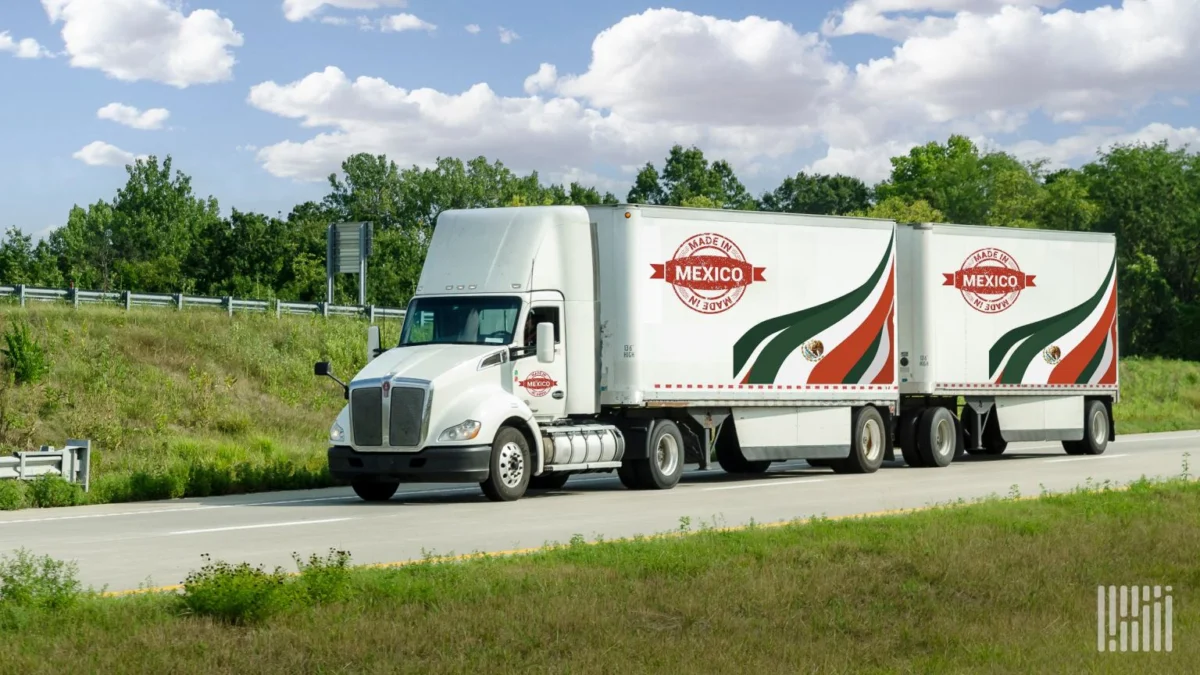
The integration of the United States and Mexican economies has reached a level of sophistication where a single agricultural commodity—the Hass avocado—can serve as a primary engine for logistics employment, while regional infrastructure projects and parcel networks scramble to keep pace with an industrial renaissance along the Gulf Coast and the border.
In this week’s Borderlands Mexico, we examine how the "green gold" of Mexican agriculture is fueling billions in U.S. economic output, how parcel giant GLS is cementing its footprint in El Paso, and how Jetco is retooling for the heavy-haul demands of a data-center-driven industrial boom.
The Economic Engine: Mexican Avocado Imports and U.S. Logistics
The U.S. supply chain is no longer just a series of warehouses and trucking routes; it is a finely tuned, interconnected ecosystem. A landmark report released this week by the Avocado Institute of Mexico and researchers at Texas A&M University quantifies the massive scale of this dependency.
Main Facts: The $7.1 Billion Impact
For the fiscal year 2025-26, Mexican Hass avocado imports were not merely a grocery store staple; they were a macroeconomic powerhouse. The study estimates that these imports generated a staggering $7.1 billion in total U.S. economic output. Perhaps more importantly for the logistics sector, the trade supported 37,163 jobs across multiple industries, including long-haul trucking, cold-chain warehousing, and distribution management.
Of that total impact, the logistics sector—specifically transportation and warehousing—reaped $641.5 million in direct activity, supporting over 4,150 specialized jobs. This reflects a shift in the U.S. supply chain toward "just-in-time" delivery, where refrigerated perishables require rapid, reliable transit from the border to the dinner table.
Chronology of the Avocado Supply Chain
The journey of a Hass avocado begins in the orchards of Michoacán and Jalisco, but its economic life in the U.S. is dictated by the efficiency of Texas land ports.
- The Border Crossing: In 2024, nearly 98% of all Mexican avocados entering the U.S. arrived via truck through Texas.
- The Texas Gateway: Pharr-Reynosa International Bridge acted as the primary artery, handling 58.2% of total import volume, followed by the World Trade Bridge in Laredo, which handled 39.4%.
- The Nationwide Distribution: Once cleared by Customs and Border Protection (CBP) and inspected by the USDA, the fruit enters a complex web of cold-storage facilities. From these hubs, specialized reefer (refrigerated) trucks move the produce to wholesalers, retail distribution centers, and food processors in every state in the union.
Supporting Data: A State-by-State Breakdown
While the border states are the points of entry, the economic benefits are dispersed nationwide.
- Texas: The state saw $245.1 million in direct import value generate $428.9 million in economic output, contributing $265.5 million to the state’s GDP and sustaining 2,402 jobs.
- California: As the nation’s largest consumer market, California saw an economic output of $968.2 million associated with the imports, supporting 5,325 jobs.
- The National Spread: Crucially, Texas and California combined account for only about 20% of the total national economic contribution. This underscores the reality that the supply chain for Mexican avocados is truly continental, supporting fuel providers, equipment manufacturers, and logistics brokers in the Midwest, Northeast, and Southeast.
Official Responses
Ron Campbell, executive director of the Mexican Hass Avocado Import Association, emphasized that the trade is a testament to decades of North American integration. "Mexican avocados don’t simply cross the border; they generate economic activity throughout the U.S. economy," Campbell noted. "They support transportation networks, restaurants, and communities across the country."
Parcel Evolution: GLS US Targets the El Paso Gateway
The logistics landscape in West Texas is undergoing a significant transformation as regional parcel delivery provider GLS US continues its aggressive expansion. On Oct. 20, the company announced its entry into the El Paso market, a move designed to capture the burgeoning e-commerce and manufacturing traffic flowing between the U.S. and Ciudad Juárez, Mexico.
Strategic Implications of the El Paso Expansion
El Paso is not just a city; it is a critical trade gateway. With a heavy concentration of maquiladoras (manufacturing plants) on the Mexican side and a sophisticated warehousing sector on the Texas side, the demand for "first- and middle-mile" logistics is at an all-time high.
GLS US’s new facility allows local businesses to access specialized parcel shipping for items weighing up to 150 pounds. By offering both domestic and international shipping solutions, the company is positioning itself as the "go-to" for businesses that need to move components from Mexican factories to U.S. assembly lines or distribution centers.
A Pattern of Growth
The move into El Paso is the latest chapter in a broader strategy. Over the last 18 months, GLS has methodically expanded its footprint across the Lone Star State:
- 2025: Entered the Dallas-Fort Worth market.
- 2026 (Early): Expanded into the Houston, Austin, and San Antonio markets.
- 2026 (Q4): Secured the El Paso gateway.
As a subsidiary of the global GLS Group—which handles over 900 million parcels annually across 50 countries—GLS US is leveraging its parent company’s capital and expertise to challenge traditional carriers in a region where reliability is the primary currency.
Heavy-Haul Logistics: Jetco’s Industrial Pivot
While the parcel market focuses on speed and volume, the heavy-haul sector is focused on sheer capacity and the demands of the "new industrial era." Houston-based Jetco is currently leading this charge with the launch of its new specialized cargo division, aimed directly at the Gulf Coast’s booming infrastructure projects.
The Catalyst: The Data Center and Power Boom
The demand for heavy-haul transport—the movement of oversized and overweight loads—is currently being driven by the construction of data centers, power generation plants, and specialized manufacturing facilities.
"Three years ago, we started positioning ourselves to capitalize on the accelerated growth of domestic power, manufacturing, and infrastructure," said Jetco President Kyle Kristynik. The company recognized that as the U.S. re-shores manufacturing and builds the massive infrastructure required for AI-driven data centers, the demand for moving heavy, non-standard components would skyrocket.
Fleet Expansion and Technical Capabilities
To meet these needs, Jetco has made significant capital investments in its rolling stock this year:
- Two Faymonville Multimax trailers: Each capable of hauling 125,000 pounds.
- One Goldhofer trailer: Rated for 180,000 pounds, designed for the heaviest industrial components.
- Fontaine Hydraulic RGN: A 55-ton capacity trailer with a 16-foot footprint, ideal for complex, over-dimensional loads.
By combining its internal fleet with prequalified third-party carriers and collaborating with its Canadian sister companies—Precision Specialized and Scott Woods Transport—Jetco is building a cross-border, heavy-haul powerhouse. This integrated approach allows the company to handle projects that require multi-modal, cross-continental expertise.
Implications: The Future of the Border Economy
The developments highlighted in this week’s Borderlands Mexico provide a roadmap for the future of the U.S.-Mexico trade relationship.
- Supply Chain Resilience: The data from the Avocado Institute of Mexico proves that trade is not a zero-sum game. When an industry grows, it builds a secondary economy around it—logistics, insurance, fuel, and labor.
- Infrastructure as a Competitive Advantage: Whether it is the cold-chain efficiency required for avocados, the parcel speed required for e-commerce, or the specialized capacity required for heavy-haul, the companies that succeed are those that view the border not as a barrier, but as an operational hub.
- The Texas Dominance: Texas continues to cement its status as the primary gateway for North American trade. From Laredo and Pharr to El Paso and Houston, the state’s logistics infrastructure is the backbone that keeps the U.S. economy moving.
As we look toward the remainder of the fiscal year, the trends are clear: the integration of U.S. and Mexican supply chains is accelerating. For logistics providers, the message is simple: invest in the right equipment, secure the right geographic gateways, and prepare for a market that is increasingly demanding more of its cross-border infrastructure.


 Evan Lee Salim
 Jia Lissa

 Lina Irawan

 Pevita Pearce

 Suro Senen


 Ammar Sabilarrohman

 Raul Delapena Setiawan
