
 Neng Nana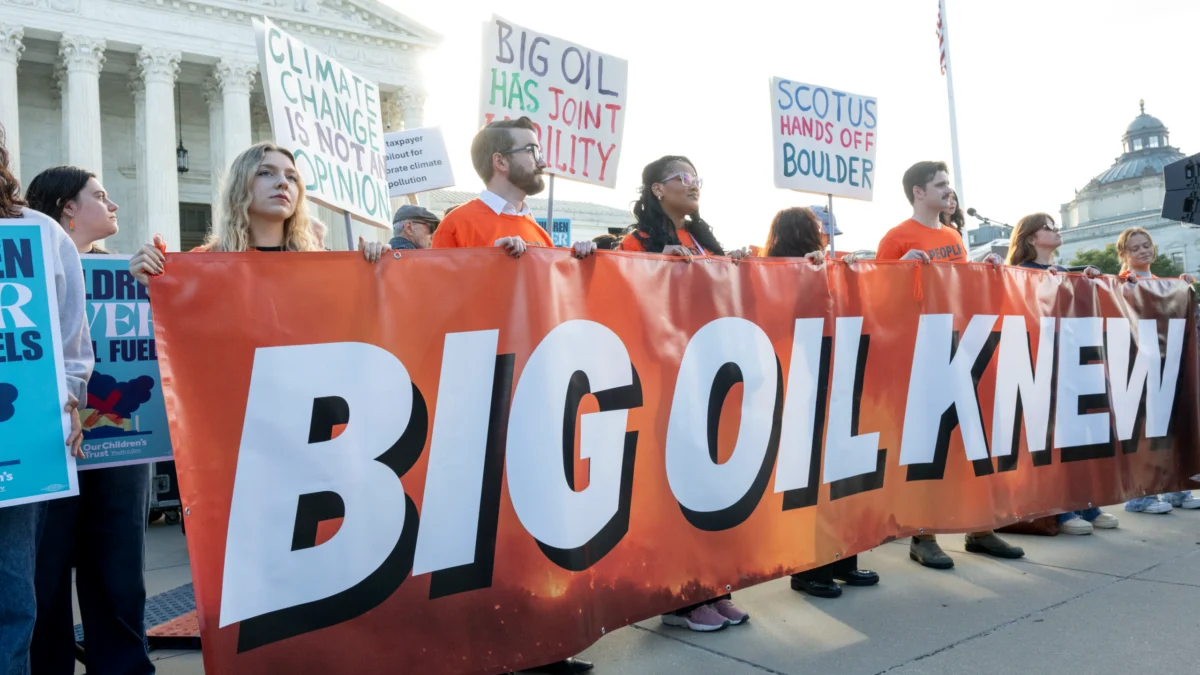
By [Your Name/Journalistic Correspondent]
On a crisp Monday morning in Washington, D.C., the marble steps of the United States Supreme Court served as the stage for a profound collision between two worlds: the high-stakes, technical maneuvering of corporate litigation and the raw, visceral grief of families decimated by climate-driven disasters.
As the eight remaining justices convened inside to hear oral arguments in Suncor Energy v. Boulder, a crowd of roughly one hundred protesters gathered outside. They were not merely activists; they were survivors of wildfires, ranchers facing the loss of their livelihoods, and youth advocates whose futures are inextricably linked to the legal precedent being set within the chamber. Their message was simple, echoing through the streets in a rhythmic chant: "They knew, they lied."
The Core of the Conflict: Suncor Energy v. Boulder
The case of Suncor Energy v. Boulder is far more than a local dispute over municipal damages. It is widely regarded as a watershed moment for American jurisprudence regarding the climate crisis. At its heart, the legal battle asks a fundamental question: Can local and state governments hold multinational fossil fuel corporations accountable for the damages wrought by the climate change they allegedly helped to engineer?
The City and County of Boulder initiated this litigation in 2018, contending that industry giants like Suncor and ExxonMobil engaged in a decades-long campaign of deception. According to the complaint, these entities were fully aware of the link between fossil fuel consumption and rising global temperatures as early as 50 years ago. Instead of pivoting to sustainable practices, the plaintiffs argue, these corporations intentionally sowed public doubt to protect their bottom lines, effectively preventing a timely transition to clean energy.
Boulder is seeking damages to offset the astronomical costs of adapting to and recovering from climate-induced heat waves, catastrophic wildfires, and systemic droughts. The energy companies, however, are pushing for an aggressive dismissal, arguing that state courts lack the jurisdiction to penalize multinational firms for global climate phenomena. They maintain that climate policy is a matter for federal regulation, not tort litigation.
A Chronology of Deception and Disaster
To understand the urgency felt by the protesters on the Supreme Court steps, one must look at the timeline of the fossil fuel industry’s internal knowledge versus the external reality of those on the front lines.
- The 1970s–1980s: Fossil fuel scientists, including those within Exxon, conduct internal research confirming the greenhouse effect and predicting the subsequent rise in global temperatures.
- The 1990s–2000s: Rather than alerting the public, internal documents and investigations suggest a concerted effort to fund climate-denial campaigns, mirroring strategies once used by the tobacco industry to obscure the dangers of smoking.
- 2018: The City and County of Boulder file their landmark lawsuit, alleging that the companies knowingly contributed to the climate-induced destruction of their local environment.
- 2021: The Marshall Fire tears through Boulder County, destroying hundreds of homes and displacing thousands. It becomes a flashpoint for the necessity of climate accountability.
- 2025: The Eaton Fire in Altadena, California, causes further death and destruction, reinforcing the nationwide nature of the crisis.
- October 2026: The Supreme Court hears oral arguments in Suncor v. Boulder, with Justice Samuel Alito recusing himself at the eleventh hour, leaving an eight-justice panel to decide the fate of dozens of similar state-level climate lawsuits.
Voices from the Front Lines: Beyond the Legal Briefs
The courtroom arguments focused on the intricacies of federal preemption and jurisdictional boundaries. However, the human cost was articulated with devastating clarity outside the building.
Louie Delaware, who lost his home in the 2021 Marshall Fire, stood among the protesters to demand a reckoning. "No company or industry should gain an advantage by hiding facts that people need to protect their health, their communities, and their future," he stated. For Delaware, the three years he spent displaced were not just a personal tragedy, but a predictable outcome of corporate negligence.
Zaire Calvin, who lost his sister, Evelyn McClendon, in the 2025 Eaton Fire, provided a harrowing reminder of what is at stake. "The Eaton Fire took my sister and eighteen other people," Calvin said. "My family lost five homes, including my childhood home. From Altadena to Boulder, we carry different stories. Today, we stand together in one demand: Let the evidence be heard."

The economic impact is equally dire for the agricultural sector. Deirdre Macnab and Dr. Kathryn Bedell, regenerative cattle ranchers from Rio Blanco County, described a landscape transformed by extreme heat and drought. For Bedell, a sixth-generation rancher, the crisis is personal: "I’ve had these same cattle for generations, so I know them all personally. They’re moving to the sale yard on December 19."
Bedell warned that the crisis extends far beyond the ranching community. "If you can’t grow food, we have to import it, and we won’t have any food security or control over the price. People should be terrified. It terrifies me."
Official Responses and Political Stakes
The political weight of the issue was highlighted by the presence of former Washington state Governor Jay Inslee. A champion of climate policy, Inslee did not mince words regarding the conduct of the fossil fuel industry.
"The fossil fuel industry malignantly and maliciously lied to the American people," Inslee stated during the rally. "They knew for decades what the consequences of their products were, and they chose to lie." Inslee, who signed the Climate Commitment Act in 2021, has become a vocal critic of industry-backed immunity laws that seek to shield corporations from liability lawsuits. He argues that the right to hold industries accountable in a court of law is a cornerstone of American democracy.
While the legal teams for Suncor and ExxonMobil continue to maintain that the courtroom is not the appropriate venue for climate policy, the plaintiffs argue that this is a classic case of corporate malfeasance. They point to historical precedents, such as the massive settlements against tobacco companies and pharmaceutical firms over the opioid epidemic, as evidence that the judiciary is well-equipped to handle cases of systemic harm caused by powerful, profit-driven entities.
The Broader Implications
The decision in Suncor Energy v. Boulder will send shockwaves through the American legal system. Currently, dozens of climate-related lawsuits across the country are effectively on "pause," awaiting the outcome of this case. A ruling in favor of the energy companies could effectively grant them a "liability shield," potentially ending the wave of state-level litigation aimed at holding them accountable.
Conversely, a ruling that allows these cases to proceed to trial would be a monumental victory for climate advocates. It would force the internal records of these companies into the public sphere, compelling executives to testify under oath about what they knew and when they knew it.
As oral arguments drew to a close, the mood among the survivors was one of grim determination. Jenny Singer-Rupp, another survivor of the Marshall Fire, reflected on the difficulty of explaining the situation to her children. "I never thought I’d be standing in front of the Supreme Court," she said. "But I’m doing everything I can to protect that future for them."
For the families who have lost homes, loved ones, and livelihoods, the Supreme Court is not just a venue for legal theory. It is the final gatekeeper for justice. As they wait for the court’s decision, the consensus among the protesters remains clear: the era of "knowing and lying" must come to an end, and the cost of climate change must finally be shifted back to those who stood to profit from it.


 Laily UPN
 Dwi Wanna
 Nana
Nana
 Evan Lee Salim
 Lina Hope
 Jia Lissa
 Suro Senen
 Ali Ikhwan