
 Asro
Asro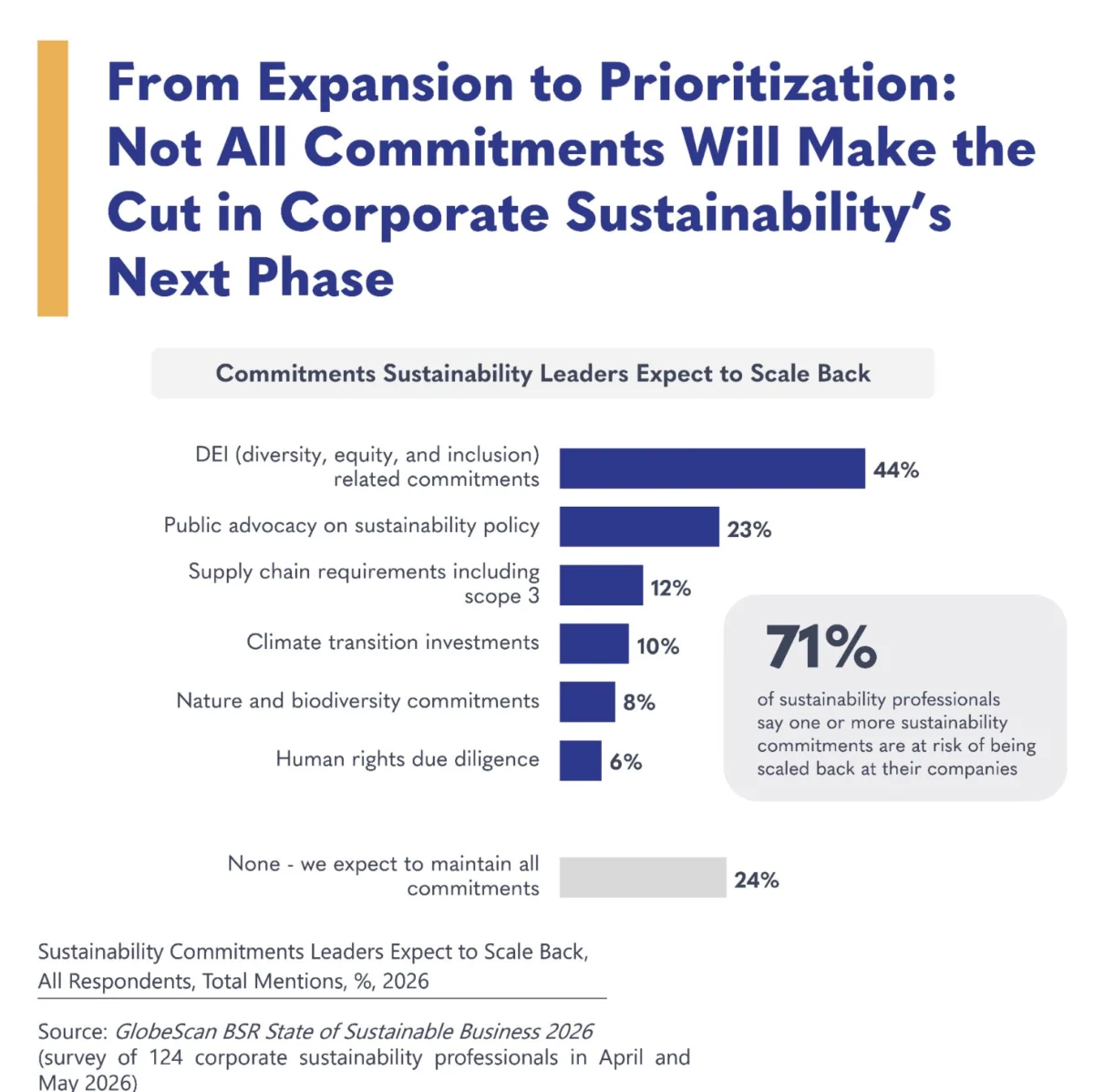
The landscape of corporate sustainability is undergoing a seismic shift. For years, the narrative surrounding Environmental, Social, and Governance (ESG) initiatives was one of boundless expansion—a "more is better" approach fueled by stakeholder demand, investor enthusiasm, and a booming global economy. However, new research from BSR and GlobeScan, based on a comprehensive survey of sustainability professionals at organizations with over $1 billion in annual revenue, indicates that this era of unbridled ambition is yielding to a more constrained, selective, and cautious phase.
As the corporate world grapples with shifting regulatory winds and an increasingly polarized political environment, sustainability departments are finding their mandates under the microscope. The findings are clear: the honeymoon period of voluntary, expansive sustainability commitments is effectively over. In its place, a "pragmatic pivot" is taking root, where the survival of a commitment is increasingly tied to its direct, demonstrable impact on the bottom line.
Main Facts: The Scaling Back of Corporate Ambition
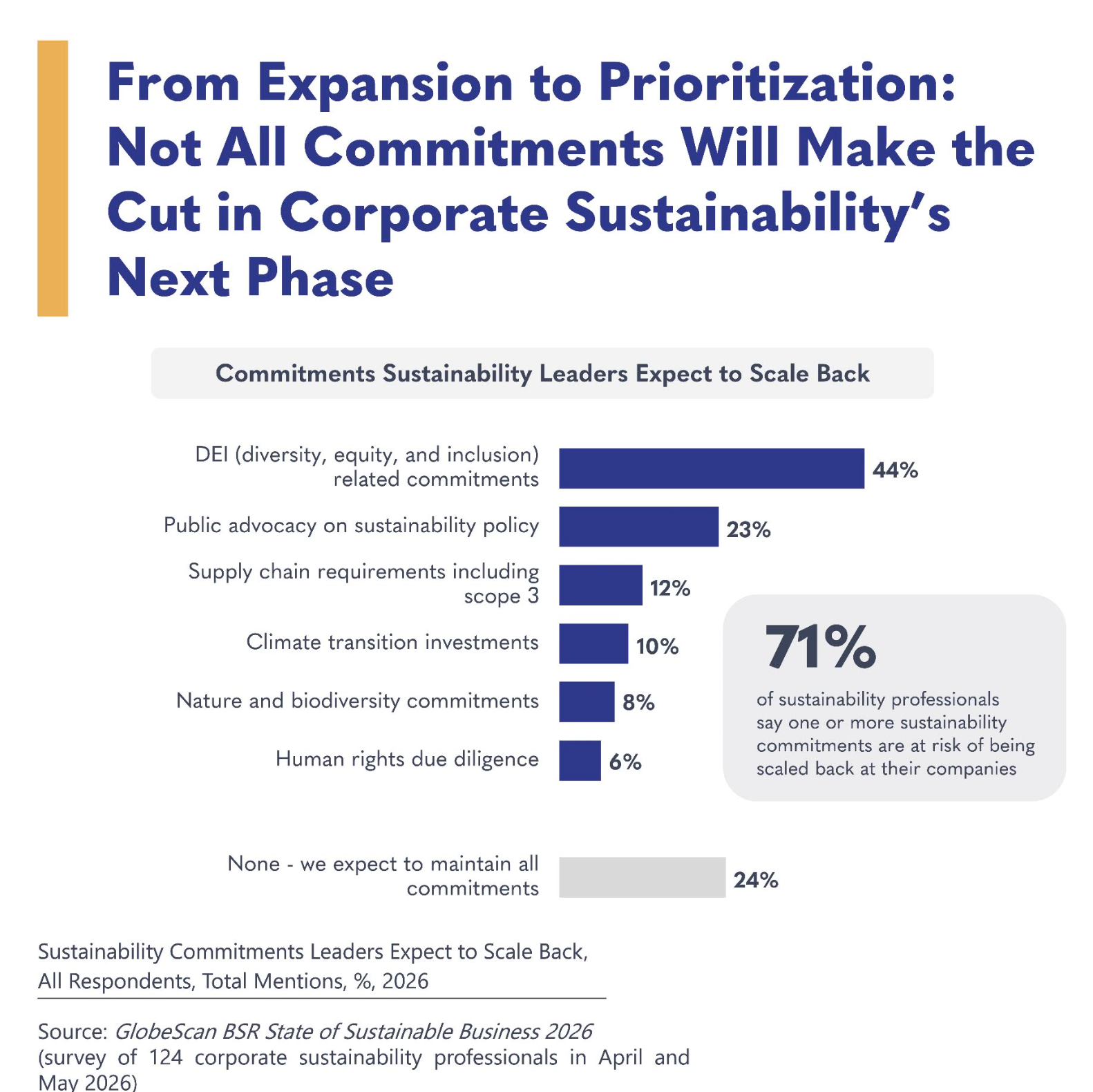
The BSR and GlobeScan data reveals a startling trend: a staggering 71 percent of sustainability professionals at major firms report that one or more of their company’s existing sustainability commitments are at risk of being scaled back. This is not a subtle trend; it is a fundamental reassessment of the corporate social contract.
Perhaps most telling is the inverse statistic: fewer than one in four respondents believe their organizations will maintain their current suite of commitments without modification. This suggests that for the vast majority of large-cap companies, the status quo is no longer sustainable—at least not in its current form.
The retrenchment is not uniform. It is highly selective, targeting areas of the ESG spectrum that have become lightning rods for political controversy or those that lack a clear, short-term ROI. Diversity, Equity, and Inclusion (DEI) initiatives lead the list of "at-risk" programs, with 44 percent of professionals citing them as primary candidates for rollback. Public advocacy on sustainability policy follows at 23 percent. Interestingly, foundational pillars like climate transition investments, human rights due diligence, and supply chain requirements appear more resilient, though they are not entirely immune to the tightening of corporate purse strings.
A Chronology of the Shift: From Advocacy to Audit
To understand how we arrived at this moment of contraction, one must look back at the trajectory of the sustainability movement over the past decade.
2016–2020: The Era of Aspiration
The late 2010s represented the "Golden Age" of corporate ESG. Following the adoption of the Paris Agreement and the UN Sustainable Development Goals, companies rushed to set bold, long-term targets. During this period, sustainability was often treated as a brand-building exercise—a way to attract talent, appeal to values-driven consumers, and appease institutional investors who were beginning to view ESG as a proxy for risk management.

2021–2023: The Regulatory Awakening
The post-pandemic era brought a massive influx of regulatory scrutiny. The introduction of the Corporate Sustainability Reporting Directive (CSRD) in the EU and shifting disclosure requirements from the SEC in the U.S. forced companies to move beyond "marketing-led" sustainability. Sustainability data was no longer just a glossy infographic; it became a matter of legal and financial audit. As the burden of reporting increased, companies began to realize the sheer operational cost of maintaining their sprawling, often siloed, ESG portfolios.
2024–2026: The Pragmatic Retrenchment
By mid-2026, the convergence of high interest rates, geopolitical instability, and a pushback against "woke capitalism" has created a perfect storm. Sustainability teams, once granted significant autonomy, are now being asked to justify every line item. The research conducted in April and May 2026 captures this exact moment: a transition from "growth-oriented" sustainability to "efficiency-oriented" sustainability.
Supporting Data: Dissecting the Risk Landscape
The survey of 124 sustainability professionals provides a granular look at where the cuts are happening. The prioritization of cuts reflects a strategic move toward "defensible" sustainability—initiatives that can be directly mapped to risk mitigation or regulatory compliance, rather than broader social or policy goals.
- DEI Under Pressure (44%): The high risk associated with DEI initiatives mirrors the broader cultural and political polarization in the United States and elsewhere. As companies face litigation and backlash regarding affirmative action and internal hiring practices, many are opting to rebrand or quietly sunset these programs to avoid becoming targets in the "culture wars."
- Public Advocacy (23%): Corporate lobbying on climate and social policy is increasingly viewed as a high-risk activity. With the potential for legislative turnover and the risk of alienating certain consumer bases, firms are retreating from the public square, preferring to focus on internal operations rather than influencing external policy.
- The "Core" Resilience: Climate transition and supply chain requirements remain the most stable, likely because these areas are increasingly tied to hard regulatory mandates (such as the EU’s supply chain due diligence laws). Companies cannot easily walk away from these without inviting significant legal and operational disruption.
Official Perspectives: The View from the C-Suite
While the report highlights the pressure on sustainability teams, industry experts suggest this is not necessarily the "death" of sustainability, but rather its "professionalization."
James Morris, who leads GlobeScan’s San Francisco office, notes that the current environment requires a fundamental change in how sustainability is sold internally. "The challenge for sustainability professionals today is to move away from the ‘aspirational’ language of the last decade and toward a language of business resilience," Morris explains. "If a sustainability program cannot be clearly linked to a reduction in operational risk, a boost in efficiency, or a long-term competitive advantage, it is currently on the chopping block."
Other observers suggest that the current contraction is a necessary clearing of the decks. By cutting back on "performative" ESG initiatives, companies may actually be able to focus their limited resources on the truly transformative projects—such as the massive capital expenditure required for net-zero energy transitions—that will define their viability in the 2030s and beyond.
Implications: The Future of the Sustainability Function
The shift toward a more constrained model has profound implications for how companies will operate in the coming years.
1. The Integration Imperative
Sustainability can no longer exist as a separate, boutique department. To survive the current budget cuts, sustainability teams must be deeply integrated into Finance, Operations, and Procurement. The most successful companies will be those that stop treating sustainability as a "department" and start treating it as a "lens" through which every business decision is made.
2. From Volume to Value
The era of setting dozens of disconnected KPIs is ending. Companies will increasingly focus on a smaller, "material" set of indicators that directly impact their financial performance. This move toward materiality—focusing on what matters most to the business and its stakeholders—will likely lead to better-quality data and more credible outcomes.
3. The Risk of Stagnation
While pruning the "fluff" of ESG may increase efficiency, there is a genuine risk that this retrenchment will leave companies ill-prepared for the long-term realities of a changing climate and a changing social contract. If firms focus only on the short-term, they may lose their "social license to operate," leaving them vulnerable to future shocks that are currently being ignored in favor of immediate, quarterly-focused financial metrics.
4. A New Breed of Sustainability Professional
The skill set required for the next generation of sustainability leadership is changing. It is less about activism and communication, and more about data analytics, supply chain engineering, and corporate strategy. Professionals who can speak the language of the CFO—discussing cost of capital, asset resilience, and regulatory exposure—will be the ones who steer their companies through this challenging period.
Conclusion: A More Mature Discipline
The BSR and GlobeScan research confirms what many in the industry have suspected: the "wild west" of corporate sustainability is over. We are entering a phase of maturity characterized by skepticism, rigor, and intense focus.
For those working in the field, this is undoubtedly a difficult moment. However, it is also a moment of opportunity. By shedding the performative aspects of their mandates and focusing on the hard, often gritty work of transforming core business operations, sustainability leaders have the chance to secure a more permanent seat at the table.
The companies that succeed in the next decade will not be those with the most elaborate sustainability reports or the most aggressive PR campaigns. They will be the ones that have successfully embedded sustainability into the DNA of their business models, transforming it from an optional add-on into a fundamental driver of corporate longevity. The "constrained" phase of sustainability, if managed with precision and purpose, may ultimately be the most consequential chapter yet.


 Dwi Wanna

 Nila Kartika Wati
 Jia Lissa
 Basiran
 Sagoh
Sagoh

 Lina Hope