
 Evan Lee Salim
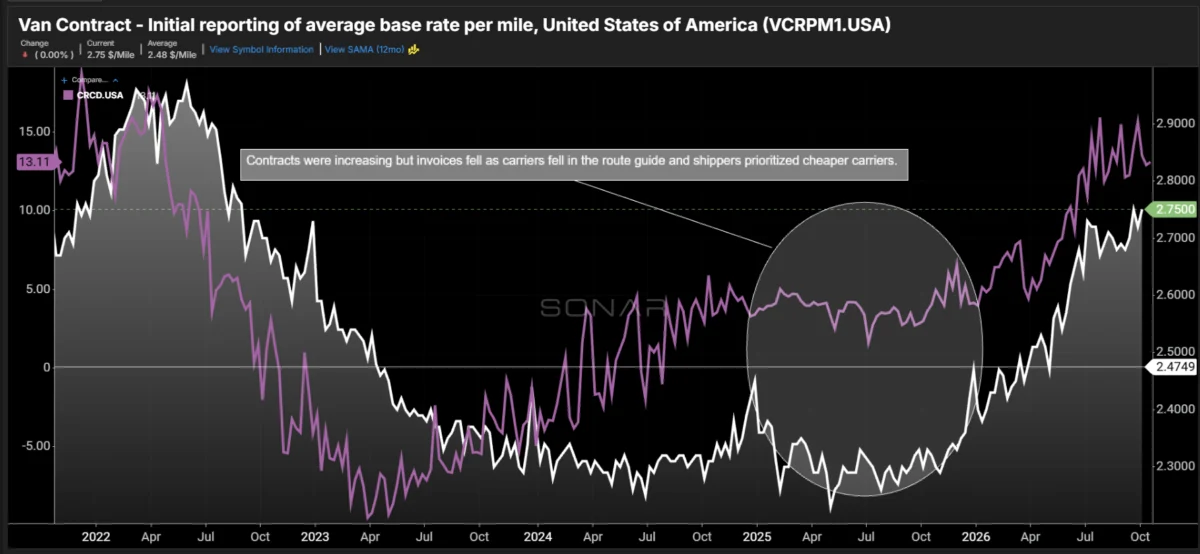
For shippers and logistics managers across the United States, the current freight environment is characterized by a stark, inescapable reality: the era of cheap, easily negotiated contract rates is firmly in the rearview mirror. As of late October 2026, data from FreightWaves’ SONAR platform reveals that shippers are facing a steep inflationary curve, with new truckload contracts resetting at an average of 13% higher than the rates they are replacing.
This trend is not merely a statistical anomaly or a seasonal blip; it represents a durable shift in the structural economics of the U.S. trucking industry. By isolating true bid-cycle repricing through the new Contract Rate Change Direction (CRCD.USA) index, market analysts are finally able to peel back the layers of "noise" that often obscure the health of the freight market, revealing that the power dynamic between carrier and shipper has undergone a significant transformation over the past twelve months.
Decoding the CRCD: A New Lens on Market Health
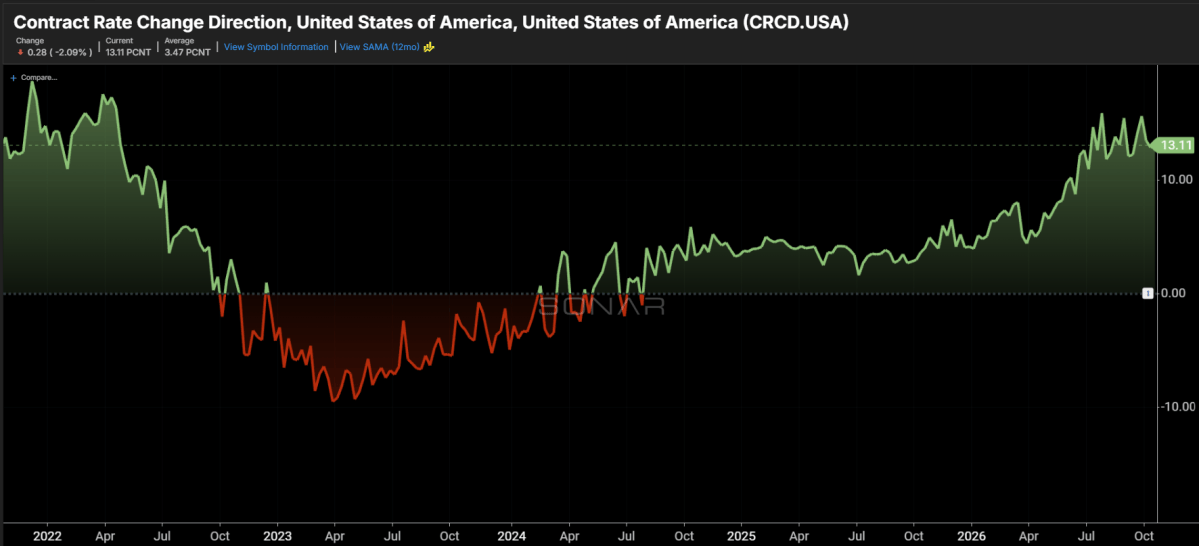
To understand why rates are climbing, one must first understand the metric driving the conversation. The Contract Rate Change Direction (CRCD.USA) index measures the average percentage difference between a new contract base rate and the one it replaces within an established shipper-carrier relationship.
Unlike other indices that may be swayed by spot market volatility or temporary "waterfalling"—where shippers rely on backup carriers when primary providers fail—the CRCD focuses exclusively on long-term, structural agreements. By filtering for rates that have held steady for at least 90 days, the index effectively silences short-term market noise, isolating the true cost of repricing.
As of October 22, 2026, the index stood at 13.11%. To put this in perspective, that same index sat at a modest 3.53% just one year ago. This trajectory confirms that the "base rate" reset—the core building block of logistics procurement—is experiencing its most aggressive upward pressure in recent memory.
Chronology of a Tightening Market
The path to this 13% increase was neither sudden nor linear. To trace the evolution of the current market, one must look back to the closing months of 2024 and the entirety of 2025.

Late 2024: The Seed of Change
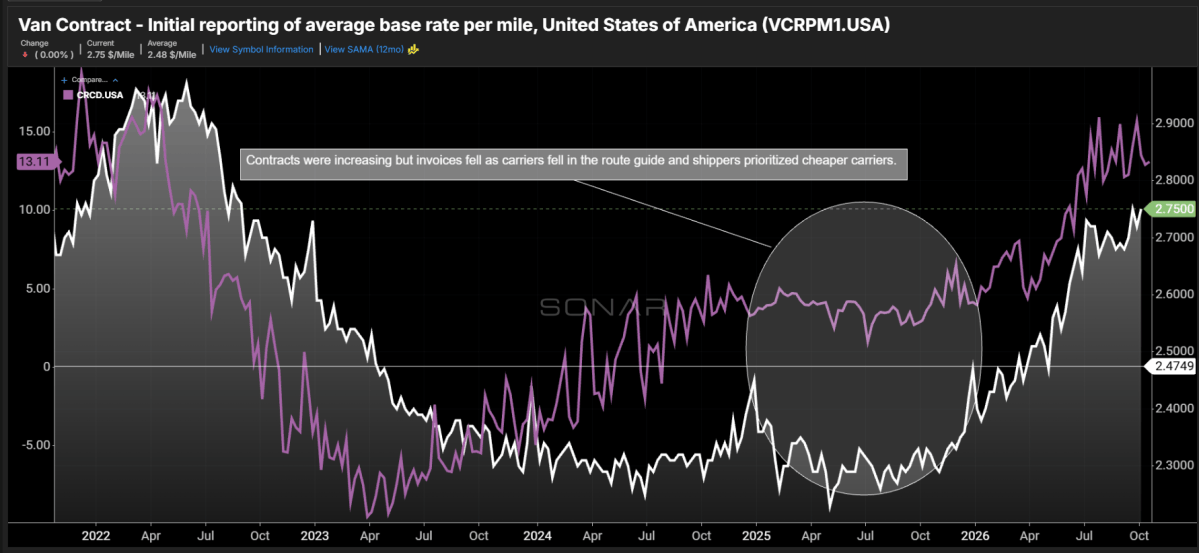
Starting in the final quarter of 2024, contract resets began to show modest, single-digit growth in the 3% to 4% range. At the time, however, these increases were not immediately reflected in the broader invoice data. The average contract rate index (VCRPM1) remained largely flat or even slightly lower throughout 2025, suggesting a disconnect between what carriers were asking for and what they were actually realizing in their billing cycles.
2025: The Capacity Stagnation
Throughout 2025, the industry saw a period of "false calm." While procurement teams were pushing for rate adjustments to account for rising operational costs, many shippers were still benefiting from legacy contracts negotiated during previous soft-market cycles. This period served as a cautionary tale: carriers were pushing for increases months before the cycle truly turned. Shippers who ignored these early warning signs found themselves unprepared when the market eventually shifted in 2026.
2026: The Inflection Point
By the second quarter of 2026, the divergence between asking rates and market reality began to narrow. Tender rejection rates—a bellwether for market tightness—jumped above 9% and have since maintained a sustained average near 13% over the past few months. The CRCD index acts as a lagging indicator to these rejections; it requires a sustained period of capacity pressure before the "sticker shock" of new contract rates becomes the new market standard. We are currently in that phase of implementation, where the backlog of contract negotiations is finally reflecting the reality of a constrained capacity environment.
Supporting Data: Why the Increases Are Sticking
The central question for supply chain executives today is whether these 13% increases are sustainable or if they will be rolled back in the next bid cycle. Data suggests that these increases are, in fact, "sticky."
The primary evidence lies in the correlation between the CRCD and the broader contract rate index (VCRPM1). Because the CRCD is designed to be volume-agnostic, it captures the raw price movement of contracts as they are signed. The fact that the VCRPM1 is now tracking upward in tandem with the CRCD indicates that shippers are accepting these higher prices as the "new normal" rather than attempting to fight them with short-term, spot-reliant strategies.
Furthermore, Federal Motor Carrier Safety Administration (FMCSA) data reveals a sobering truth: capacity has not grown meaningfully over the past 12 months. Despite the lure of higher rates, the industry has seen a lack of significant fleet expansion or new entrant activity. In a market where supply is effectively capped, the equilibrium price is naturally pushed upward. Without a major influx of new capacity or a massive contraction in consumer demand, the supply-demand curve suggests that this upward pressure on rates will persist for the foreseeable future.
Implications for Shippers and Procurement
For the modern shipper, the current environment necessitates a fundamental rethink of procurement strategy. The days of treating truckload capacity as a commodity that can be bid down to the lowest common denominator are largely over, at least for the current cycle.
1. The Death of "Contract-Plus" Reliance
Many shippers have relied on "waterfall" routing guides—starting with a primary carrier and moving down the list when that carrier rejects a tender. While this was a cost-effective strategy in a soft market, it is now an expensive gamble. Relying on spot-market rates, which can fluctuate wildly, is proving to be far more volatile than simply locking in the higher 13% contract rates.
2. The Cost of Inaction
The lag between tender rejection spikes and contract rate adjustments is the "danger zone" for procurement teams. Shippers who wait until their routing guides fail completely are forced to negotiate from a position of weakness. The data suggests that companies that proactively reset their contracts earlier in the year are already shielded from the most extreme parts of the current rate inflation.
3. Sustainability vs. Profitability
Carriers are now, for the first time in years, prioritizing financially healthy contracts. This means that shippers who were previously viewed as "difficult" or "low-margin" customers are facing the sharpest rate hikes. "Shipper of Choice" status is no longer just a marketing term; it is a financial lever. Companies that provide good driver amenities, fast loading times, and consistent, predictable freight are seeing more favorable terms than those that do not.
Industry Expert Perspective: The Path Forward
The FreightWaves team, through the consistent analysis of SONAR data, emphasizes that the 13% figure is a snapshot, not a ceiling. As carriers move onto these more financially stable contracts, the pace of increases may begin to moderate—but only if the macroeconomic environment remains stable.
The upcoming "Future of Freight Festival" (F3) in Chattanooga is expected to serve as a forum for further discussion on these trends. With industry leaders and technology innovators gathering to discuss everything from brokerage compliance to the future of freight tech, the focus will undoubtedly be on how to navigate this high-cost landscape.
As noted by market experts, the current situation is a correction. For years, the market favored the shipper; the industry is now rebalancing to ensure that carriers can cover the rising costs of insurance, equipment, fuel, and labor.
Conclusion: A New Baseline
The 13% contract rate increase is a reflection of a supply-constrained market where the cost of doing business has risen across the board. For the transportation and logistics industry, the challenge for the remainder of 2026 and into 2027 will not be fighting the rate environment, but adapting to it.
Shippers who recognize that the current index readings are a response to a long-term lack of capacity growth will be the ones who survive the current cycle with their supply chains intact. Those who continue to wait for a return to 2024-style rates may find themselves increasingly marginalized in a market that has already moved on to a new, higher, and more durable baseline.
As we look toward the end of the year, the data is clear: the market is not waiting for anyone. Whether through better technology, improved shipper-carrier partnerships, or more agile procurement cycles, the industry must prepare for a future where freight rates reflect the true, unvarnished cost of moving goods across the United States.


 Jia Lissa
 Neng Nana
 Sagoh

 Rifan Muazin

 Ali Ikhwan
