
 Lina Hope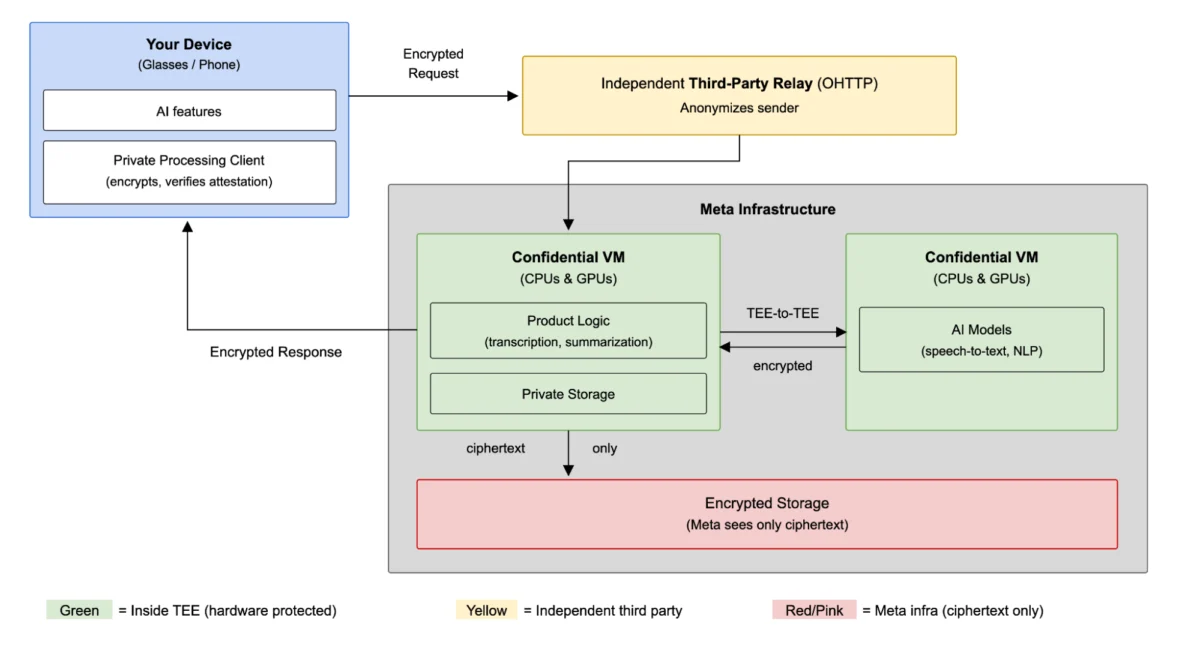
As the race to define the next era of personal computing intensifies, Meta has staked its claim on a bold proposition: the future of artificial intelligence is not trapped behind a smartphone screen, but worn on the face. According to Meta’s internal research and the vision articulated by CEO Mark Zuckerberg, smart glasses represent the ultimate AI form factor—a device that sees what you see, hears what you hear, and offers proactive assistance without the friction of a handheld device.
However, the transition from "smart glasses" to a truly intelligent, agentic wearable introduces a profound privacy paradox. To be genuinely useful, these devices must process deeply personal data—context that spans days, weeks, and complex social interactions. Yet, traditional cloud architectures, which require data to be decrypted in host memory to be processed, are fundamentally at odds with the level of privacy required for such intimate insights. To bridge this gap, Meta is rolling out "Private Processing," a confidential computing infrastructure designed to extend the security boundary of a wearable device directly into the heart of the cloud.
The Evolution of Privacy: From WhatsApp to Wearables
The journey toward Private Processing began long before the current push for AI-integrated eyewear. In April 2025, Meta introduced Private Processing for WhatsApp and the Meta AI app. This initiative established a precedent: allowing users to interact with AI models in a way that ensured even Meta—the service provider—could not access the raw data being processed.
By leveraging Confidential Computing, Meta successfully decoupled user interaction from system access. Having validated this approach in text-based chat, the company is now scaling the architecture to handle the significantly higher data demands of AI glasses. The shift is not merely a technical upgrade; it is a fundamental re-architecting of how cloud-based AI interacts with the individual, moving from a model of "trust the provider" to one of "verify the provider."
Understanding the Pillars: TEEs and Confidential Computing
To grasp the significance of Private Processing, one must first understand the shift from traditional encryption to Confidential Computing. Historically, data protection has relied on two states: at rest (stored on a disk) and in transit (moving over a network). The "in-use" state has long been the industry’s Achilles’ heel; data must be decrypted in memory to be computed upon, leaving it vulnerable to host operating systems, hypervisors, and cloud administrators.
Meta’s solution centers on the Trusted Execution Environment (TEE)—a hardware-level capability embedded in modern CPUs and GPUs. A TEE enables the creation of Confidential Virtual Machines (CVMs). Within these CVMs, memory is encrypted via keys managed by dedicated hardware on the chip. To the host system—and even the infrastructure operator—the data inside these virtual machines appears as indecipherable ciphertext.
The Confidential Computing Consortium (CCC) defines the TEE by its ability to enforce strict isolation and provide remote attestation. For Meta, this means that when an AI model processes a user’s query, it does so in a "black box" where the code and data are cryptographically protected from the very environment they inhabit.
Architectural Chronology: Building the Trust Boundary
Meta’s deployment of Private Processing for AI glasses follows a rigorous five-stage engineering roadmap designed to handle intensive workloads like real-time transcription, long-term memory recall, and contextual search:

- Non-targetable Routing (Decoupling Identity): Before data leaves the glasses, Meta ensures that metadata cannot be tied to a specific user. Using anonymous, blind-signed tokens and third-party OHTTP relays, the system selects a TEE node without the infrastructure ever knowing who is making the request.
- Remote Attestation (Verification): Before sending a single byte of context, the glasses demand a hardware-signed report from the server. The device cross-references the TEE’s binary hashes against an independent, public transparency ledger. If the hash does not match, the connection is immediately terminated.
- Encrypted Processing: Once trust is established, data is transmitted over TLS. AI models operate entirely within the isolated TEE. If multiple models need to communicate, they must undergo the same strict attestation protocols, ensuring the entire chain of custody remains secure.
- Encrypted Storage: Recognizing that "stateful" AI—the ability to remember past interactions—is crucial, Meta moved the storage engine inside the TEE. Data is encrypted with user-provided keys, ensuring that even the stored memories are inaccessible to anyone outside the virtual boundary.
- Operational Observability: Perhaps the most difficult engineering feat was maintaining system health without human access. By relying on aggregate, out-of-band telemetry (CPU, latency, failure rates), Meta engineers can troubleshoot the system without ever "looking inside" a CVM to see user data.
Supporting Data: The Transparency Ledger
Meta is acutely aware that "trust us" is no longer a viable security strategy. The cornerstone of the Private Processing architecture is its Verifiable Transparency model.
Every CVM image deployed in production is registered to an append-only, publicly-witnessed ledger. This creates a state of "tamper-evidence." If Meta were to swap a secure binary for a compromised one, the mismatch would be immediately visible to external monitors and client devices. By opening this process to external auditing—and partnering with firms like the NCC Group—Meta is attempting to standardize a new, higher bar for cloud security. Furthermore, by expanding their Bug Bounty program to explicitly cover Private Processing, they are incentivizing the global security research community to probe the, at times, adversarial environment of their own data centers.
Official Responses and Strategic Implications
Mark Zuckerberg’s vision, as outlined in his July 2025 address on "Personal Superintelligence," suggests that these devices will become our primary computing interfaces. "Personal devices like glasses that understand our context—because they can see what we see, hear what we hear, and interact with us throughout the day—will become our primary computing devices," he noted.
The implications of this shift are immense. By moving the "trust boundary" from the device’s limited hardware into a protected, encrypted space in the cloud, Meta is effectively allowing for the performance of a supercomputer on a device that weighs mere grams.
However, this architecture also presents a new operational reality. By "debugging in the dark," Meta is sacrificing the traditional granular oversight that companies usually demand over their infrastructure in favor of user privacy. It is an admission that the only way to gain the level of trust required for an always-on, vision-enabled assistant is to build a system that is, by design, opaque to the provider.
The Agentic Future: What Comes Next?
While current Private Processing tasks are discrete—summarizing a text or recalling a recent conversation—the long-term goal is the development of "agentic" AI. In this future, your glasses will act as a personal agent, taking proactive steps on your behalf, navigating complex, multi-session tasks, and managing your digital life.
This evolution will require even more complex security boundaries, including inter-CVM communication and more robust data provenance. As these systems grow in capability, the challenge will be ensuring that the security infrastructure scales at the same rate.
Ultimately, Meta’s move to normalize Confidential Computing in consumer electronics suggests a turning point. As wearable AI becomes the norm, the industry is being forced to choose between the convenience of centralized, "transparent-to-the-provider" cloud computing and the security of "black box" processing. If Meta’s gamble on Private Processing succeeds, it may provide the blueprint for how we live alongside hyper-intelligent assistants without surrendering the sanctity of our personal context. The infrastructure is now in place; the question remains whether the public, and the security community at large, will validate these defenses as the robust, impenetrable shield they are designed to be.

 Nila Kartika Wati
 Neng Nana
 Basiran
 Iffa Jayyana
 Raul Delapena Setiawan
 Rifan Muazin
 Asro
Asro