
 Neng Nana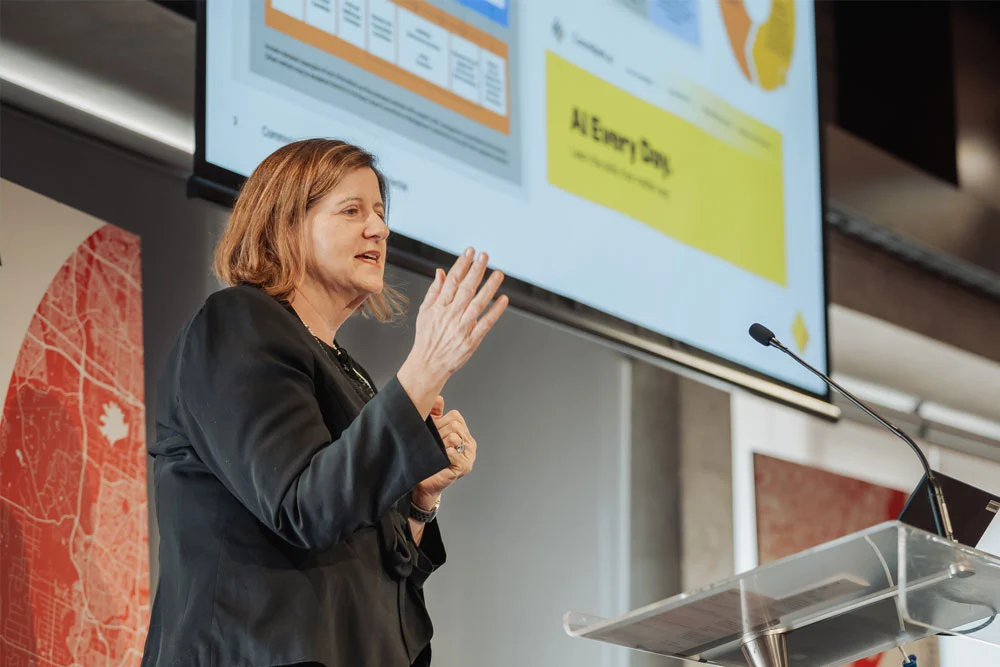
The Sydney Opera House is more than a postcard icon; it is a monument to the volatile intersection of creative genius and bureaucratic friction. As the venue for the 2026 Australia Forum, its soaring, sail-like silhouettes served as a poignant backdrop for a gathering of procurement leaders tasked with navigating a different kind of structural revolution: the integration of Artificial Intelligence into the global enterprise.
For those gathered within its hallowed halls, the juxtaposition was impossible to ignore. Just as Jørn Utzon’s vision for the Opera House was nearly derailed by political infighting and budgetary crises—leading to his resignation and a lifetime spent without ever seeing his masterpiece completed—modern Chief Procurement Officers (CPOs) are currently navigating their own "overruns" and "controversies" as they attempt to reconcile the immense promise of AI with the practical realities of corporate transformation.
The Weight of History: The Opera House Legacy
The story of the Sydney Opera House is one of unabridged ambition. When the Danish architect Jørn Utzon won the international design competition in 1957, he proposed a structure that was technically impossible by the standards of the era. The construction was marred by years of intense budgetary strain and complex political maneuvering.
By the time the project reached its conclusion, the cost had ballooned from an initial estimate of $7 million to over $102 million. Utzon, exhausted by the constant interference and the refusal of the government to support his vision for the interiors, resigned in 1966. He left Australia, never to return, and never to witness the completed silhouette that would define a nation.
This narrative of "vision versus reality" provided a sobering framework for the 2026 Australia Forum. In procurement, as in architecture, the difference between a legacy-defining success and a costly failure often lies in the management of the transition—a theme that permeated the day’s discussions on AI adoption.
Procurement at the Precipice: The 2026 Forum
The 2026 Australia Forum brought together the brightest minds in procurement to dissect the current state of technology. The morning sessions featured high-level case studies from industry titans, including Kimberley Fisk, CPO of New Zealand-headquartered dairy giant Fonterra, and Angela Connolly, CPO of the Commonwealth Bank of Australia (CommBank).
While the discussions ranged from supply chain resilience to sustainability, the primary focus remained on the rapid evolution of AI. Both Fisk and Connolly emphasized that the true challenge of the current technological wave is not merely technical, but human. As algorithms become more sophisticated, the roles and capabilities of procurement teams must undergo a radical, and sometimes uncomfortable, evolution.
The CommBank Framework: A Blueprint for Scalable AI
Angela Connolly’s presentation provided perhaps the most structured roadmap for organizations struggling with the "noise" of the AI revolution. She introduced the CommBank framework—a six-step cycle designed to move AI from a buzzword to a tangible business driver. The framework follows a specific sequence: Democratise, Scale, Redesign, Leverage, Scan, Rinse and Repeat.
1. Democratise
Connolly argues that AI should not be restricted to the IT department or a small group of data scientists. "Democratising means putting AI in everyone’s hands," she explained. This involves a culture of radical transparency, where both successes and, crucially, failures are shared. By asking, "How can AI help me today?" employees at every level are empowered to identify small-scale efficiencies that aggregate into massive operational gains.
2. Scale
The transition from a pilot project to an enterprise-wide asset is where most initiatives die. Scaling, in Connolly’s view, requires the industrialization of "what works." This involves the creation of a centralized, common repository of use cases. By capturing reusable prompts, agents, and patterns, the organization ensures that one employee’s breakthrough becomes the baseline for the entire department.
3. Redesign
Perhaps the most disruptive element of the framework is the requirement to challenge the status quo. Connolly challenges her teams to ask: "If we started from scratch, would we design this process the same way?" In an era of legacy systems and deeply ingrained corporate habits, the answer is almost always a resounding "No." Redesigning processes for an AI-first world is not about layering technology over old workflows; it is about tearing down the old workflows entirely.
Implications: The Psychological Toll of Transformation
While frameworks like Connolly’s offer the necessary structural integrity, they do not account for the psychological pressure on leadership. Throughout the forum, a recurring sentiment emerged: the anxiety of falling behind is causing many CPOs to move too fast, often with disastrous results.
This is where the insights of Mark Sheldrick, representing Transurban, provided a necessary counterpoint. When asked for a single piece of advice for CPOs tasked with rolling out AI, Sheldrick’s answer was disarmingly simple: "Keep calm."
In a market obsessed with the "fear of missing out" (FOMO) and the rapid-fire release of new LLMs and agents, "keeping calm" is a radical act of leadership. It implies that the technology, while transformative, is not a reason to abandon fundamental principles of risk management, governance, and human-centric design.
Chronology of the AI Procurement Shift
To understand where we are, we must look at the rapid progression of the last few years:
- 2023: The Era of Curiosity. Procurement teams began experimenting with basic generative AI tools for contract drafting and spend analysis.
- 2024: The Era of Governance. Following initial security breaches and data privacy concerns, the focus shifted to building guardrails and AI policies.
- 2025: The Era of Integration. AI agents began to be embedded directly into procurement platforms (ERP systems), automating routine sourcing tasks.
- 2026: The Era of Redesign. As seen at the Australia Forum, the focus has moved beyond automation to the complete restructuring of procurement functions and the elevation of human roles.
Supporting Data and Official Responses
Industry data presented during the Forum highlighted that organizations that successfully implement "democratised" AI frameworks see a 30% reduction in time spent on administrative procurement tasks within the first 18 months. However, the data also pointed to a "skills gap" crisis.
"The demand for talent is outstripping supply," noted Kimberley Fisk of Fonterra. "We aren’t just looking for procurement analysts anymore; we are looking for ‘AI-literate strategists.’ The capability set we require today was barely on the horizon three years ago."
Official responses from the attendees indicated a strong consensus: procurement is no longer a back-office function. By leveraging AI to automate the "rinse and repeat" aspects of the job, CPOs are positioning their teams as strategic advisors to the board. The goal is to move from transactional management to value-creation partnerships.
Conclusion: Lessons from the Sails
The Sydney Opera House stands today as a testament to the fact that while the process may be fraught with conflict, the end result—when managed with persistence and a clear, unified vision—can change the landscape forever.
The CPOs of 2026 are not so different from the builders of the Opera House. They are working with new, complex "materials"—algorithms and data—to construct a future that many others cannot yet fully visualize. The risk of budget overruns, political resistance, and "technological fatigue" is high. However, by adopting disciplined frameworks, maintaining a "keep calm" mindset, and focusing on the human element of organizational design, the procurement leaders of today are building their own masterpieces.
As the Forum concluded and the attendees exited into the cool Sydney evening, the shadows of the Opera House sails loomed large—a reminder that great things take time, but that every great journey begins with the courage to start, even when the path ahead is not entirely clear.
To receive weekly insights from the Procurement Leaders community, sign up to the CPO Crunch newsletter.

 Basiran
 Raul Delapena Setiawan
 Iffa Jayyana
 Rifan Muazin
 Asro
Asro