Nana
Nana
In the high-stakes environment of the modern boardroom, few phrases are as seductive—or as perilous—as the promise of "radically improved cash-to-cash cycles." It typically begins with a strategic consultant, armed with polished slide decks and a penchant for buzzwords, standing before a Chief Financial Officer. They point to the balance sheet, highlight stagnant capital tied up in inventory, and propose a silver-bullet technology deployment. The goal is simple: slash inventory, free up cash, and drive shareholder value.
For the supply chain executive brought in to execute this vision, the reality is often far bleaker. The project is frequently "doomed from the start," built on a foundation of theoretical gains that ignore the structural realities of the industry. As the consultant collects their fee and moves to the next account, the supply chain leader is left holding a bag of broken promises and unachievable KPIs.
The Anatomy of a Failed Strategy: A Chronology of Disconnect
The failure of these initiatives rarely stems from a lack of effort; it stems from a fundamental disconnect between financial expectation and operational capability. The chronology of these failed projects usually follows a predictable path:
- The Diagnosis (The Consultant’s Pitch): A consultant identifies "excess inventory" as a drag on financial performance. They compare the company’s current turnover ratios against a best-in-class benchmark, often from a completely unrelated industry.
- The Mandate (Boardroom Approval): Armed with the consultant’s projection, the CFO and Board mandate an aggressive inventory reduction target. This target is often divorced from customer service level requirements or market volatility.
- The Implementation (The Project Launch): A cross-functional team is assembled. They deploy sophisticated software intended to optimize safety stock or automate demand planning.
- The Collision (Operational Reality): The system goes live. Almost immediately, the company experiences stock-outs, plummeting service levels, or a surge in premium freight costs to expedite shipments.
- The Aftermath (The "Holding the Bag" Phase): When the promised cash-to-cash improvement fails to materialize, the consultant has already exited the engagement. The internal team is tasked with explaining why the "guaranteed" ROI evaporated, often resulting in a return to the status quo or, worse, a significant loss in market share.
Supporting Data: The Decline of Inventory Potential
The core issue lies in a failure to understand "industry potential." Executives often operate under the assumption that inventory efficiency is a static goal that can be improved through sheer willpower and technology. However, data from the Supply Chains to Admire research series suggests a more sobering reality: across almost every major industry, inventory potential has been in a sustained decline for decades.

A Sector-Wide Trend
The evidence is stark. In the food industry, inventory turns fell by 30% between 2016 and 2020, following a 28% decline in the decade prior. Similarly, the chemical sector saw a 20% decline in the same 2016-2020 period, compounding a 20% drop from the preceding ten years.
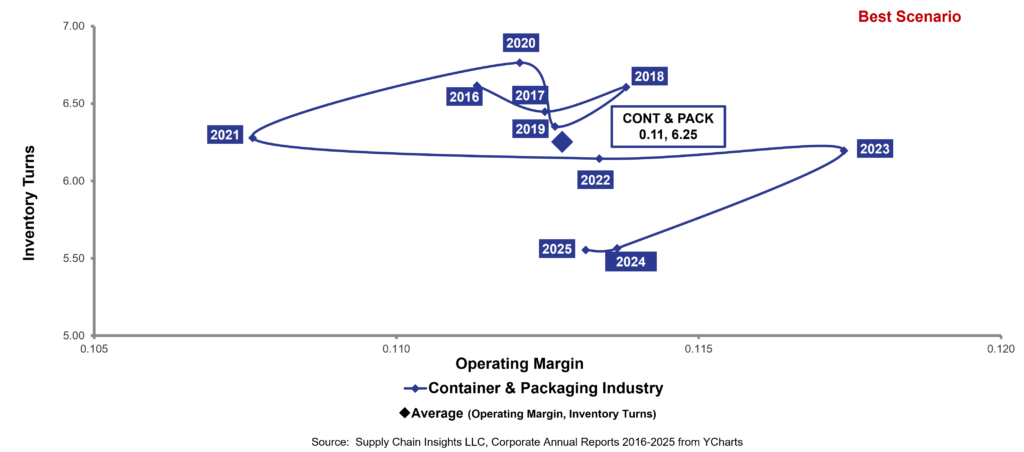
Even the container and packaging industry, often viewed as a bellwether for industrial health, experienced a 15% decline in inventory turns between 2016 and 2025. This pattern is not an anomaly; it is an omnipresent reality across:
- Aerospace & Defense
- Apparel Manufacturing
- Automotive and Aftermarket
- B2B Technology and Semiconductors
- Beverages and Consumer Packaged Goods (CPG)
- Pharmaceuticals and Medical Devices
With the exception of a few isolated retail sectors, the ability to turn inventory has diminished globally. When consultants ignore this downward trend, they set targets based on outdated historical baselines that no longer exist in today’s volatile market.
The Paradigm Shift: Redefining the Role of Inventory
Effective inventory management can no longer be viewed as a simple process-improvement project. It is, in fact, a strategic redefinition of the role of inventory within an evolving operating model.

Moving Beyond "Safety Stock" Optimization
Most consultants treat inventory as a single bucket to be minimized. However, inventory serves different "forms and functions" depending on the demand stream. It is simultaneously the most critical buffer against supply chain volatility and the largest potential source of waste.
To manage it effectively, organizations must employ network design technologies—such as Gains, Lyric, or Optilogic—to map the specific requirements of their demand streams. This involves analyzing three key pillars:
- Forecastability: How predictable is the demand?
- Demand Latency: The time interval between a channel purchase and the visibility of that order within the supply chain.
- Volume: The scale of the movement and the cost of capital associated with the product.
By aligning inventory tactics—such as strategic decoupling points, localized distribution, or centralized pooling—with these specific demand stream characteristics, companies can move away from one-size-fits-all mandates.
Implications for Future Leadership
The implications of ignoring these realities are severe. When a company attempts to force inventory reduction in an environment where the "potential" for such reduction is declining, the organization is effectively starving its own supply chain. This leads to brittle operations that cannot handle market shocks, leading to lost sales and brand erosion.
The Need for Data-Driven Advocacy
For the supply chain executive, the primary takeaway is the necessity of "fighting back with data." When a consultant or C-suite executive presents an unachievable target, the response must be a rigorous, data-driven argument that highlights:
- Peer-Group Benchmarking: Compare the organization’s results against direct competitors rather than generic industry standards.
- The Cost of Inaction: Quantify the impact of stock-outs and service level drops that would result from aggressive, across-the-board inventory cuts.
- Operating Model Alignment: Demonstrate how current inventory levels are tied to specific business strategies—for example, the inventory strategy for a high-volume CPG firm like Unilever is fundamentally incompatible with the just-in-time, configuration-heavy model of a technology firm like Dell.
Bottom Line: Avoiding the "Check You Cannot Cash"
The temptation to pursue quick financial wins through inventory reduction is understandable, but it is rarely sustainable. History is no longer a reliable predictor of the future in a landscape defined by declining inventory potential.
To succeed, leaders must stop treating the supply chain as a passive recipient of boardroom mandates and start positioning it as a strategic partner that understands the nuance of form, function, and demand. Do not let ill-informed advisors set expectations that the organization cannot meet. When a consultant proposes a plan that looks too good to be true, ask for the data behind their assumptions. If they cannot provide it, the check they are asking the company to write is one that will inevitably bounce—and you will be the one tasked with explaining the deficit.
In an era of global volatility, the goal is not merely to hold less inventory; it is to hold the right inventory in the right place for the right reasons. Anything less is not strategy—it is a gamble.


 Sagoh
Sagoh
 Ali Ikhwan
 Raul Delapena Setiawan
 Reynand Wu

 Azzam Bilal Chamdy