
 Muslim
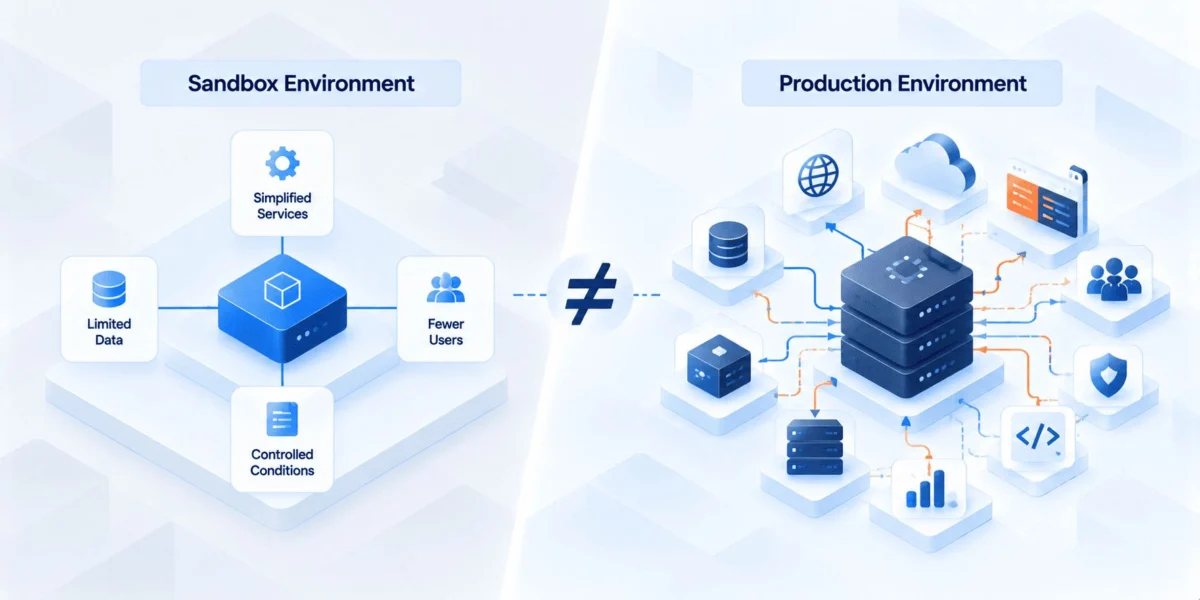
For decades, the "holy grail" of software engineering has been the pursuit of the perfect development environment. Engineering leads have spent countless man-hours and millions of dollars attempting to create a sandbox that mirrors production with absolute fidelity. Yet, despite the rise of containerization, infrastructure-as-code, and sophisticated orchestration tools, the gap between the sandbox and production remains a structural constant.
The sandbox has never matched production. It never will. This is not a failure of tooling or a lack of engineering rigor; it is an inherent characteristic of distributed systems. The realization that this gap is inevitable is the first step toward building a testing strategy that actually works.
The Structural Gap: Why Drift Is the Default
Drift is not a symptom of a poorly managed environment; it is the natural state of any software ecosystem. Production is a living, breathing entity. It evolves through a constant stream of application deployments, infrastructure updates, API versioning, database schema migrations, and third-party integration shifts.
Conversely, the sandbox is a static snapshot. It captures a version of reality that was true at the moment of its creation. Because production and the sandbox operate on different triggers and disparate timelines, drift accumulates by default.
Teams that attempt to solve this by blaming the environment—labeling it as "broken" or "out of sync"—are misdiagnosing the problem. The sandbox does not possess an autonomous mechanism to track production. It requires deliberate, coordinated maintenance. Without a proactive strategy to tether the sandbox to the evolving state of the production ecosystem, divergence is not just likely; it is guaranteed.
The Anatomy of Drift: Infrastructure vs. Behavioral Contracts
To manage the gap, engineers must first categorize it. Not all drift is created equal, and obsessing over the wrong type is a common trap.
The Infrastructure Mirage
Infrastructure divergence—such as running on different instance types, varying memory limits, or utilizing scaled-down subnets—is often the primary focus of DevOps teams. On paper, these gaps look significant. They are easy to identify, easy to measure, and provide a sense of accomplishment when "fixed."
However, in practice, infrastructure parity rarely dictates whether an integration test succeeds or fails. If a test is designed to validate how an application handles a payment service response, the underlying compute architecture is largely irrelevant. Whether that test executes on a high-performance production instance or a throttled development container, the logical outcome remains the same. Chasing infrastructure parity is often a vanity metric that offers little return on investment regarding actual system reliability.
The Behavioral Contract: Where Tests Actually Break
The real danger lies in behavioral contract drift. This occurs when the assumptions baked into your simulated dependencies no longer align with the actual responses of upstream services.
If an order service’s simulated payment dependency expects an old response structure, but the real-world payment service has since updated its schema, the test will pass. It validates the code against a fantasy. The integration fails not because the code is fundamentally flawed, but because the simulation is a lie. When this happens, the test suite becomes a liability: it provides a false sense of security that holds until the moment of production deployment, where the code inevitably crashes against the reality of the new schema.
The Maintenance Paradox: Triggering Accuracy
The difference between teams that successfully navigate this complexity and those that fail lies in their maintenance triggers.
Many teams update their simulations only after a production failure has occurred. In this model, the sandbox is perpetually "wrong" for the duration of the gap between the upstream deployment and the production incident. This creates a cycle of reactive patching.
High-performing teams, by contrast, link simulation updates to upstream deployment events. When an upstream service deploys a change, the downstream simulation is updated immediately. By shifting the trigger from "failure-based" to "event-based," the window of drift is reduced from weeks to mere hours.
Embracing Observation-Based Simulation
Modern tooling has begun to solve the burden of manual simulation authoring. The manual process—where developers document what they believe an upstream service returns—is inherently prone to human error and stagnation.
Newer, observation-based approaches shift the burden to the system itself. Tools that capture real HTTP traffic at the kernel level—such as those utilizing eBPF (Extended Berkeley Packet Filter)—allow for the creation of simulations based on actual production traffic patterns. By capturing what services actually return during interaction, rather than what documentation claims they return, teams can build simulations grounded in objective reality.
When these tools generate a "diff" between the existing simulation and the updated one, they highlight exactly which fields have changed. This provides the downstream team with actionable intelligence: they can instantly determine whether their application logic needs to adapt to a new schema or whether the change is irrelevant to their specific use case.
Strategic Scope: What Should the Sandbox Cover?
Full production parity is an expensive, elusive myth. The objective of sandbox testing should not be to replicate the entire production environment, but to maintain targeted accuracy for the specific behavioral contracts that define the system’s integrity.
A sandbox does not need to handle production-level data volume, nor does it need to mimic traffic patterns or run at the same scale as the live environment. These are the aspects of a system that production reveals naturally. Instead, the sandbox should focus on:
- Request and response structures: Ensuring the "handshakes" between services are intact.
- Error conditions: Validating that the system fails gracefully when a dependency provides a non-200 response.
- State transitions: Ensuring that logical flows—such as adding to a cart or initiating a payment—behave as expected under controlled conditions.
By narrowing the scope, teams can reduce the overhead of environment management while simultaneously increasing the reliability of their test results.
Implications for Distributed Systems Architecture
The shift toward "contract-first" testing has profound implications for how distributed systems are architected. If developers accept that the sandbox is a limited boundary, they must compensate by building more observability into their production environments.
The sandbox is designed to eliminate failures that don’t require production to reveal them. This saves time, reduces cost, and improves developer velocity. However, it will never account for emergent behaviors that only appear under massive, real-world load or through the chaotic variety of actual user data.
Therefore, the engineering lifecycle must be split into two distinct modes:
- The Sandbox: The laboratory for validating logic and contracts.
- Production: The ultimate testing ground for scale, performance, and emergent failure modes.
Conclusion: Redefining the Goal
The goal of environment management is not to eliminate the gap between the sandbox and production. It is to make that gap legible.
When teams treat the sandbox as a "mini-production" environment, they are doomed to maintain a structure that will always be lagging. When they treat the sandbox as a tool for validating behavioral contracts, they gain a clear, maintainable, and high-trust testing suite.
The most successful teams are not those with the most powerful simulation hardware; they are those that have built the most disciplined feedback loops. By linking simulation updates to upstream events and utilizing observation-based data, engineers can ensure that their tests remain trustworthy.
Environment drift is not the enemy. The enemy is the silent, undetected drift of behavioral contracts—the "green" test suite that masks the reality of a breaking production change. By focusing on the contracts that matter, teams can stop fighting the impossible war for parity and start winning the battle for system reliability.

 Dwi Wanna
 Sagoh

 Iffa Jayyana

 Suro Senen

 Pevita Pearce

 Basiran

 Azzam Bilal Chamdy

 Nila Kartika Wati
