
 Pevita Pearce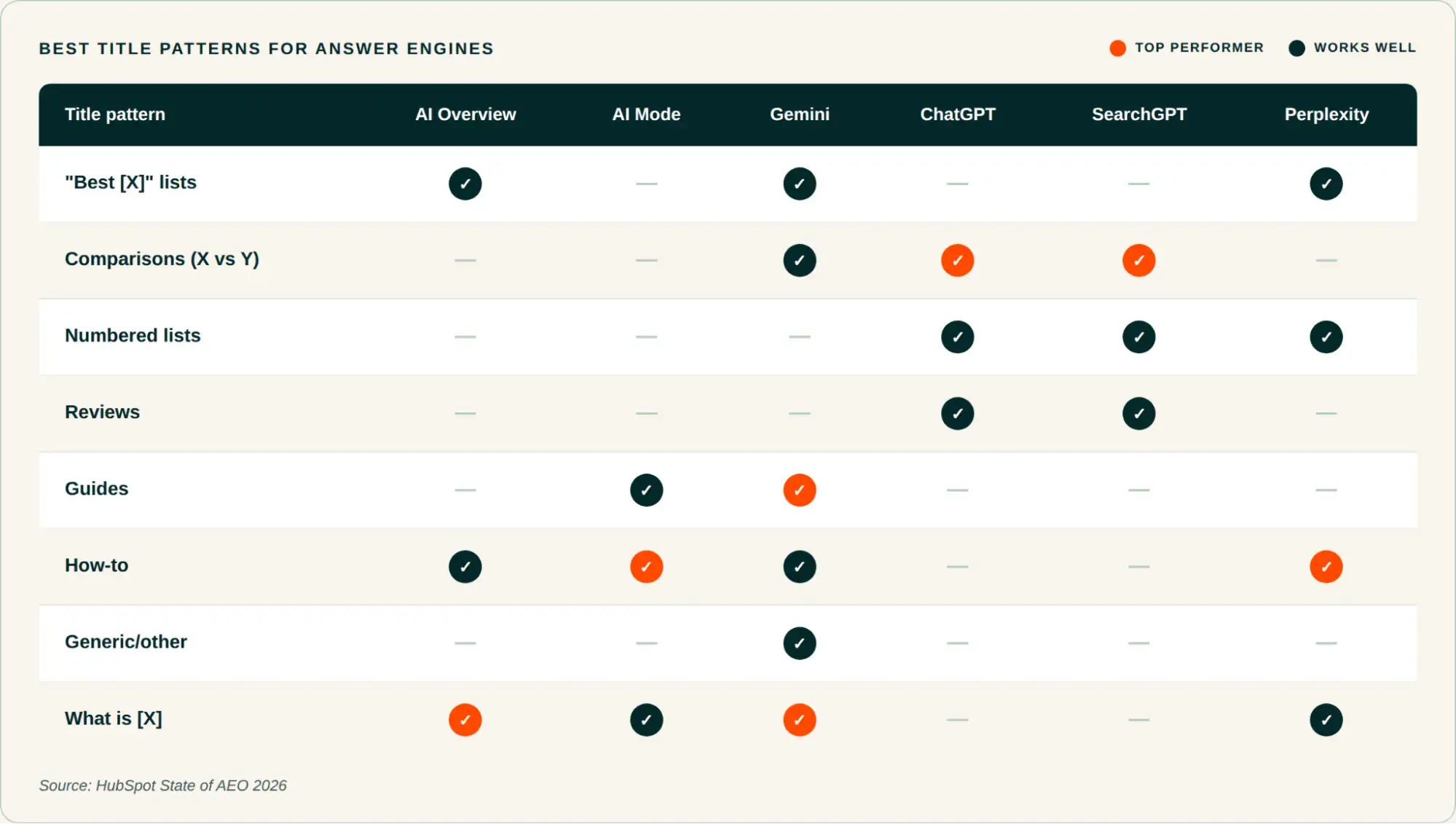
In the rapidly evolving landscape of digital discovery, the traditional "blue link" SEO playbook is undergoing a radical transformation. As generative AI engines like ChatGPT, Google AI Overviews (AIO), Gemini, and Perplexity become the primary gateways for information retrieval, brands are scrambling to secure their relevance in this new "answer engine optimization" (AEO) paradigm.
The question for marketers is no longer just "How do I rank?" but "How do I get cited?" Fortunately, new empirical research has emerged to remove the guesswork. By synthesizing findings from the HubSpot State of AEO 2026 report and the Wix Studio AI Search Lab—which together analyzed over a million AI citations—we can now identify the specific content formats that LLMs favor and the structural signals that turn a page into an authoritative source.
The Core Data: What AI Engines Actually Cite
The research confirms that while AI models are complex, they are surprisingly predictable in their preferences. Across the board, four formats consistently outperform others: listicles, long-form articles, product pages, and category pages.
A Chronology of Discovery
The shift toward AEO began in earnest in 2025 as generative search features moved from experimental sidebars to the center of the user experience.
![On-page content formats answer engines actually favor [new research]](https://53.fs1.hubspotusercontent-na1.net/hubfs/53/best-on-page-content-formats-for-ai-1-20260525-6914910.webp)
- Late 2025: Initial industry observations suggested that LLMs prioritized concise, factual, and highly structured data.
- Q1 2026: The HubSpot State of AEO 2026 study tracked thousands of citation themes, revealing that while ChatGPT remains relatively format-agnostic, AI Overviews are highly selective, favoring depth and specific title patterns.
- Mid-2026: Wix Studio’s AI Search Lab published its extensive analysis, corroborating the findings and providing a clear taxonomy of which content types dominate specific buyer intents.
Supporting Data: Performance by Engine
The data suggests that one size does not fit all. Different engines prioritize different formats based on their underlying architecture:
| Content Format | Primary Strength | Engine Leader |
|---|---|---|
| Comparison Articles | 95% Citation Rate | ChatGPT |
| Long-Form Articles | 42% Citation Rate | AI Overviews |
| Product Listings | 84% Citation Rate | Perplexity |
| Listicles | Cross-Engine Stability | High across all |
While ChatGPT demonstrates a remarkable ability to extract data from almost any format—maintaining citation rates between 86% and 95%—AI Overviews are far more discerning. For Google’s AIO, the difference between a "news" snippet and a "blog post" can mean the difference between a 5% and 42% citation rate.
The Architecture of Authority: Why LLMs Prefer Certain Formats
To understand why these formats win, one must understand how LLMs "read." Unlike humans, who scan for tone and branding, LLMs process information as tokenized chunks. Research from Stanford and recent GEO-SFE (Generative Engine Optimization) preprints indicate that models struggle with "lost in the middle" phenomena, where relevant information buried in long prose is ignored.
1. Predictable Extraction
The winning formats—listicles and articles—rely on a consistent hierarchy. By using numbered H2s, bulleted lists, and tables, content creators provide "anchor points" that LLMs can easily extract. The research shows that structured formats improve extraction accuracy by roughly 43% compared to unstructured, prose-heavy content.
![On-page content formats answer engines actually favor [new research]](https://no-cache.hubspot.com/cta/default/53/9dd5e54b-fbef-4dd0-bc44-1689feb1ea18.png)
2. Citation Signals
Beyond the format itself, LLMs look for trust markers. Schema markup (Article, HowTo, FAQPage, ItemList) acts as a roadmap for crawlers, explicitly stating the purpose of the page. When combined with visible "last-updated" dates and verified author bios, these signals provide the LLM with the confidence to attribute information to your brand.
Official Guidance: Matching Format to Buyer Intent
The most successful content strategies align the format with the specific question the user is asking. Per the Wix Studio research, intent is the strongest predictor of citation success.
Informational Intent ("What is X?")
For conceptual questions, long-form articles are the undisputed champion. These pages should focus on defining the subject, explaining the "why," and providing a deep dive that satisfies curiosity. Essential structural elements include a clear FAQ section with schema and expert-authored insights.
Commercial Intent ("Best X")
When a user is looking for a recommendation, listicles win. The key here is clarity; using numbered headers that contain the brand name allows the AI to clearly distinguish between options. Vague headings like "Our Top Pick" are less effective than "1. [Brand Name] – Best for Budget."
![On-page content formats answer engines actually favor [new research]](https://53.fs1.hubspotusercontent-na1.net/hubfs/53/best-on-page-content-formats-for-ai-2-20260525-5829990.webp)
Comparative Intent ("X vs. Y")
For users in the middle of the funnel, comparison pages are the gold standard. ChatGPT, in particular, favors these. A side-by-side table that clearly contrasts features is a "must-have" for this format, as it provides the model with a structured data set it can easily synthesize into a comparison response.
Transactional Intent ("Buy X")
When a user is ready to purchase, they need product or category pages. These pages should be optimized with product schema and detailed specification tables. This is where Perplexity users spend most of their time, looking for technical confirmation before moving to checkout.
Implications for Modern SEO Strategy
The transition to AEO requires a pivot in how marketing teams manage their web presence.
The Five-Step Audit for Legacy Content
- Map existing content to intent: Identify which pages answer the "What," "How," or "Best" questions.
- Add "TL;DR" sections: Front-load your answers at the top of the page to satisfy the AI’s need for immediate extraction.
- Implement Schema: Ensure every page has the appropriate structural data (Article, FAQ, etc.).
- Update H-Tags: Use descriptive, keyword-rich headers that act as a summary of the section.
- Audit for Recency: Add a "Last Updated" date to signal to the model that the content is current.
Governance and Maintenance
AEO is not a "set it and forget it" task. Governance models should be implemented where content clusters have specific owners responsible for quarterly updates. Trigger events—such as a competitor entering the space, a new model release, or a significant shift in search volume—should mandate a re-test of the page’s citation status.
![On-page content formats answer engines actually favor [new research]](https://53.fs1.hubspotusercontent-na1.net/hubfs/53/best-on-page-content-formats-for-ai-3-20260525-9814874.webp)
Measurement Framework
To prove the value of these efforts, marketers must move beyond traditional "clicks." Instead, implement:
- Brand Visibility Score: Tracking how often your brand is cited in response to specific prompts.
- Share of Voice: Monitoring how often you appear compared to competitors for high-value queries.
- Proxy Signal Analysis: Since referral data from AI engines is often lost, monitor branded search volume and direct traffic as indicators of brand awareness generated by AI citations.
Conclusion: The Path Forward
The "Answer Engine" era is not the end of SEO; it is the evolution of it. By focusing on the formats that AI prefers—listicles, articles, and structured comparison pages—and reinforcing them with authoritative structural signals, brands can ensure they remain the primary source of truth in a machine-driven world.
As the HubSpot State of AEO 2026 report suggests, the brands that win will be those that treat their content as a structured database for AI, rather than just a narrative for humans. By aligning your content strategy with these proven formats, you are not just optimizing for today’s search—you are future-proofing your brand for the next decade of discovery.

 Nana
Nana
 Dwi Wanna
 Nila Kartika Wati
 Jia Lissa
 Basiran
 Sagoh
Sagoh

 Lina Hope