
 Dwi Wanna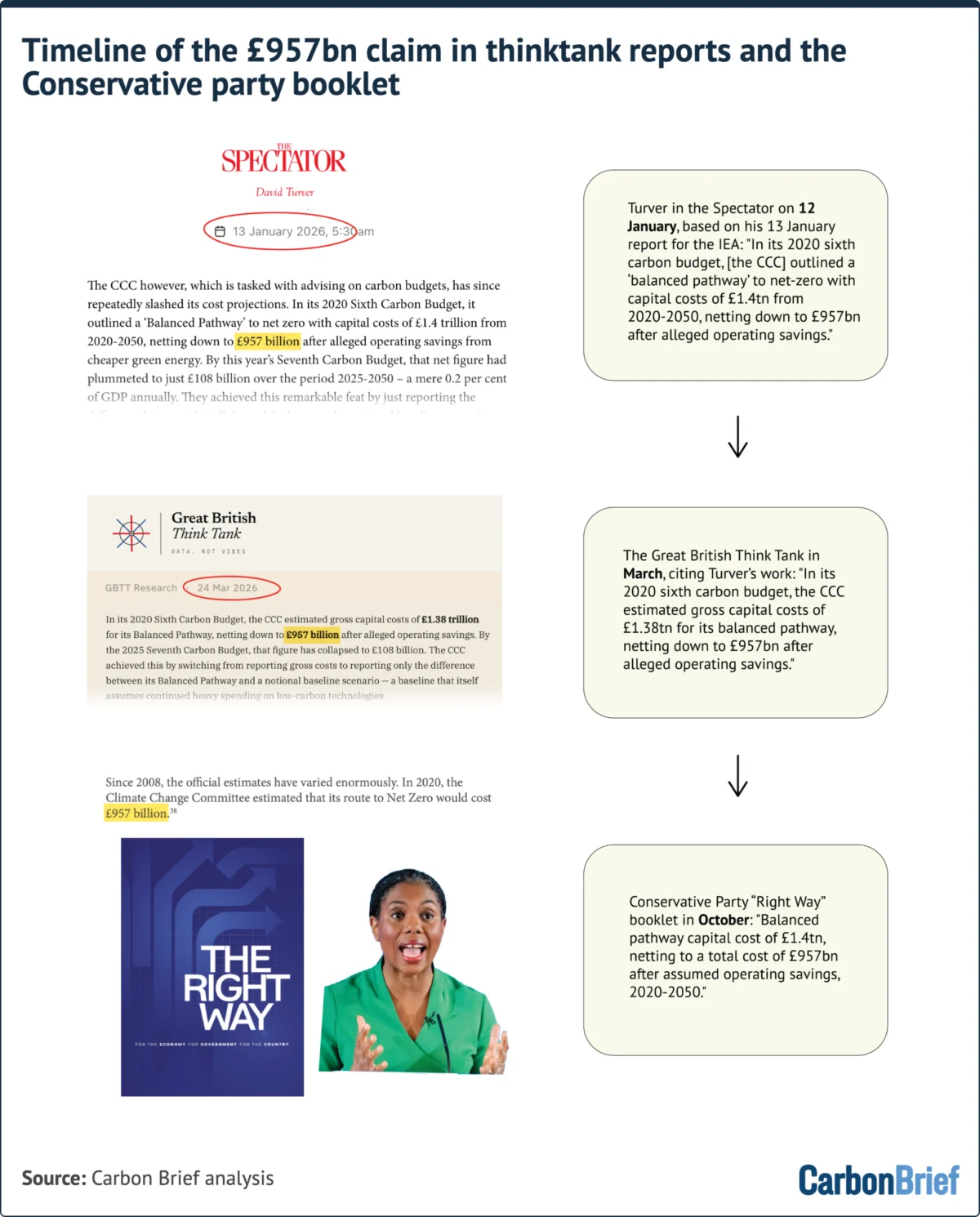
In a significant blow to the credibility of the UK Conservative Party’s latest economic policy manifesto, a central pillar of its argument against the nation’s climate transition has been revealed as the product of a basic, yet consequential, spreadsheet error. The document, titled The Right Way, which purports to offer a "common sense" alternative to current government policy, cites a cost for achieving net-zero emissions that is exactly double the figure calculated by the government’s own independent advisor, the Climate Change Committee (CCC).
The discrepancy centers on a claim that the route to net-zero would cost the British public £957 billion. However, an exhaustive audit of the source data confirms that the actual figure provided by the CCC in its 2020 assessment was £478 billion. The inflated figure has since been traced back to a misinterpretation of a technical spreadsheet, highlighting a troubling trend where complex climate modeling is being distorted by political actors, potentially misleading voters on the economic realities of the green transition.
The Anatomy of the Error: A Mathematical Mismatch
The core of the issue lies in a fundamental misunderstanding of the CCC’s 2020 data, which laid out the capital expenditures (CAPEX) and operational savings (OPEX) required to transition to a low-carbon economy.
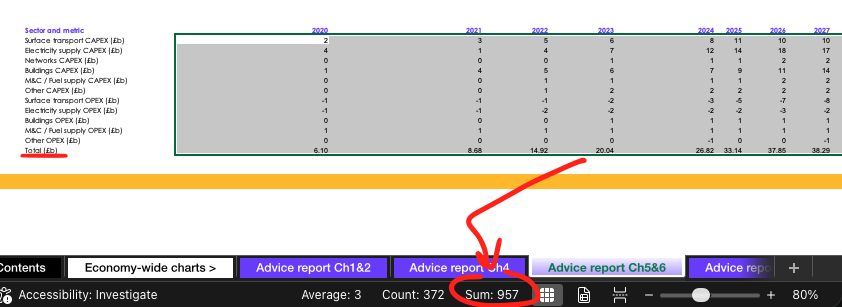
The CCC’s original data table detailed the costs associated with everything from the construction of low-carbon electricity generation to the widespread adoption of heat pumps and electric vehicles (EVs) between 2020 and 2050. These calculations included a line for "CAPEX" (investment) and "OPEX" (operational savings). Crucially, the spreadsheet already contained a row calculating the net annual total for each year.
The error, which has now permeated multiple right-leaning think tank reports before reaching the Conservative Party’s official literature, appears to have occurred when someone—likely an analyst unfamiliar with the structure of the data—decided to sum the individual sectoral costs and the pre-calculated annual total. By adding the totals to the sub-totals, the resulting sum effectively double-counted every expense and saving, magically doubling the headline cost from £478 billion to £957 billion.
This "double-counting" is not merely a rounding error; it is a fundamental flaw in the methodology of the report. By inflating the cost of the transition, the authors of The Right Way have provided a distorted baseline that calls into question the entirety of their economic critique of net-zero policies.
Chronology of a Misleading Narrative
The journey of the £957 billion figure from a technical oversight to a cornerstone of political policy is a case study in how misinformation can travel through policy circles, gaining an air of authority with each iteration.
- December 2020: The Climate Change Committee publishes its landmark advice on the Sixth Carbon Budget. The data clearly indicates a net cost of £478 billion over 30 years.
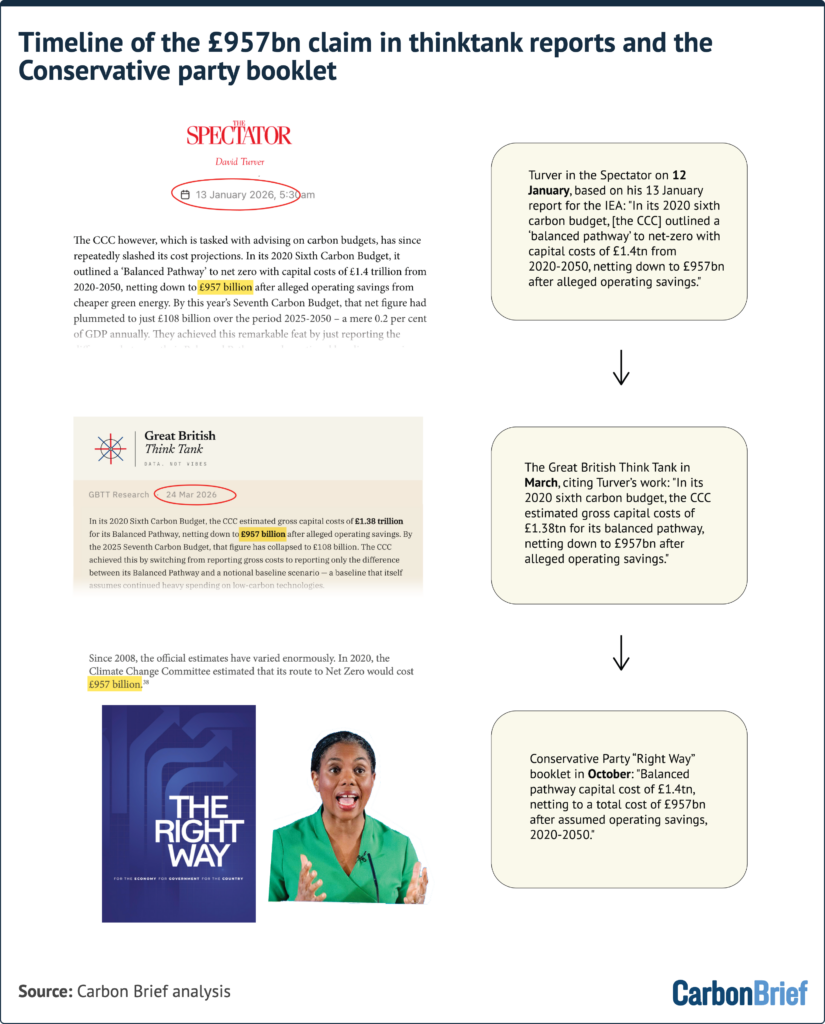
- January 12, 2026: Retired engineer and self-styled "accidental energy analyst" David Turver publishes an article in The Spectator. He cites the £957 billion figure, claiming it as the definitive cost of the UK’s climate goals.
- January 13, 2026: The Institute of Economic Affairs (IEA) publishes a report authored by Turver, which formalizes the error in a professional-looking document, citing Figure 5.3 of the original 2020 CCC advice.
- March 2026: The "Great British Think Tank," a group that prides itself on the tagline "data, not vibes," adopts the £957 billion figure in its own publications, despite its self-stated commitment to sourcing from "official public bodies."
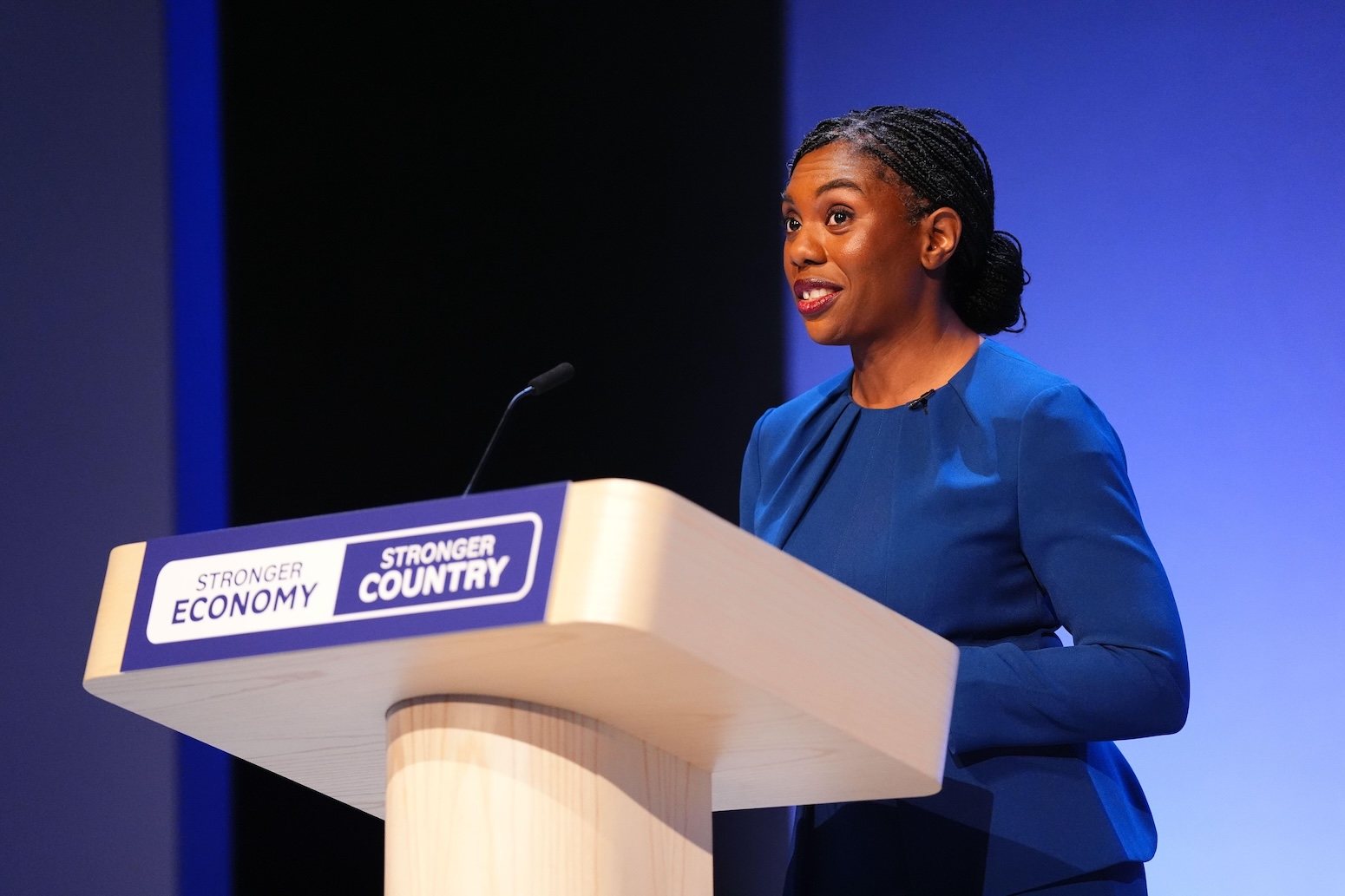
- October 2026: The Conservative Party releases The Right Way. By this point, the figure has transitioned from an obscure blog post to an official partisan policy document, serving as a pillar for the party’s rejection of current climate targets.
This timeline demonstrates how quickly an unverified, erroneous figure can become "accepted fact" within specific political echo chambers. The ease with which this misinformation was adopted suggests a lack of rigorous fact-checking within the organizations involved.
Supporting Data: The Shifting Reality of Net-Zero
The reality of the net-zero transition is far more dynamic than a static, one-off cost. Since 2020, the economic landscape of green energy has shifted dramatically, primarily due to the rapid decline in the cost of clean technologies.
In 2025, the CCC issued a revised estimate, lowering the projected cost of reaching net-zero to £108 billion over the period of 2025-2050. This drastic reduction—down from the original £478 billion—was largely driven by the plummeting cost of electric vehicle battery technology and improvements in renewable energy efficiency.
To put this into perspective, the latest CCC figures suggest that the cost of achieving net-zero is now equivalent to less than 0.2% of the UK’s GDP. Furthermore, the committee has emphasized that these investments are not merely costs; they are catalysts. By reducing reliance on imported fossil fuels, the transition protects the UK from volatile international price shocks, such as those seen during the energy crises of the early 2020s.
Economically, the transition is expected to act as a growth engine. The CCC projects that these investments will boost overall GDP by approximately 2% by 2050, as the nation moves toward a more efficient, technology-driven economy.
Official Responses and the "Political Judgement" Fallacy
The Conservative Party’s document, The Right Way, argues that "sophisticated modeling" should never be a substitute for "political judgement." While this is a common rhetorical device in policy papers, it serves as a dangerous excuse when the "judgement" is built upon a foundation of false data.
The CCC, as a statutory body, has remained focused on the empirical evidence. When confronted with these claims, experts point out that the CCC’s advice is explicitly designed to be updated as markets evolve. The insistence of the Conservative Party on using a debunked 2020 figure—rather than the updated 2025 figures—suggests a preference for a specific political narrative over the actual economic outlook.
When asked for comment on the discrepancy, representatives from the various think tanks involved have largely remained silent, pointing to the complexity of the original spreadsheets. However, the lack of a public correction from these institutions suggests a reluctance to acknowledge the systemic error that has fueled their recent anti-net-zero output.
The Broader Implications for Public Discourse
The implications of this incident extend far beyond a single spreadsheet error. It raises fundamental questions about the role of think tanks and political parties in interpreting scientific and economic advice.
1. The Erosion of Evidence-Based Policy
When political parties adopt figures from partisan think tanks without independent verification, the quality of public debate suffers. If the "cost of net-zero" is the primary battleground for voters, then that battleground must be paved with accurate, verifiable data. The use of double-counted figures serves only to confuse the public and obfuscate the genuine trade-offs required by the energy transition.
2. The Danger of "Accidental" Analysis
The rise of "accidental analysts" like David Turver, whose work is then cited by established institutions like the IEA and major political parties, represents a new challenge in the digital age. Without the institutional safeguards of peer review or rigorous editorial standards, individuals with little formal training in economics or climate modeling can exert outsized influence on national policy.
3. Misleading the Electorate
Perhaps most significantly, the use of this inflated figure in an official party document is a disservice to the voter. By framing the transition as a £957 billion burden—nearly double the actual cost—the party is effectively gaslighting the electorate. It forces voters to choose between "common sense" (as the party defines it) and a policy that, while potentially challenging, is far less expensive than the opposition claims.
Conclusion: A Lesson in Transparency
The revelation of the £957 billion error serves as a cautionary tale for all participants in the political arena. As the UK continues to navigate its path toward a net-zero future, the complexity of the transition will only increase. With that complexity comes a greater responsibility for accuracy.

Policy documents should be held to the same standard as the data they cite. If a political party claims to be "competent enough to solve the problems for which it takes responsibility," it must first demonstrate the competence to perform basic arithmetic. Until the Conservative Party corrects its record and acknowledges the reality of the lower, updated costs of net-zero, The Right Way will remain a flawed document, standing as a monument to the dangers of putting political narrative above empirical truth.
The path to net-zero is undoubtedly a significant undertaking, requiring massive investment and strategic foresight. However, as the CCC’s actual, corrected data shows, it is an investment that is increasingly cost-effective and vital for the nation’s long-term economic and energy security. The public deserves an honest conversation about these costs, not one built on a broken spreadsheet.


 Laily UPN
 Lina Hope
 Iffa Jayyana
 Rifan Muazin
 Suro Senen
 Lina Irawan