
 Raul Delapena Setiawan
At Microsoft Build 2026, GitHub officially ushered in a new era of software engineering. As the industry grapples with the “agentic shift”—a paradigm where AI agents perform increasingly complex tasks—GitHub has unveiled a comprehensive suite of tools designed to move beyond simple AI assistance. By introducing the GitHub Copilot app, sophisticated sandboxing, and an extensible agent framework, the platform is transforming from a passive repository host into a dynamic, agent-native control center.
The State of the Agentic Shift: Moving Beyond Chaos
The integration of AI into the developer workflow has undeniably accelerated the pace of innovation. However, this speed has come at a cost. Many engineering teams currently report disjointed workflows characterized by excessive context switching, fragmented oversight, and the burden of manually reviewing high volumes of agent-generated code.
The fundamental problem, according to GitHub, is that existing developer tools were never architected to manage multiple, autonomous agents working in parallel. In the current landscape, context often scatters across various browser tabs and terminal windows. Developers frequently lose track of which processes are active, and code often lands in pull requests without a clear, traceable history of the agent’s rationale, validation steps, or the specific points where human intervention was required.
GitHub’s latest updates at Build 2026 are a direct response to this architectural gap. By providing a unified "control center," the company aims to turn the current chaotic "agentic frontier" into a structured, reliable, and highly scalable environment.
Chronology of the Shift: From Assistance to Autonomy
The evolution of GitHub’s Copilot has followed a clear trajectory:

- Phase 1 (The Assistant): Copilot started as an autocomplete engine, suggesting code snippets to speed up typing.
- Phase 2 (The Conversationalist): The introduction of Copilot Chat brought reasoning and natural language interaction into the IDE.
- Phase 3 (The Agent): As of 2026, the focus has shifted toward autonomy. Agents are now tasked with moving from an initial prompt to a complete plan, executing that plan, handling code reviews, and managing the merge process.
This year’s announcement marks the transition to Phase 4: Agent-Native Development. In this model, the developer is no longer just a coder, but an orchestrator. They manage a fleet of agents, each assigned to specific, isolated initiatives—ranging from production bug fixes to backlog implementation—all controlled through a centralized interface.
Supporting Data: The Velocity of the Modern Stack
The demand for these tools is driven by unprecedented growth in development activity. On the GitHub platform alone, the velocity of software creation has reached staggering heights:
- Commit Volume: Annual commits have nearly doubled year-over-year, now exceeding 1.4 billion per month.
- CI/CD Load: GitHub Actions now processes over 2 billion minutes of compute time per week, reflecting the sheer scale of automated testing and deployment.
These figures underscore why GitHub’s focus has pivoted toward "resilience and stability." As developers increasingly offload work to agents, the underlying infrastructure must support a higher density of API calls and concurrent processes without failing.
The New Ecosystem: Key Features and Tools
The Copilot App: A Command Center for the Workflow
The cornerstone of this update is the new GitHub Copilot app. Designed as a desktop-native experience, it provides a "My Work" dashboard. Here, a developer can monitor active sessions, pull requests, and background automations across all connected repositories. Every agent session is isolated within its own git worktree, ensuring that agents working on different features do not interfere with one another. This eliminates the manual overhead of branch management and environment cleanup.
Canvases: Bridging Instruction and Execution
GitHub introduced "Canvases" to solve the "scroll fatigue" of long chat threads. While chat is ideal for brainstorming and instruction, it is poorly suited for tracking long-term progress. Canvases are bidirectional, interactive surfaces where agents display their plans, terminal outputs, and deployment statuses. Developers can directly edit these surfaces, allowing for a seamless "human-in-the-loop" experience where the agent updates the canvas as it learns, and the developer steers the progress.
Sandboxes: Security and Isolation
To ensure agents don’t wreak havoc on production systems, GitHub has implemented cloud and local sandboxes.
- Local Sandboxing: Runs in an isolated environment on the developer’s machine, restricted by centrally configured policies.
- Cloud Sandboxing: Executes in ephemeral, isolated Linux environments hosted by GitHub. This allows developers to pick up their agent sessions from any device, providing a consistent, secure environment that adheres to enterprise-grade policy enforcement.
Intelligent Code Review
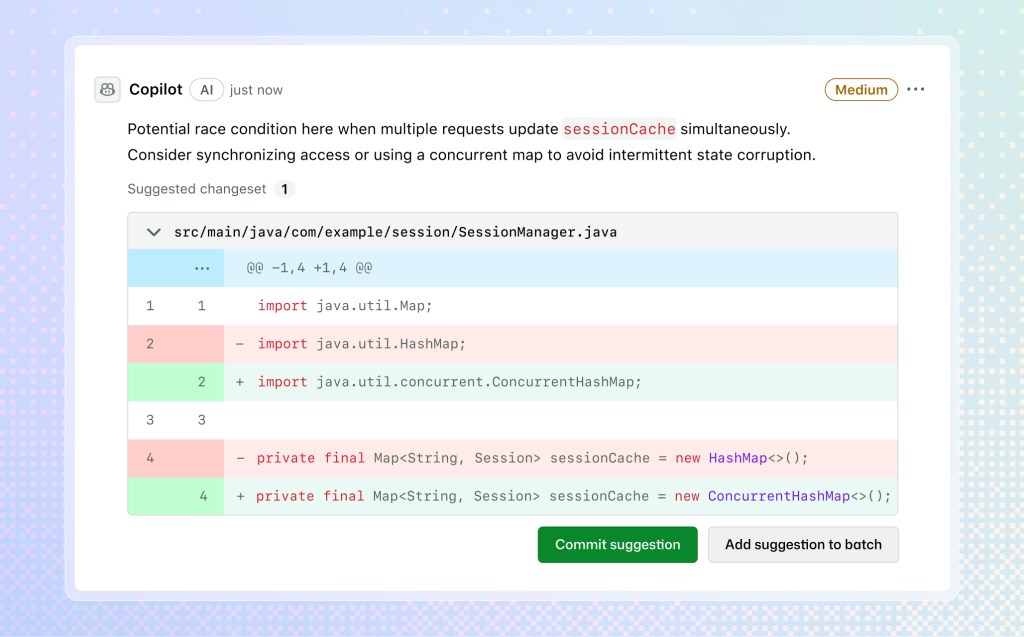
As agents generate more code, the burden on human reviewers could become unsustainable. GitHub is addressing this with Copilot Code Review. This system allows for "medium-tier" reviews, which utilize higher-reasoning models for complex tasks while saving lower-cost models for routine code. Furthermore, the introduction of specialized skills—such as /security-review and the popular /rubberduck—enables teams to tailor the critique process to their specific organizational standards.
Official Responses and Industry Impact
David Jobling, Master Technology Architect at Avanade, noted that the Copilot app has become a "much-needed control center for agentic development." According to Jobling, their "Forward Deployed Engineers" now use the platform to manage multiple, simultaneous initiatives, shifting from individual task completion to high-level system orchestration.
The inclusion of a robust GitHub Copilot SDK (supporting Node.js, Python, Go, .NET, Rust, and Java) further demonstrates GitHub’s commitment to an open ecosystem. By exposing the same agentic runtime that powers the Copilot app, GitHub is enabling organizations to build their own custom internal agents, such as automated release-notes generators or specialized support bots, using the same underlying foundation.
Implications for the Future of Engineering
The shift toward agent-native development carries significant implications for the profession:
- The Rise of the Orchestrator: The developer’s role is evolving. Writing code is becoming a smaller portion of the job, replaced by defining intent, verifying agent outputs, and maintaining high-level architectural standards.
- Scalability of Quality: With agents capable of performing complex code reviews and security analysis, the baseline quality of software could rise. However, this places a premium on the ability to write effective prompts and manage agentic policies.
- Enterprise Control: The ability to define organizational policies—which agents can run, what access they have, and how they interact with production—will become a critical competitive advantage for CTOs.
- Terminal-Centric Workflows: For the purists, the redesigned Copilot CLI, featuring voice input and a new terminal user interface (TUI), ensures that the shift to agent-native work doesn’t require abandoning the command line.
Conclusion: A New Foundation for Software
The announcements from Microsoft Build 2026 reveal that GitHub is positioning itself as the primary operating system for the AI-driven software lifecycle. By integrating the developer’s tools, the code, and the agents into one cohesive, verifiable, and secure environment, GitHub is attempting to solve the fragmentation that has plagued the first wave of AI adoption.
As the industry moves forward, the success of these tools will be measured not just by the number of lines of code generated, but by the ability of teams to maintain speed without sacrificing the accountability and security that professional software development demands. GitHub’s vision is clear: the future is agent-native, and the platform is ready to host the next billion commits.


 Jia Lissa
 Nila Kartika Wati

 Reynand Wu
 Sagoh
Sagoh

 Azzam Bilal Chamdy
 Ali Ikhwan