
 Lina Hope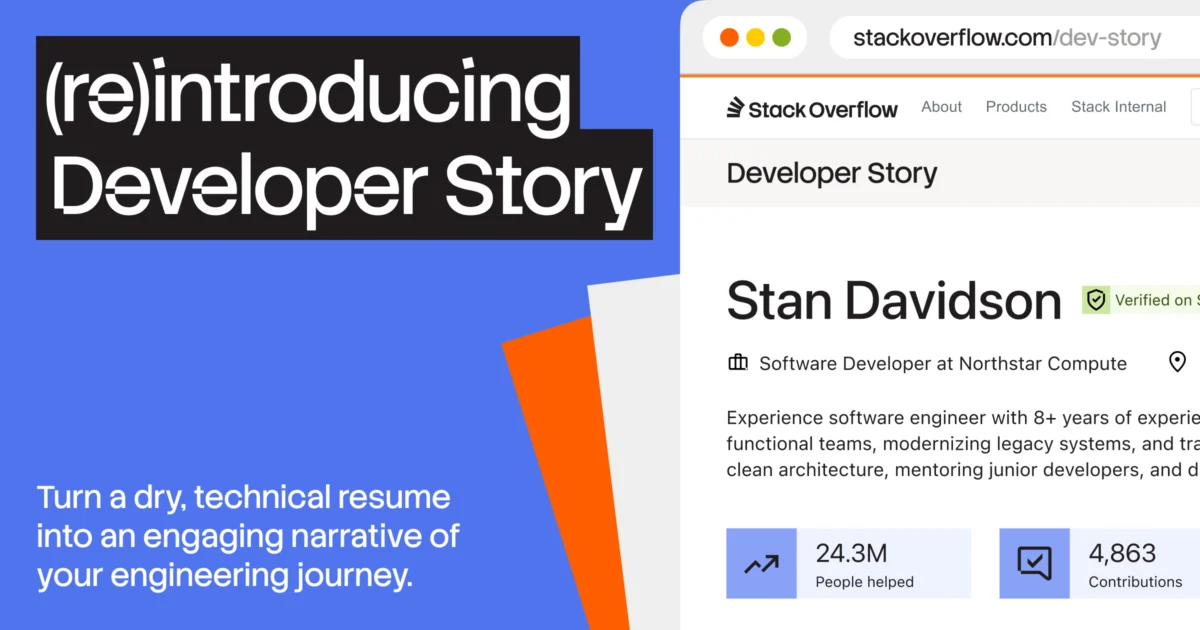
For over a decade, the tech industry’s hiring landscape has been in a state of constant, often turbulent flux. From the gold-rush era of the mid-2010s to the current, more cautious, employer-led market, the mechanisms used to connect talent with opportunity have struggled to keep pace. At the center of this friction is a document that has remained stubbornly unchanged for decades: the traditional resume.
As a talent acquisition professional who has been recruiting for Stack Overflow’s product and engineering teams since 2015, I have had a front-row seat to the erosion of trust in the hiring process. Today, the system is not just strained—it is effectively broken. In response, Stack Overflow is looking to its own history, resurrecting and modernizing the "Developer Story" as a radical alternative to the stagnant, often misleading, standard of the modern CV.
The State of Play: Why Hiring Has Become Exponentially Harder
The difficulty of identifying "good fit" talent at the top of the application funnel has reached an all-time high. Several converging factors have created a "perfect storm" that makes traditional recruiting practices feel like relics of a bygone era.
First, the market has shifted dramatically. Where the mid-2010s were defined by a candidate-led market—where top-tier developers could command multiple offers and aggressive counter-offers—we are now firmly in an employer-led environment. This has led to a surge in active job seekers, creating a volume of applications that overwhelms even the most efficient talent acquisition teams.
Second, the technical landscape itself has mutated. The rise of machine learning, generative AI, and advanced data science has created entire job categories that simply did not exist a decade ago. As developers pivot into these high-demand fields, the markers of "expertise" have become increasingly difficult to standardize.
The AI-Driven Trust Deficit
The most disruptive element, however, is the dual-sided impact of artificial intelligence. On the candidate side, job seekers are increasingly using AI tools to polish, format, and "optimize" their resumes to bypass Applicant Tracking Systems (ATS). This results in a sea of homogenous applications that read with eerie similarity.
On the recruiter side, the reaction has been one of mounting suspicion. When a recruiter opens a resume, they are no longer just asking, "Can this person do the job?" but rather, "Is this resume real?" This atmosphere of distrust has forced companies to add layer upon layer to their hiring processes—longer take-home assignments, more interview rounds, and deeper vetting—to verify that a candidate is who they claim to be. The result is a cycle of exhaustion for both the hiring manager and the applicant.
Chronology: From Careers to the "Developer Story"
To understand why this change is necessary, one must look at the trajectory of Stack Overflow’s own involvement in the hiring space.
- 2015–2018: The Careers Era: During this period, Stack Overflow operated a dedicated careers product. It was a time of growth and experimentation, where the platform sought to bridge the gap between community contribution and professional placement.
- 2019–2021: The Pivot: As the company shifted its focus toward internal tooling and high-level product development—including Overflow AI and Stack Internal—recruiting processes were put under extreme pressure due to the sheer scale of the engineering team’s expansion.
- 2024: The Breaking Point: The recent posting for a Staff Data Scientist position served as a litmus test. Within 24 hours, the team received over 1,000 applications. The uniformity of these documents confirmed that the traditional resume format was failing to highlight nuance or individual capability.
- 2026: The Resurrection: Recognizing that the industry was trending toward a "trustless" hiring environment, the product team made the decision to resurrect and evolve the "Developer Story," a concept designed to replace static text with verifiable professional narratives.
Supporting Data: The Volume and the Void
The data suggests that the volume of applications is not necessarily correlated with an increase in quality candidates. When a single job posting receives over a thousand applications in 24 hours, the math becomes prohibitive. For a lean talent acquisition team, the time required to manually audit these applications is unsustainable.
Industry-wide, the reliance on AI for both application submission and initial screening has created a "dead zone" of communication. Candidates feel the need to game the system, often sacrificing authenticity for visibility. Conversely, recruiters—who are increasingly under-resourced—are forced to rely on automated filters that often discard viable candidates who lack the right keywords but possess the right skills.
The "Developer Story" initiative aims to replace this guessing game with objective data. By leveraging Stack Overflow’s 20-year history of community engagement, the platform aims to provide a space where a developer’s professional history is not just claimed but demonstrated.
Official Stance: The Vision for Developer Story
The vision for the revived Developer Story is simple yet ambitious: it is a place for technologists to showcase their work, their expertise, and their impact, whether that impact occurred within the Stack Overflow community or in the broader professional sphere.
Moving Beyond the "Guessing Game"
Instead of forcing candidates to guess what recruiters want to see in a resume, the platform aims to provide a structured, high-signal format that highlights exactly what hiring managers are looking for.
Key features include:
- Verifiable Impact: A clear, chronological, and skill-based display of a candidate’s projects.
- Contextualized Experience: The ability to link professional achievements with community contributions, such as bug fixes, documentation, or mentorship.
- Holistic Portfolios: A space to showcase not just "resume-worthy" career milestones, but personal projects and hobbies that demonstrate technical curiosity and problem-solving skills.
As the product team notes, if we can combine the collective wisdom of nearly 20 years of developer collaboration with a modern interface for professional growth, we can move away from the "black box" of the traditional resume.
Implications for the Future of Hiring
The resurrection of the Developer Story has profound implications for the tech industry. It represents a move away from the "transactional" nature of hiring toward a "narrative-based" approach.
Restoring Trust
The primary goal is the restoration of trust. By providing a platform where professional history is tied to verifiable contributions, the burden of "proving" one’s skill set is significantly lowered. When a recruiter can see not just a job title, but the specific technical hurdles a developer has cleared, the need for five or six rounds of screening diminishes.
A Repository for Life-Long Learning
Furthermore, the Developer Story is designed to be useful even when the user is not actively searching for a job. It acts as a professional diary—a place to archive the "weekend apps," the late-night production bug fixes, and the technical milestones that define a career. When the time comes to look for a new role, the candidate does not need to scramble to assemble a resume; they simply curate the story they have already been building.
The End of the "One-Size-Fits-All" Application
For companies, this approach promises to reduce the time-to-hire by surfacing the right information earlier in the funnel. For candidates, it offers a way to stand out from the crowd without resorting to the "resume-gaming" tactics that have become so prevalent.
Conclusion: A New Chapter
The hiring crisis is not something that will be solved by better AI filters or more rigorous testing. It will be solved by changing the medium of the communication itself. By moving toward a model that values verified expertise over polished, static claims, Stack Overflow is attempting to bridge the gap between employers and job seekers.
The "Developer Story" is more than a resume—it is a commitment to the idea that in the world of technology, what you have built and what you have learned should always speak louder than how you have formatted your application. As we look toward the future, the hope is that this new approach will allow everyone to showcase their work, learn from one another, and find the roles that truly match their potential.
For those looking to take control of their professional narrative, the Developer Story is now open for engagement. It is time to move past the broken status quo and start telling the story of your career in a way that is as unique as the code you write.


 Nila Kartika Wati
 Iffa Jayyana
 Dwi Wanna
 Muslim
 Nana Wu

 Rifan Muazin
 Asro
Asro