
 Iffa Jayyana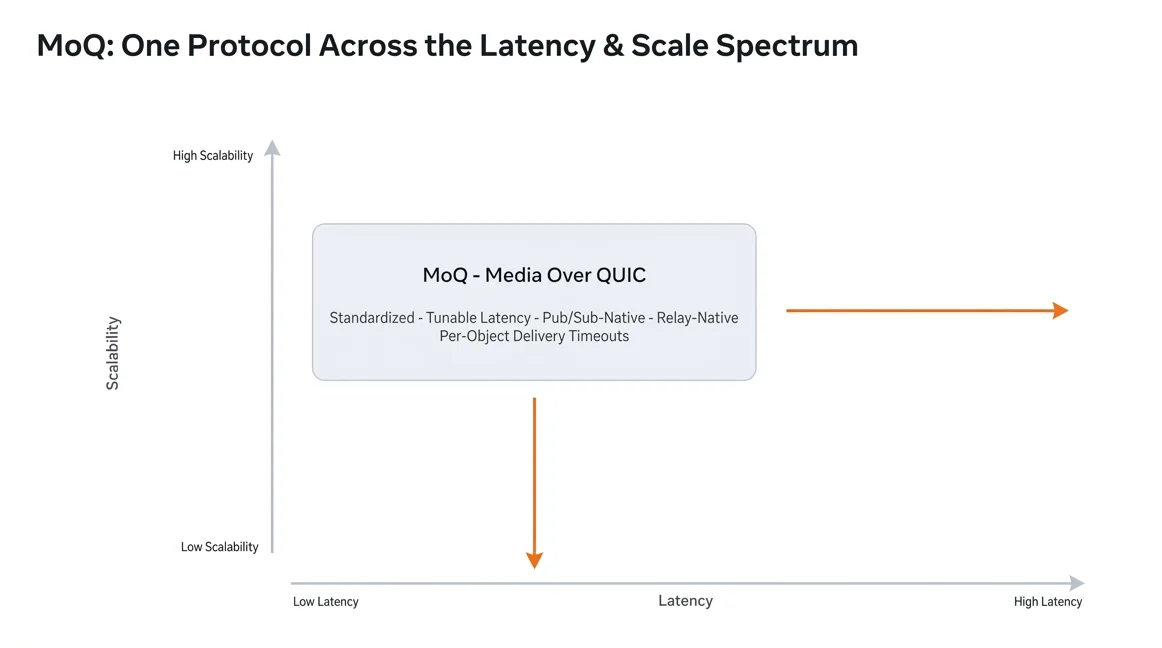
In a significant evolution of internet infrastructure, Meta has officially transitioned Instagram Live’s video ingest pipeline to Media over QUIC (MoQ), an emerging open-standard transport protocol. This shift, deployed across both iOS and Android platforms, marks one of the most substantial real-world applications of MoQ to date. By moving away from proprietary or legacy protocols, Meta is signaling a broader industry push toward a unified, low-latency foundation for the next generation of live streaming, interactive AI, and real-time social experiences.
The Architectural Evolution: From Fragmented Protocols to Unified Standards
For decades, the internet has relied on a patchwork of media protocols, each designed for specific constraints: RTMP for ingest, HLS and DASH for playback, and WebRTC for real-time communication. While these protocols collectively powered the growth of digital media, they created a fragmented ecosystem.
At Meta, this fragmentation presented a growing operational challenge. An engineer working on live streaming would often find themselves managing different protocol stacks, serving infrastructures, and monitoring tools for different facets of the same application. As the lines between live video, interactive features, and generative AI tools continue to blur, maintaining these distinct "silos" has become increasingly inefficient.
MoQ represents a move toward simplification. By utilizing the QUIC transport layer—which is inherently more resilient to packet loss and network instability than traditional TCP-based protocols—MoQ offers a single, scalable solution that can handle everything from high-definition broadcast ingest to ultra-low-latency real-time interactions.
A Chronology of the Transition: From RUSH to MoQ
The path to adopting MoQ was paved by years of experimentation and internal development at Meta.
- The RUSH Era (2015–2024): For nearly a decade, Meta utilized "Reliable Ultra-low-latency Streaming over HTTP" (RUSH), an in-house, QUIC-based protocol. RUSH was highly successful, proving that QUIC could handle live media at scale and effectively replacing the aging RTMP standard for Meta’s internal workflows.
- The Standardization Phase (2023–2024): As the IETF began formalizing MoQ, Meta recognized that maintaining a proprietary protocol like RUSH was no longer optimal. The company shifted its focus toward the collaborative, open-standard MoQ, working alongside partners including Google, Akamai, Cisco, and Cloudflare.
- The Pilot Program (Early 2024): Engineering teams initiated testing on Instagram Live. The goal was simple: achieve "metric parity" with RUSH. This meant the new protocol had to perform exactly as well as the proven incumbent across all reliability and streaming quality benchmarks before a full rollout could be considered.
- The Deployment (Late 2024): Meta successfully transitioned Instagram Live’s ingest pipeline to MoQ. By implementing a translation layer at the edge, Meta allowed the existing backend to treat MoQ traffic as if it were the familiar RUSH format, ensuring a seamless experience for creators and viewers without requiring a complete overhaul of downstream infrastructure.
Supporting Data: Why Instagram Live?
Meta’s choice to pilot MoQ on Instagram Live was deliberate. As one of the company’s largest and most demanding video surfaces, Instagram Live serves as the ultimate "stress test."
- Massive Scale: Proving MoQ at the scale of Instagram Live ensures the protocol is ready for the most rigorous global ingest workloads. If it can handle the concurrent traffic of Instagram’s massive creator base, it can handle nearly anything else in the Meta portfolio.
- Operational Sustainability: RUSH served its purpose, but it was essentially a "Meta-only" protocol. By adopting MoQ, Meta shifts the burden of protocol development to a global, standards-based community. This allows Meta’s engineers to benefit from the interoperability testing and contributions of other industry leaders.
- Performance Parity: During the rollout, Meta tracked streaming quality indicators (SQIs) and reliability measures. The data confirmed that the MoQ-based ingest path met or exceeded the performance of RUSH. This parity was the "green light" needed to move forward with plans to deprecate RUSH entirely.
Technical Mechanics: The Power of "Tracks"
At the heart of MoQ lies the Track—a fundamental abstraction that defines an addressable stream of media objects. Unlike older protocols that might struggle when a network connection experiences jitter, MoQ allows for a network of relays that can cache and forward these objects without needing to parse the actual media payload.
Because these relays only need to understand the MoQ framing and delivery metadata, the system is incredibly efficient. Furthermore, MoQ’s integration with Meta’s open-source moxygen library allows for highly granular control. By using a single configuration parameter, engineers can route traffic through the MoQ pipeline, allowing for phased rollouts, rapid experimentation, and, if necessary, an immediate rollback to legacy protocols.
Implications for the Future: Beyond Simple Streaming
The implications of this shift extend far beyond just Instagram Live. By establishing a unified transport protocol, Meta is laying the groundwork for several major technological leaps:
1. The End of Protocol Fragmentation
Meta aims to collapse several special-case stacks into one. By using MoQ for everything from live ingest to playback and signaling, the company can streamline its infrastructure, reduce technical debt, and simplify the development of new features.
2. Real-Time Interactive AI
As generative AI becomes more integrated into social media, the demand for "continuous human-to-server communication" is rising. AI-driven filters, real-time translations, and interactive avatars require bidirectional, ultra-low-latency communication. MoQ’s ability to carry both signaling and media on the same transport layer makes it the ideal candidate for these "always-on" interactive experiences.
3. Resilience and Adaptive Bitrate
MoQ enables "partial reliability," a feature that allows the system to intelligently skip stale video frames after a network loss rather than allowing latency to accumulate. This is a game-changer for users on unreliable mobile networks. Furthermore, as bandwidth fluctuates, MoQ supports more sophisticated adaptive bitrate (ABR) strategies, allowing the system to trade resolution for continuity in real-time.
Official Perspective: The Move Toward Open Standards
Meta’s engineering leadership emphasizes that this is not just a tactical win for Instagram, but a strategic investment in the future of the internet. By championing the MoQ IETF standard, Meta is ensuring that its infrastructure remains compatible with the broader web ecosystem.
"Shipping MoQ for Instagram Live makes this one of the largest application usages of MoQ we are aware of in the industry," a Meta engineering spokesperson noted. "An open IETF-standard transport is now carrying media at Meta’s scale, and the future it unlocks—from richer interactive experiences to more resilient streaming—is incredibly exciting."
For the wider developer community, Meta has made its moxygen library available as open source, encouraging others to experiment with the protocol. By contributing to the moxygen and mvfst (Meta’s QUIC stack) ecosystems, Meta is inviting a broader conversation about how to optimize media delivery in an era where speed and interactivity are the primary currencies of user engagement.
Conclusion: A Foundation for What’s Next
The transition of Instagram Live to MoQ is a milestone in the history of streaming media. It represents the successful transition of a high-stakes, real-world production environment from a custom-built solution to a collaborative, open-standard future.
While the average user may not notice a difference in their streaming experience today, the underlying technology now provides a much more flexible and resilient foundation. As Meta continues to integrate MoQ across its various platforms—and as other tech companies follow suit—the internet is likely to become significantly more responsive, paving the way for a new era of high-fidelity, real-time social experiences. Whether it is through the lens of a live creator or the interaction of a real-time AI, the future of media delivery is being rewritten, one packet at a time.

 Lina Hope
 Nila Kartika Wati
 Dwi Wanna
 Muslim
 Nana Wu

 Rifan Muazin
 Asro
Asro