
 Lina Hope
In the high-stakes world of digital product development, A/B testing is the gold standard for decision-making. Over the last decade, a quiet revolution has swept through the experimentation landscape: a widespread pivot from traditional frequentist statistics to Bayesian inference. Commercial platforms—including industry stalwarts like Optimizely, VWO, and Amplitude, alongside newer entrants like GrowthBook, PostHog, LaunchDarkly, Statsig, and Eppo—have all integrated "Bayesian modes" into their core offerings.
The narrative driving this shift is compelling: Bayesian statistics are marketed as modern, flexible, and intuitively interpretable. Proponents argue that the framework bypasses the rigid, often counterintuitive complexities of frequentist methods, such as the need for strict multiple-testing corrections or the "peeking problem." Yet, a rigorous new investigation suggests that this transition is frequently based on a profound misunderstanding of statistical mechanics. In many cases, the "Bayesian advantage" is an illusion born of oversimplification, leading to inferential practices that are no more robust—and potentially more dangerous—than the frequentist methods they replace.
The Chronology of a Statistical Shift
The rise of Bayesian A/B testing can be traced back to the industry’s growing frustration with the limitations of null-hypothesis significance testing (NHST). For years, experimenters were taught that "peeking" at data before a pre-calculated sample size was reached would inflate false-positive rates, a reality that often frustrated product managers needing to make quick decisions.
As experimentation platforms matured, they began looking for ways to provide more "product-friendly" metrics. Bayesian methods, which allow for the continuous updating of probabilities as data rolls in, appeared to be the perfect solution. By the late 2010s, "Bayesian A/B testing" became a marketing necessity for experimentation platforms. The messaging was clear: switch to Bayes, and the statistical headache of fixed-horizon testing disappears.
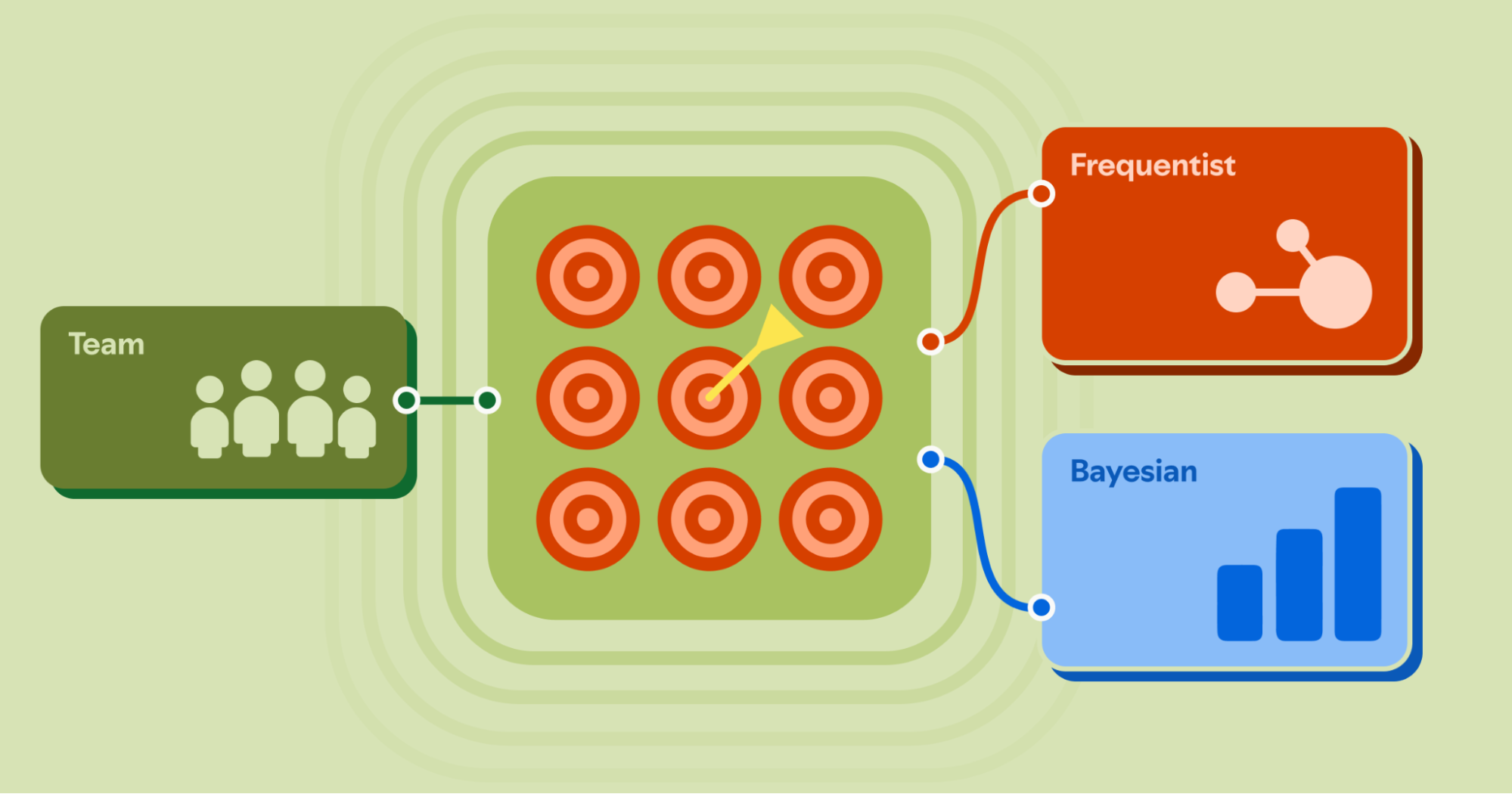
However, recent research—culminating in a comprehensive paper by Spotify’s experimentation team—seeks to interrogate these claims. The authors argue that the industry has conflated goals with configurations, leading to a landscape where companies adopt complex Bayesian tools without fully understanding the underlying mechanics or the trade-offs involved.
Deconstructing the Bayesian Claims
To understand why the "Bayesian is better" narrative is often flawed, one must distinguish between the philosophical framework and the specific mathematical configuration.
1. The Myth of the "Peeking" Panacea
A common claim in the industry is that "Bayesian testing does not require peeking correction." While technically true under the Likelihood Principle—which posits that the posterior distribution is a valid representation of belief regardless of when data collection stops—it is a narrow guarantee.
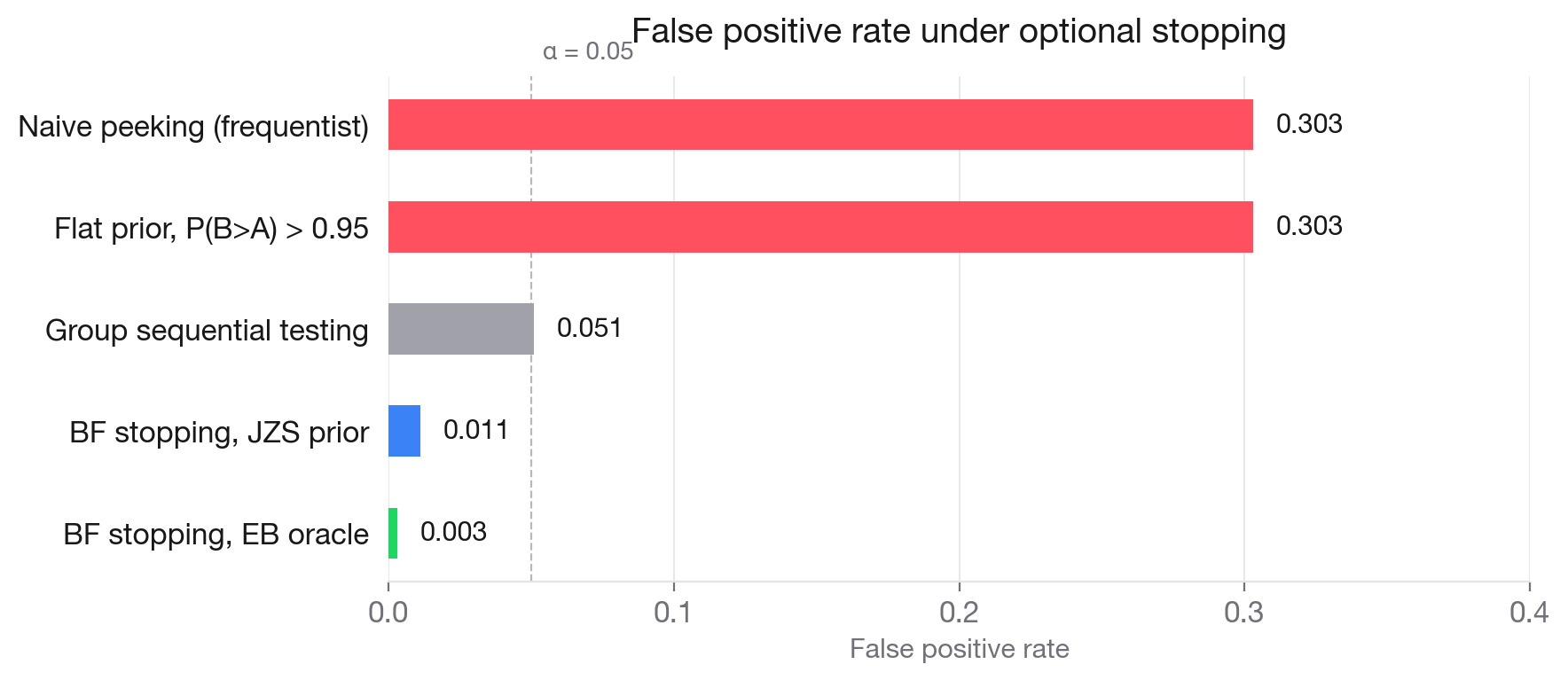
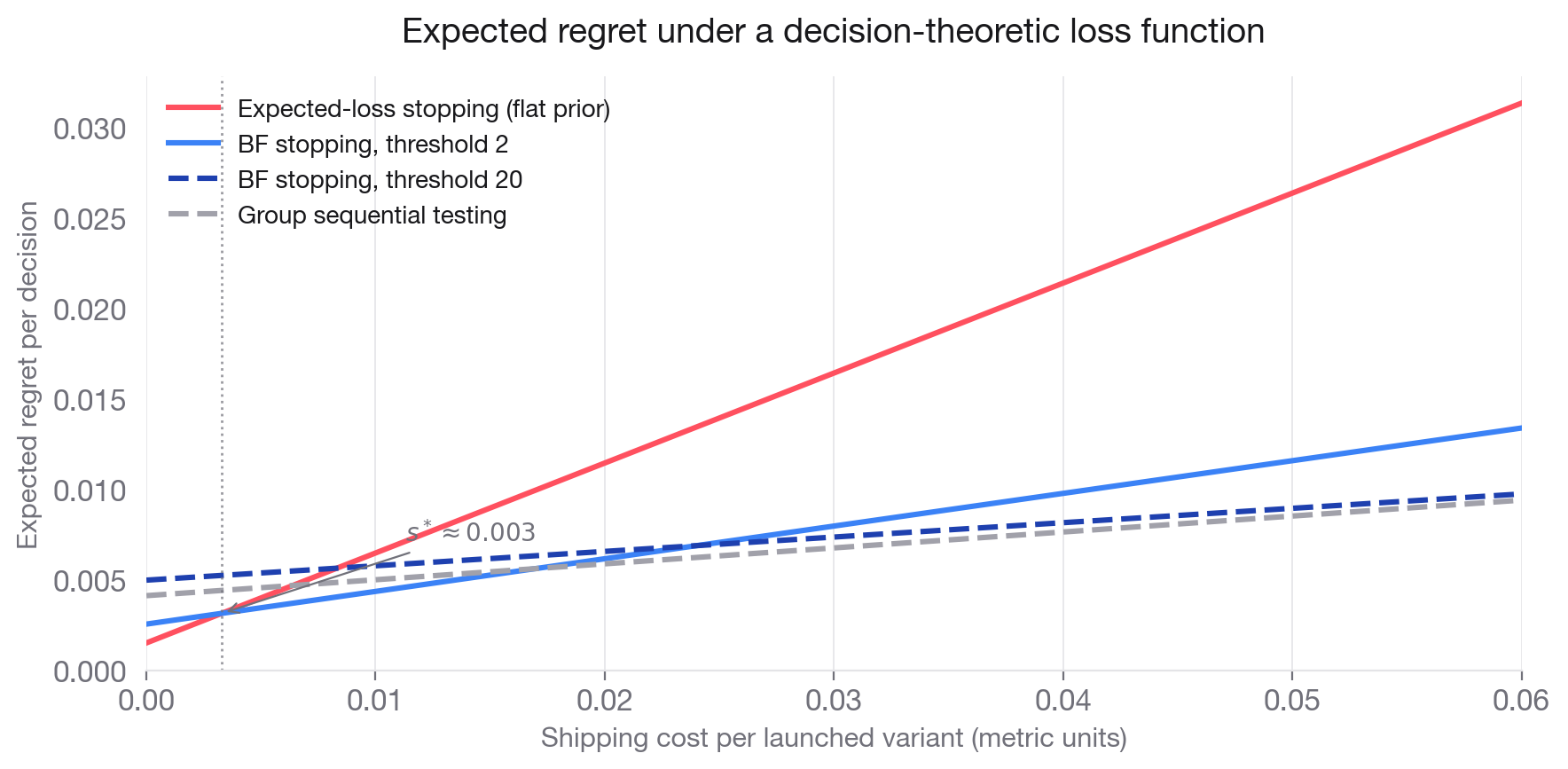
The researchers highlight a critical nuance: if you care about controlling the false-positive rate (an error-rate objective), the Likelihood Principle alone does not protect you. True protection requires a specific configuration, such as Bayes-factor stopping. Yet, remarkably, few commercial platforms offer Bayes-factor stopping as their default. Many platforms instead rely on configurations that, while "Bayesian" in name, lack the specific mathematical safeguards required to prevent the very errors that frequentists have spent decades trying to control.
2. Multiple Metrics and the "Free Lunch"
Another recurring claim is that Bayesian methods handle multiple metrics "automatically." This is often touted as a way to avoid the Bonferroni or False Discovery Rate (FDR) corrections required in frequentist testing.
The reality is far more demanding. To achieve FDR control without explicit correction, one must employ a highly sophisticated Empirical Bayes prior, calibrated with a deep, historical archive of past experiments. This prior must include a "point-mass" component representing the proportion of historical null results. If this prior is poorly calibrated—due to heterogeneous metrics or shifting product dynamics—the "automatic" protection vanishes. As the study notes, this isn’t an absence of correction; it is a highly intricate, maintenance-heavy version of one that most organizations are not equipped to manage.
3. The Winner’s Curse and Shrinkage
The "Winner’s Curse"—the tendency for winning variants to have their effect sizes overestimated—is a genuine problem. Bayesians correctly point out that an informative prior can shrink these estimates toward a more realistic mean. However, most platforms default to a "flat prior" (a non-informative prior), which provides zero shrinkage. In these instances, the "Bayesian" estimate is mathematically identical to the frequentist Maximum Likelihood Estimate, rendering the supposed benefit nonexistent.
Supporting Data: When Frameworks Converge
Perhaps the most startling conclusion from the research is how close the two frameworks actually are. Under a flat prior and a standard two-group normal model, Bayesian and frequentist procedures produce near-identical numerical outputs. The posterior probability that variant B is better than A is essentially one minus the p-value.
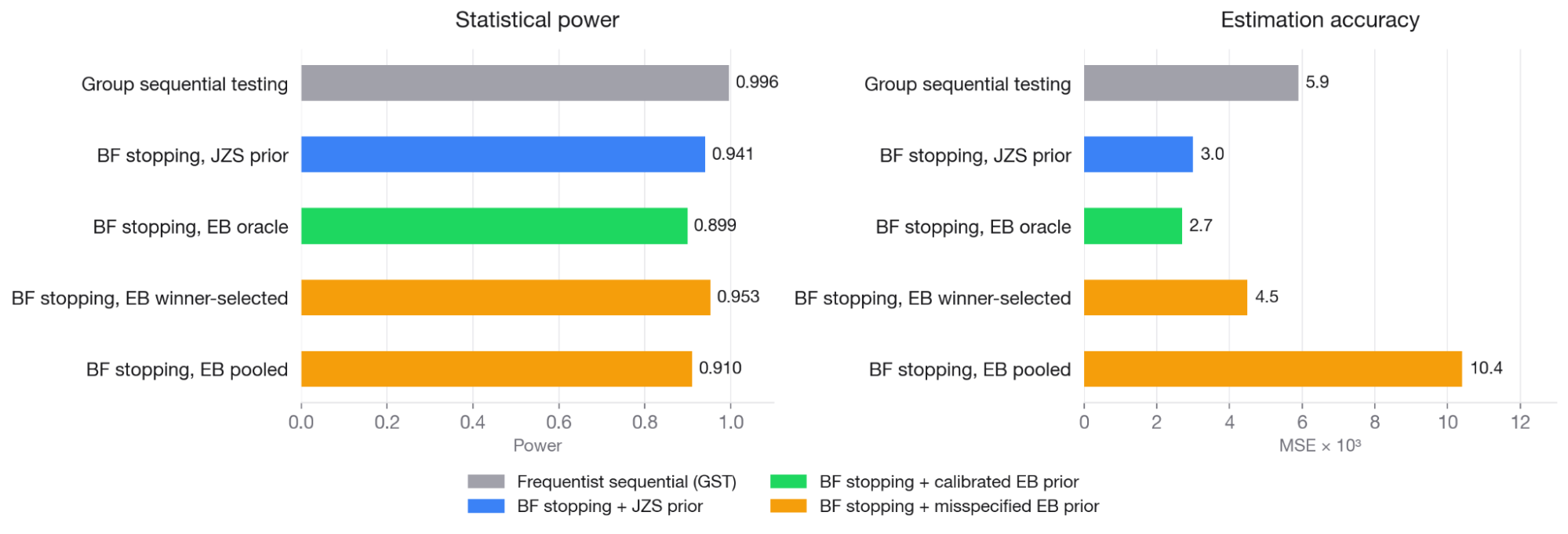
When we move beyond the flat-prior case, the overlap persists. A frequentist using a mixture Sequential Probability Ratio Test (mSPRT) to maximize power is, for all intents and purposes, utilizing a Bayesian prior. When these tools are properly calibrated, they converge on the same decision-making logic. The divide is often one of vocabulary rather than outcome.
The Spotify Perspective: Why Silence is Strategic
In an industry rushing to embrace Bayesianism, Spotify’s stance is a notable outlier. Despite having the resources to implement complex Bayesian architectures, the company has chosen to stick with frequentist methods.
The rationale is rooted in organizational efficiency. Spotify’s experimentation program relies on high levels of collaboration and cross-functional consistency. Adding a second statistical framework would require doubling the training, monitoring, and interpretation overhead. The leadership at Spotify concluded that the marginal utility of a Bayesian mode was eclipsed by the complexity it would introduce.
Furthermore, the Spotify team warns that "sophistication that adds confusion can reduce the strength of evidence." If an organization doesn’t have the statistical maturity to maintain an Empirical Bayes prior—or to explain the difference between a posterior probability and a frequentist confidence interval—the introduction of Bayesian tools can lead to lower trust in data-driven decisions.
Implications for Industry Leaders
For companies currently evaluating their experimentation stack, the message is clear: don’t let the marketing overshadow the math.
- Define Your Goals, Not Your Tool: Before choosing a platform, ask what you actually need. Do you need to control false-positive rates? Are you running multiple metrics on every test? Do you have the data science talent to maintain a historical archive for Empirical Bayes?
- Beware the "Default" Settings: Most commercial platforms offer a one-size-fits-all Bayesian implementation. If you aren’t configuring your priors and stopping rules, you may be getting all the complexity of Bayesianism with none of the benefits.
- Invest in the "Learning" Framework: The most successful experimentation programs focus on how evidence propagates to decisions, rather than the specific statistical engine used to generate the p-value or the posterior probability.
- Simplicity Wins: If your current frequentist setup is well-understood and stable, the burden of switching to a Bayesian framework—with its associated training costs and potential for misinterpretation—is likely not worth the gain.
Conclusion
The "Bayesian vs. Frequentist" debate is largely a distraction. For the vast majority of product teams, the choice of statistical framework is secondary to the rigor of the experimental design, the quality of the data, and the clarity of the decision-making process.
Bayesian inference is a powerful tool, but it is not a silver bullet. By oversimplifying the complexity of these methods, the industry risks creating a false sense of security that could lead to poor product decisions. As the research suggests, whether you are a Bayesian or a frequentist, the most important work happens before the data is ever collected—in the careful definition of goals, the selection of appropriate stopping rules, and the honest acknowledgement of the trade-offs inherent in any statistical system.


 Rifan Muazin
 Sagoh
Sagoh
 Laily UPN
 Iffa Jayyana
 Suro Senen

 Lina Irawan