
 Nana
Nana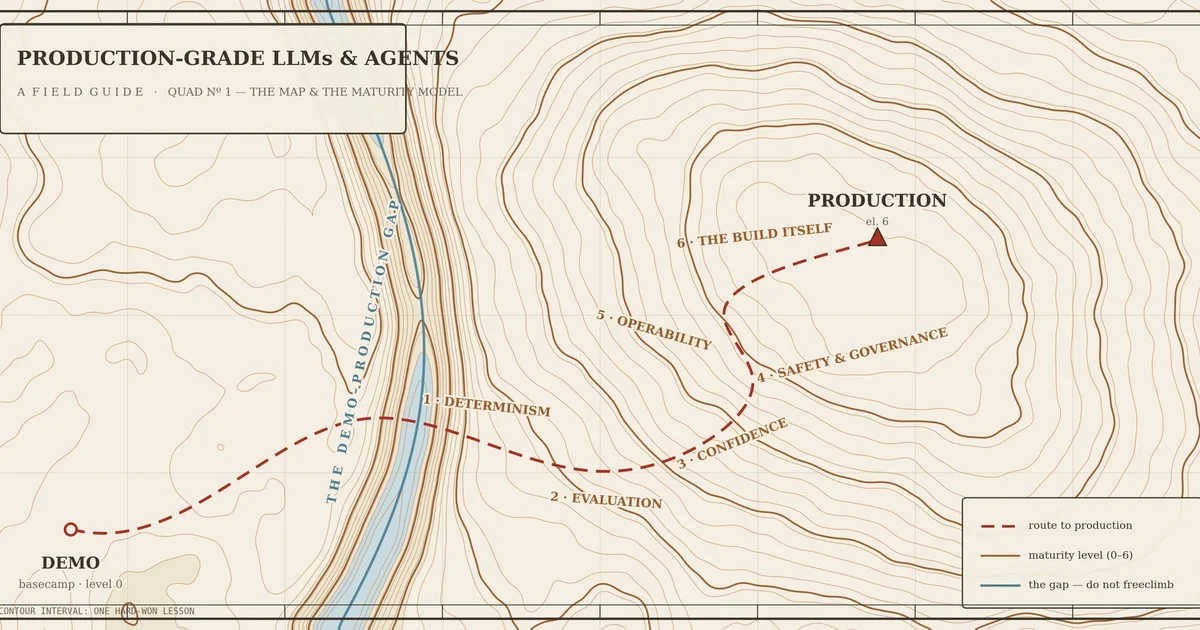
The chasm between an artificial intelligence agent that performs flawlessly during a boardroom demo and one that can safely handle live customer interactions or sensitive financial transactions is the most significant bottleneck in modern software engineering. For many organizations, the allure of Large Language Models (LLMs) has led to a rush of development, yet these projects frequently stall at the "prototype phase."
The industry is beginning to realize that crossing this canyon is not a matter of scaling to larger, more expensive models. Instead, it requires the implementation of rigorous, "boring" engineering machinery. Reliability in AI is not found in the model’s probabilistic output, but in the deterministic scaffolding built around it.
The Reality of Probabilistic Systems
At the core of the current AI maturity crisis is a fundamental misunderstanding of what LLMs are. Because LLMs are inherently probabilistic, they can never be truly deterministic. However, production systems demand high-level guarantees.
The industry standard for achieving this stability is to shrink the model’s scope to the smallest possible decision that requires genuine judgment. By isolating this decision, developers can wrap it in a deterministic architecture that can be tested, gated, audited, and observed. In a mature production environment, the LLM is not the system; it is merely one contained, replaceable component within a robust, well-engineered infrastructure.
A Chronology of Maturity: The Six Levels of Agent Development
To move from a fragile prototype to a production-grade agent, teams must climb a six-level hierarchy. Skipping steps often leads to catastrophic failure when the agent encounters edge cases in the wild.
Level 1: Determinism
The foundational layer is the creation of "boring" agents. This involves moving away from free-form prompting toward structured output. By enforcing strict schemas, developers can ensure that the agent’s response is predictable enough to be parsed by downstream services. This level also introduces "Bounded ReAct"—limiting the agent’s ability to loop indefinitely, which is a common failure point for autonomous systems.
Level 2: Evaluation
Once the output is predictable, the system needs a "deployment gate." This level focuses on establishing automated evaluation benchmarks. If an agent’s performance deviates from these benchmarks, it is flagged. Drift detection becomes critical here, ensuring that as models are updated, their performance on specific, defined tasks remains constant.
Level 3: Confidence
At this stage, the system must learn to admit when it doesn’t know the answer. This is achieved through calibrated confidence scores and "LLM-as-a-judge" frameworks. Integrating a human-in-the-loop (HITL) UX allows the agent to escalate uncertain decisions to a human operator, preventing the "hallucination" of facts that could damage customer trust.
Level 4: Safety and Governance
As the agent begins to handle sensitive data, the focus shifts to defense-in-depth. This involves rigorous PII (Personally Identifiable Information) scrubbing at the boundary, an append-only audit ledger to track every decision made, and a sophisticated memory model that handles multi-tenant data isolation.
Level 5: Operability
This level transforms the AI from a script into a platform. It incorporates hexagonal architecture, allowing for model routing (switching between models based on task complexity), graceful degradation (falling back to simpler systems if the main model fails), and centralized observability. Cost control is also integrated here, ensuring that high-performance agents do not become budget liabilities.
Level 6: The Disciplined Build
The final level is the "Operating System for Agents." Here, the build itself is managed by parallel autonomous agents. This creates a feedback loop where the development process is as automated as the output. The key differentiator is the "decision log," which provides a complete forensic trail of why an agent performed a specific action, allowing for iterative improvement.
Supporting Data: Why "More Model" Isn’t the Answer
The common fallacy among engineering teams is the belief that a larger model—such as moving from a 7B parameter model to a 175B+ model—will inherently fix production issues. Industry data suggests otherwise.
- The Error Rate Plateau: While larger models often improve the "correctness" of a response, they do not solve the issue of output variance. Even the most advanced models will produce non-deterministic responses given the same input.
- The Cost-to-Reliability Ratio: As model size increases, so does the latency and cost per request. For high-volume production, the cost of a "smart" but unmanaged model quickly becomes prohibitive compared to a smaller, "dumb" model wrapped in a high-quality, deterministic framework.
- Observability Gaps: Teams that focus solely on the model often fail to implement proper logging. Without an audit trail, troubleshooting a failure in a complex agent pipeline can take days. Teams that prioritize Level 5 observability can identify and resolve failures in minutes.
Official Industry Perspectives
Leading voices in AI infrastructure argue that the "Model-First" era is ending, replaced by the "System-First" era.
"We are moving from an era where people were impressed by what an LLM could say to an era where they demand to know how an agent behaves," says one industry analyst. "You cannot deploy to a bank or a hospital with a model that is a ‘black box.’ You need a ‘glass box’—a system where every step, every memory retrieval, and every guardrail trigger is visible and accountable."
Critics of the current AI landscape point out that many teams are "Level 0" (the demo stage) but aspire to "Level 5" (fully automated production). The consensus is that teams often fail because they try to shortcut the safety and observability layers. "You don’t get to sleep at night," an expert noted, "until your observability is as strong as your model’s inference."
Implications for the Future of AI Development
The shift toward a formal maturity model has profound implications for how companies will build AI in the future.
The Death of the "Black Box"
Organizations that treat their agents as black boxes will be unable to meet regulatory standards. The future of enterprise AI lies in transparent, auditable architectures. If an agent makes a decision that results in a financial loss, the company must be able to trace that decision back through the audit ledger to a specific prompt, a specific piece of context, and a specific guardrail check.
Specialized Roles in AI Engineering
As the industry matures, the role of the "AI Engineer" will split. We will see a divide between Model Researchers, who focus on fine-tuning and weights, and Agent Systems Architects, who focus on the deterministic machinery described in the maturity model. The latter will become the more critical role for companies trying to scale AI to millions of users.
The Competitive Advantage of "Boring"
In a market saturated with "AI-powered" startups, the competitive advantage will shift from who has the most impressive demo to who has the most reliable system. The companies that build the most "boring" systems—those with strict gatekeeping, consistent testing, and iron-clad observability—will ultimately win the market.
"The demo is a hook," conclude the architects of this framework. "But the infrastructure is the business. If you want to put your agents in front of money, stop trying to make the model smarter and start making the system around it safer."
Conclusion: A Roadmap for Teams
For teams currently evaluating their own AI maturity, the prescription is clear: find the weakest level and address it. If you lack determinism, stop building features. If you lack evals, stop deploying updates. By treating LLM systems as software engineering problems rather than research experiments, organizations can move from the fragility of the demo to the reliability of the production enterprise.
The path is long, but it is well-mapped. Each rung of the ladder—from determinism to the disciplined build—is a step away from the chaotic nature of probabilistic models and toward the secure, predictable systems that the modern enterprise demands.


 Rifan Muazin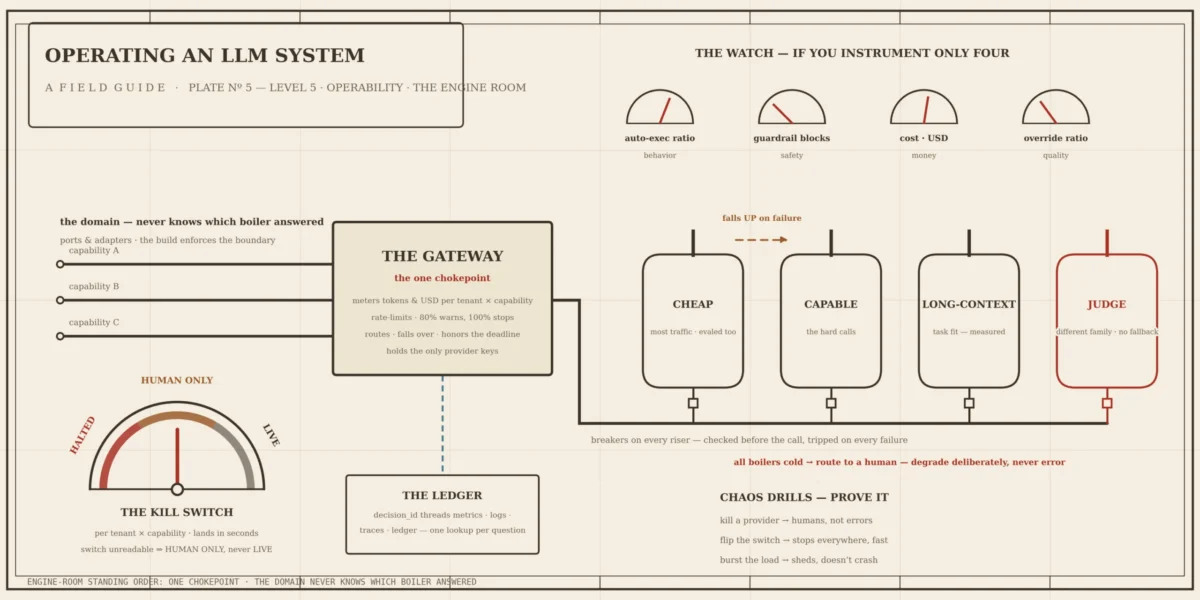
 Sagoh
Sagoh
 Laily UPN
 Iffa Jayyana
 Suro Senen
 Lina Hope
 Lina Irawan