
 Asep Darmawan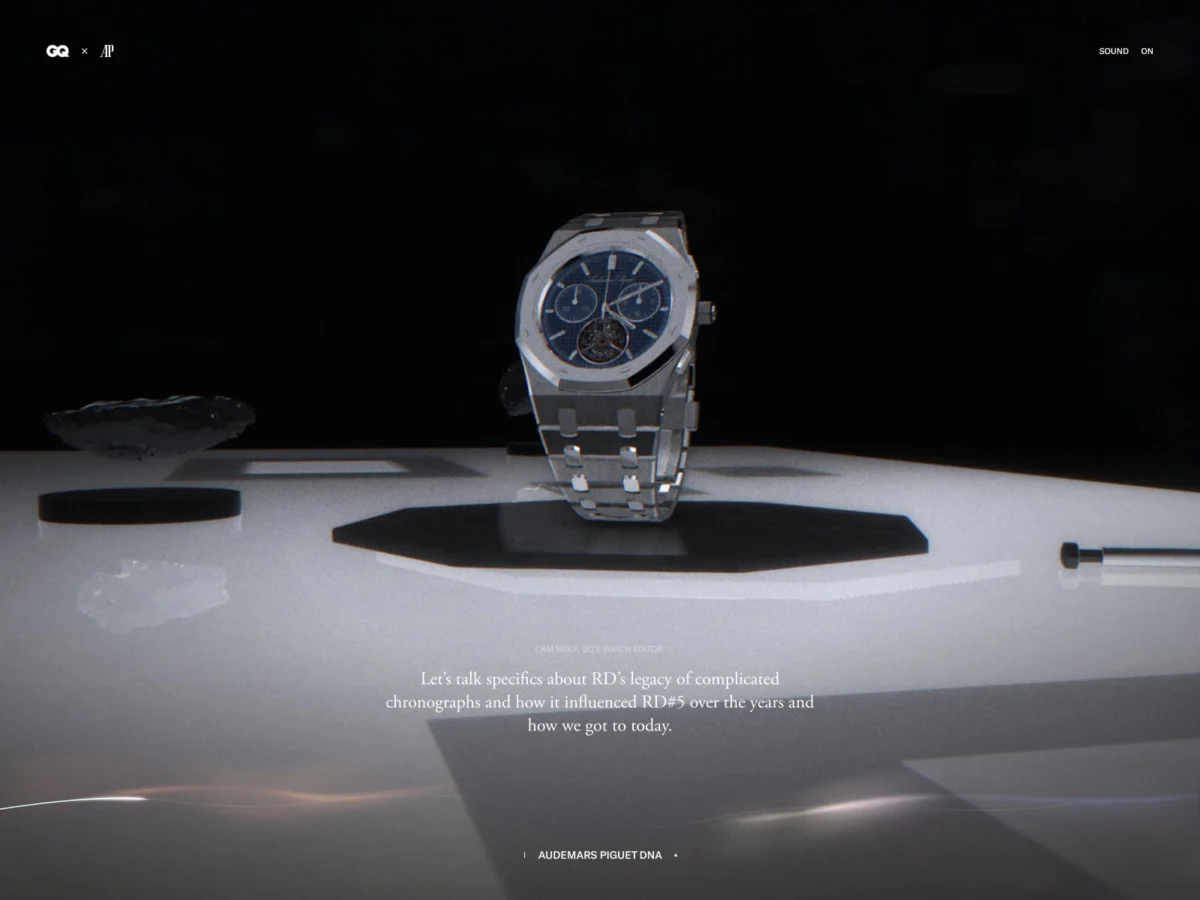
In the rarefied world of high-end horology, the digital presentation of a timepiece is often as critical as the movement inside the watch itself. When Audemars Piguet sought to unveil the RD#5—a marvel of engineering and design—they required a digital platform that transcended the limitations of a traditional product showcase. The result was "The Extraordinary Lab," an immersive, real-time cinematic experience created in collaboration with Condé Nast and GQ, and executed by the creative studio Immersive Garden.
The project represents a paradigm shift in how luxury brands communicate their heritage and technical prowess, moving away from static catalogs toward living, breathing digital environments.
The Genesis of an Immersive Mandate
The ambition behind "The Extraordinary Lab" was singular: to mirror the extreme precision, intense craftsmanship, and obsessive attention to detail inherent in an Audemars Piguet watch. The creative brief explicitly forbade a "traditional luxury campaign website." Instead, the project needed to function as a cinematic WebGL experience that synthesized storytelling, sound design, real-time rendering, and interactive systems into a single, cohesive timeline.
For the team at Immersive Garden, this was a daunting challenge. Audemars Piguet maintains a visual identity defined by uncompromising standards for lighting, material physics, and motion. Every shadow, reflection, and transition had to feel tactile and "real" while remaining performant across a spectrum of devices. The project was brought to life over a period of three and a half months by a multidisciplinary team of ten, including creative directors, WebGL engineers, sound designers, and 3D artists.
Chronology: Building the Continuous Cinematic Track
Early explorations for the project leaned toward a "lightweight podcast" interface, where users could navigate through static chapters of conversation. However, as the concept matured, the team realized that the power of the experience lay in its continuity.
Phase I: Defining the Timeline (Weeks 1–4)
The team pivoted to a continuous, linear cinematic track. By designing the experience to behave like a sophisticated media player, they eliminated the friction of page loads and disconnected scenes. This allowed the user to move forward or backward through the narrative, with the scrolling mechanism acting as a conductor for the audio, visuals, and camera transitions.
Phase II: The Audio-Interaction Sync (Weeks 5–9)
Because the narrative was anchored in a dialogue between global superstar J Balvin and GQ Watch Editor Cam Wolf, audio was treated as a fundamental layer of the UI. The technical hurdle here was immense: how to allow a user to scrub through a timeline without the audio sounding disjointed. The engineering team developed a dynamic playback system that managed fades, pauses, and synchronization states in real-time, ensuring that regardless of how fast or slow a user navigated, the rhythm remained unbroken.
Phase III: Real-Time Rendering and Refinement (Weeks 10–14)
The final stage focused on the "Luxury Contradiction": the need for the product to be physically accurate while feeling more cinematic than reality. Using Three.js and custom shaders, the team optimized the RD#5 model to hold up under extreme close-ups, dynamic lighting, and dark, atmospheric environments, all while maintaining a fluid 60 frames per second (FPS).
Supporting Data: The Technical Architecture
To achieve this level of fidelity, the project relied on a robust stack of modern web technologies.
- The Orchestration Engine: Central to the workflow was Theater.js. By integrating this into the production pipeline, the team bypassed the need to hardcode every animation. Instead, designers and developers worked within the live environment to shape motion curves and timing, allowing for a collaborative "tuning" of the cinematic experience.
- The Performance Constraint: Ensuring the site performed on mobile devices—specifically the iPhone 11 and 12 generations—was the project’s most significant technical constraint. This necessitated a delicate balance between high-fidelity textures and low-latency asset loading. The team utilized techniques such as parallax mapping, custom planar reflections, and optimized billboard reflections to trick the eye into seeing complexity where the GPU was actually performing lean, efficient operations.
- AI Integration: The project served as a testbed for generative AI. The team experimented with AI-generated silhouettes of the speakers, employing alpha-mask workflows and compositing to create abstract projections that felt organic within the digital space.
Official Perspective: The Philosophy of "Invisible Craft"
In reflecting on the project’s success, the collaborators emphasize that the goal was never "technology for the sake of technology."
"The experience needed to communicate the craftsmanship, precision, and technical mastery surrounding both the RD#5 and the broader Audemars Piguet universe," notes a representative from the project team. "The technology is meant to disappear. When you create a seamless environment, the user stops focusing on the interface and starts focusing on the narrative."
For the partners involved—Condé Nast, GQ, and Audemars Piguet—the collaboration was a lesson in brand storytelling. Condé Nast provided the editorial rigor required to keep the technical spectacle grounded in a luxury narrative, ensuring the "voice" of the brand remained consistent throughout the interactive journey.
Implications: The Future of Luxury Digital Retail
"The Extraordinary Lab" has set a new benchmark for how luxury houses engage with digital audiences. The project proves that the web has evolved beyond a document-sharing platform into a medium for high-end cinematic art.
1. The Death of the "Static" Catalog
We are witnessing the end of the traditional product page. Modern consumers, particularly those in the luxury market, demand an "experience" that is reactive and emotionally resonant. As seen in this project, the integration of sound as an interactive layer is no longer a luxury; it is a necessity for maintaining user immersion.
2. Real-Time as the New Standard
Previously, luxury brands relied on pre-rendered, linear video to showcase high-end products because real-time browser rendering could not match the quality of offline engines. "The Extraordinary Lab" demonstrates that the gap between real-time browser performance and studio-grade cinematic rendering has effectively closed.
3. The Human-AI Hybrid Workflow
While the project utilized AI for experimental assets, it served as a poignant reminder that human art direction remains the final arbiter of quality. The inconsistencies inherent in early AI models highlighted that for luxury brands, where precision is paramount, there is no substitute for human-led iteration, 3D production, and rigorous creative direction.
4. Coherence Over Excess
The success of this project lies in its restraint. By focusing on rhythm, atmosphere, and storytelling, the team managed to create a digital universe that feels "alive." It serves as a reminder to the digital design industry that the most effective experiences are not the ones with the most effects, but the ones that possess the most coherence.
Conclusion: A New Era of Digital Craft
Winning "Site of the Month" was not merely a recognition of the project’s technical prowess; it was a validation of a new philosophy in digital production. The Extraordinary Lab demonstrates that when creative direction is synchronized with technical innovation, the result is more than a website—it is a digital space that carries the same weight and legacy as the physical object it represents.
As the digital landscape continues to evolve, the lessons learned here—prioritizing performance, embracing real-time interaction, and putting the story before the code—will likely define the next decade of luxury digital experiences. The watch world has entered the digital age, and it has done so with the same level of elegance and precision that one would expect from an Audemars Piguet timepiece.

 Sagoh
Sagoh
 Raul Delapena Setiawan
 Reynand Wu

 Azzam Bilal Chamdy
 Ali Ikhwan