
 Jia Lissa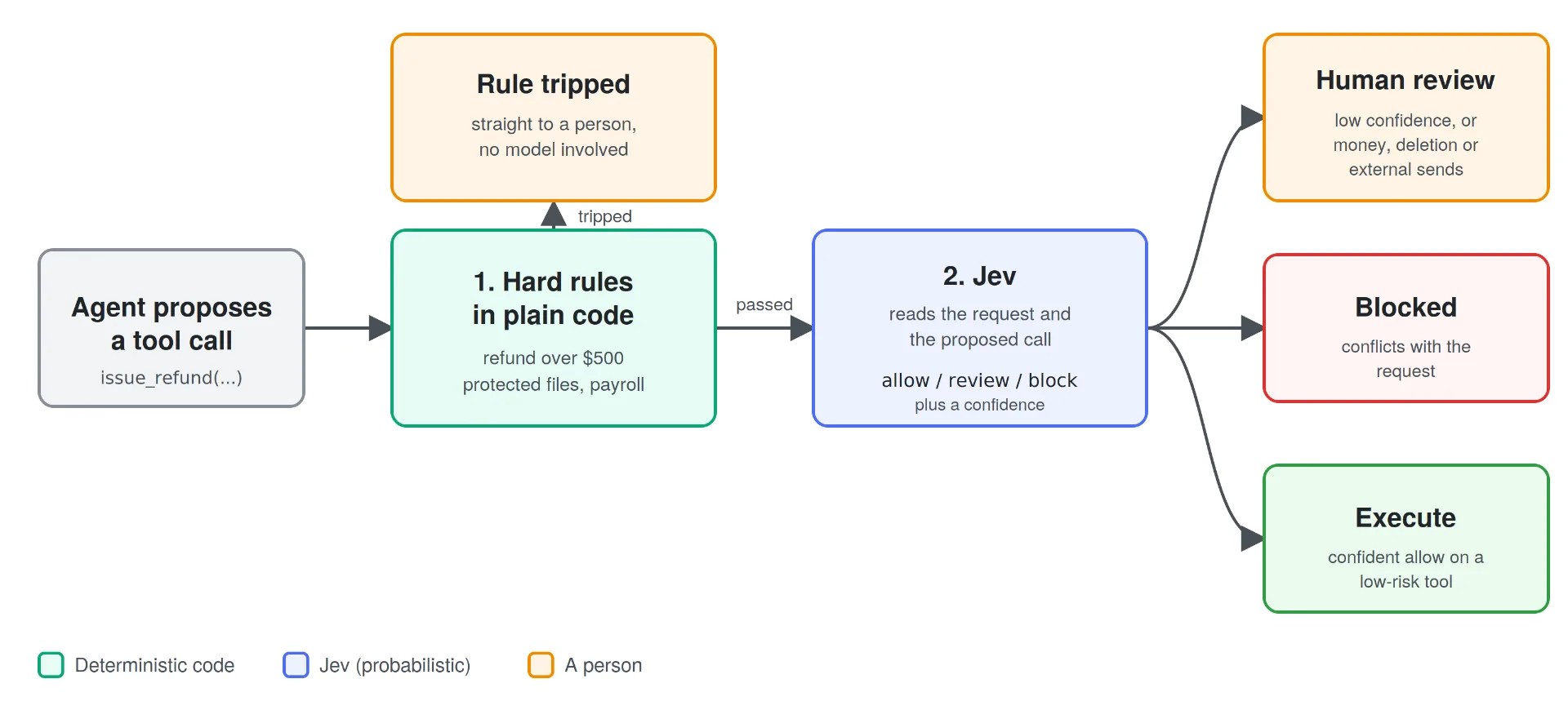
The rapid evolution of Large Language Models (LLMs) has shifted the industry focus from simple chatbots to autonomous agents—systems capable of wielding tools to execute real-world tasks. Yet, as these agents gain the ability to move payments, send emails, and modify production data, a glaring safety gap has emerged. When an agent hallucinates a text summary, the cost is a momentary frustration. When an agent hallucinates a tool argument, the cost is a business-critical error.
This tension has prompted a new architectural approach: the "System One" model. Spearheaded by the launch of TypeSafe’s Jev model, this paradigm treats decision-making as a discrete, structured task distinct from the open-ended generation of traditional chat models. By inserting a specialized, low-latency, and type-safe judgment layer between an agent’s intent and an application’s execution, developers are finally building the guardrails necessary for production-grade AI.
The Fragility of Agentic Tool Use
For most developers, the initial experience with AI agents is one of forgiving experimentation. If a model generates a clumsy sentence, a user simply clicks "retry." However, the stakes change dramatically the moment an agent is granted write access to a database or a payment gateway.
Consider a mundane, yet catastrophic, failure mode: a customer requests a refund for a $12 double-charge. The AI agent correctly identifies the refund tool and the customer ID. It prepares a payload: refund(amount_cents=1200). To the developer’s eye, the schema is valid, the types match, and the logic seems sound. The catastrophe is hidden in the nuance: the agent, confused by the conversion between dollars and cents, has inadvertently doubled the unit, resulting in a refund of $1,200 instead of $12.
This failure is particularly insidious because it isn’t a "dramatic" breakdown. The system doesn’t crash; it performs a perfectly valid, perfectly wrong action. Standard guardrails, such as a hard $500 cap, fail to protect against "sub-threshold" errors—like the agent refunding $120 instead of $12. This class of semantic, rather than structural, failure is where traditional validation logic ends and the need for intelligent, context-aware guardrails begins.
The Rise of the System One Model
On September 15, TypeSafe introduced Jev, a model designed specifically for the "System One" architecture. Borrowing from Daniel Kahneman’s psychology, where System One represents fast, automatic, and instinctive thought, Jev is built for rapid, structured decision-making rather than long-form content generation.
Unlike traditional LLMs that output streams of text, Jev is designed to consume application state and a constrained question, returning a typed, probabilistic answer. It operates as a high-fidelity filter. By restricting the output space to defined types—such as an "allow," "review," or "block" decision—Jev sidesteps the ambiguity of natural language, providing software systems with the deterministic inputs they need to route sensitive actions.
Why Not Just Another LLM?
Critics might argue that a standard, high-performing LLM could perform this same validation task. While theoretically true, the practical trade-offs are significant. Using a general-purpose, heavy LLM as a guardrail adds excessive latency, increases the risk of "prompt drift," and forces the application to parse prose into actionable data. By contrast, Jev focuses on a narrower, more reliable lane: providing a verdict on whether an action aligns with the user’s intent.

Engineering a Safety-First Pipeline
The integration of Jev—or any similar decision-making model—into an agentic stack requires a rigorous separation of concerns. A common pitfall is giving the model too much authority, effectively replacing one probabilistic agent with another.
A Layered Defense Strategy
Effective safety architecture relies on a hierarchy of decision-making:
- Deterministic Hard Rules (The "Code" Layer): Before any AI is consulted, standard programming logic should enforce absolute boundaries. If a refund exceeds $500, or if a user attempts to delete a production database, the application should block the action immediately. No model should be allowed to override these constraints.
- Semantic Judgment (The "Jev" Layer): Once an action passes the hard rules, it enters the Jev layer. Here, the model assesses the "semantic fitness" of the request. Does the tool call match the user’s intent? Is the context consistent? Does the request contain a missing prerequisite?
- Human-in-the-Loop (The "Review" Layer): If Jev returns a low-confidence score, or if the action is inherently high-stakes, the system should trigger a mandatory human review.
This layered approach ensures that the model is not acting as the sole arbiter of truth, but rather as an intelligent assistant providing a probabilistic recommendation within a strictly defined sandbox.
Semantic Failures: The "Boring" Edge Cases
The most dangerous bugs in AI agents are not the ones that cause the system to fail, but the ones that allow it to continue functioning in a state of misunderstanding.
- The Scope Creep: An agent tasked with notifying suppliers about Q3 invoices might decide, on its own, to email 214 external contacts. While the tool call is technically valid, the "blast radius" is massive. A guardrail must distinguish between a low-risk documentation search and a high-risk mass communication.
- The Missing Prerequisite: An agent tasked with deleting a temporary file might correctly identify the target but fail to verify if the preceding upload actually succeeded. Without a semantic check, the agent proceeds blindly, potentially deleting a file that was never successfully backed up.
- The Malicious Attachment: An agent instructed to "send the pricing sheet" might select the wrong file—perhaps a confidential internal document—if the file naming conventions are similar. Schema validation cannot catch this; only a model with contextual awareness of the "meaning" of the file can intervene.
The Limits of Typed Output
It is vital to temper the enthusiasm surrounding "typed" AI models. TypeSafe and similar providers emphasize that Jev avoids certain classes of hallucinations because the output is structurally constrained. While this is a significant step forward for system stability, it is not a panacea.
Typed output guarantees the shape of the answer, not the correctness of the logic. A model can return a perfectly formatted "decision": "allow" when it should have returned "decision": "block". This is a failure of judgment, not a failure of syntax. Developers must treat these models as components of a larger, defensive system rather than a "set-and-forget" security solution.
Implications for the Future of Agentic Development
The emergence of Jev and the "System One" model represents a maturation of the AI industry. We are moving away from the "black box" era, where agents were treated as monolithic entities, toward a modular, systems-engineering approach.
Key Takeaways for Developers:
- Divide and Conquer: Do not rely on a single agent to plan and execute. Use separate, specialized models for decision-making.
- Log and Learn: Start with conservative thresholds. Use logging to compare model "suggestions" against human actions, and only relax constraints once the model has proven its reliability on real-world traffic.
- Ownership of Policy: The application, not the model, must own the policy. The model should merely be a tool used to help the application enforce that policy.
As agents continue to proliferate across enterprise environments, the ability to safely and predictably manage their "will" will become the most important skill in a developer’s arsenal. By treating these models as picky, narrow-minded gatekeepers rather than autonomous brains, we can build agents that are not only powerful but, more importantly, trustworthy. The goal is not to create an AI that can do everything, but to build a system that knows exactly when to ask a human for help.


 Dwi Wanna

 Nila Kartika Wati
 Raul Delapena Setiawan

 Muslim
 Nana Wu
