
 Raul Delapena Setiawan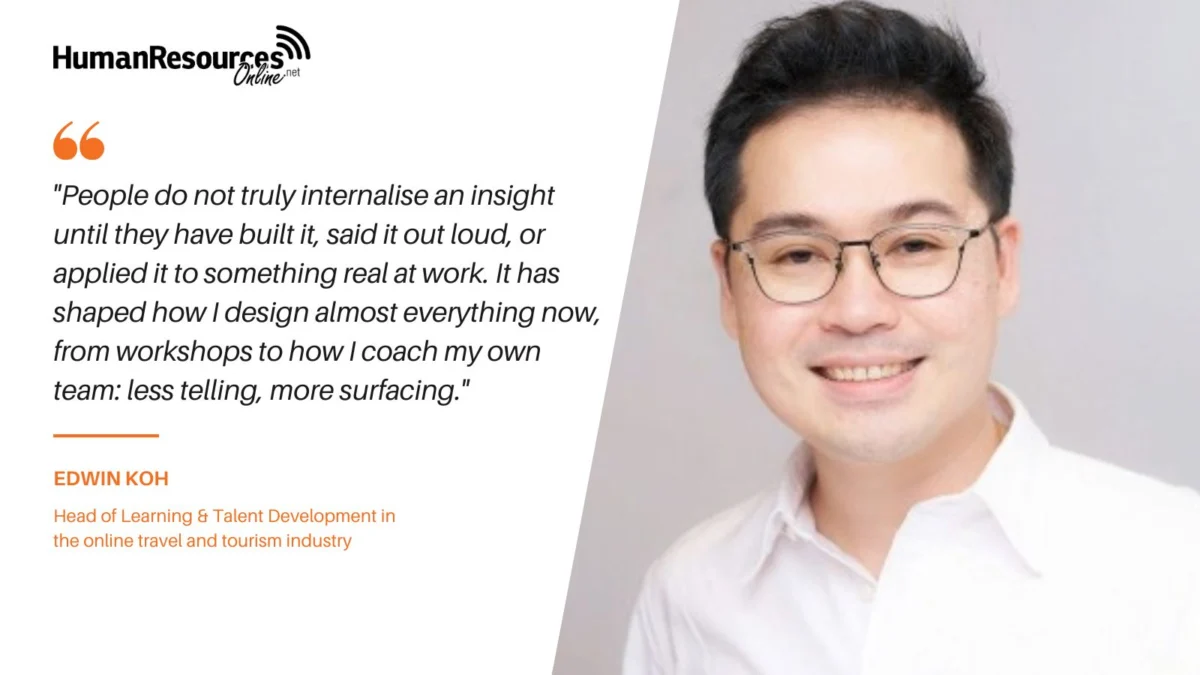
In the rapidly evolving landscape of corporate growth, the traditional classroom model of "sit and listen" is increasingly viewed as an artifact of the past. As organizations grapple with digital transformation and the integration of Artificial Intelligence (AI), the focus has shifted from the mere transmission of information to the active construction of knowledge.
At the forefront of this shift is Edwin Koh, a seasoned leader in organizational development with over a decade of experience across Asia, Europe, and the United States. Currently serving as the Head of Learning & Talent Development in the highly dynamic online travel and tourism industry, Koh is championing a philosophy that challenges the status quo of Human Resources: "Learning sticks when it is constructed, not consumed."
Main Facts: The Constructivist Approach to Modern L&D
The core of Edwin Koh’s methodology lies in constructivism—a theory suggesting that learners are not passive recipients of information but active creators of their own knowledge. In a corporate environment, this translates to workshops where participants build physical models, engage in "reverse mentoring," and apply new technologies like AI to real-world business problems immediately.
Koh’s approach is defined by several key pillars:
- Hands-on Application: Insights are only internalized when they are built, spoken aloud, or applied to professional challenges.
- Psychological Safety in Innovation: Especially regarding AI, employees must feel safe to experiment and fail before they can successfully adopt new tools.
- The Power of Unlearning: Leadership growth is as much about shedding outdated habits as it is about acquiring new skills.
- Multi-disciplinary Insight: Skills from outside the HR sphere—such as equity investing and digital content creation—are vital for sharpening business acumen.
By moving away from "telling" and toward "surfacing," Koh is redefining the role of a Learning and Development (L&D) leader as an architect of experiences rather than a distributor of content.
Chronology: From Organizational Development to AI Integration
Edwin Koh’s journey through the ranks of talent development has been marked by a consistent curiosity about how humans actually change their behavior. With more than ten years of experience, his career spans diverse geographical markets, providing him with a global perspective on how culture influences learning.
The Formative Years
Early in his career, Koh focused on the foundational elements of organizational development. Working across different continents taught him that while business goals might be universal, the methods of engagement must be localized. This period was characterized by a realization that "neat models" and polished presentations often failed to result in lasting behavioral change once the workshop ended.
The Shift to Constructivism
The mid-point of his career saw a pivot toward more tactile and psychological learning methods. He became a proponent of LEGO® Serious Play®, a facilitated meeting, communication, and problem-solving process where participants are led through a series of questions, probing deeper into the subject. Each participant builds their own 3D LEGO® model in response to the facilitator’s questions using specially selected LEGO® elements. This was a turning point for Koh, confirming that the "surprise" on a leader’s face when their hands express an idea their mouth hasn’t yet articulated is the truest form of a breakthrough.
The Digital and AI Era
In his current role within the travel and tourism sector—an industry that is notoriously volatile and tech-heavy—Koh has integrated AI into his L&D strategy. He views AI not as a replacement for human intellect but as a sandbox for reimagining workflows. His current focus is helping teams move past the "fear" of AI by encouraging them to test how these tools can create innovation breakthroughs in their daily business operations.
Supporting Data: The Science Behind "Learning by Doing"
Koh’s philosophy is backed by significant educational and neurological research. The "70-20-10" model, a widely accepted formula in the training industry, suggests that individuals obtain 70% of their knowledge from job-related experiences, 20% from interactions with others, and only 10% from formal educational events.
The Forgetting Curve
Research by Hermann Ebbinghaus on the "Forgetting Curve" shows that humans forget approximately 50% of new information within an hour of learning it, and 70% within 24 hours, unless that information is actively applied. Koh’s "built, not consumed" mantra directly combats this by ensuring that the "doing" happens concurrently with the "learning."
The Economic Impact of Reskilling
According to the World Economic Forum, more than 50% of all employees worldwide will need reskilling by 2025 due to the adoption of technology. However, traditional training programs often see a low ROI because they lack the "application" phase that Koh emphasizes. Organizations that adopt experiential learning—like the constructivist methods Koh employs—report a 25% higher increase in employee performance compared to those using traditional methods.
AI and Productivity
A recent study by Harvard Business School researchers found that when workers use AI for tasks within its "frontier" (its capabilities), they complete 12.2% more tasks on average and finish them 25.1% faster. Koh’s insistence on "safely testing" AI aligns with these findings, suggesting that the bottleneck to productivity isn’t the technology itself, but the human hesitation to engage with it.
Official Responses: Insights from the Interview
In a recent dialogue with Emily Chong-Gupta, Edwin Koh provided a deeper look into the personal and professional experiences that have shaped his worldview.
On the Principle of Constructivism
When asked which L&D principle has influenced him most, Koh was unequivocal: "Learning sticks when it is constructed, not consumed." He explained that this insight has changed how he coaches his own team. "It is less telling, more surfacing," he noted. He recounted an instance where a senior leader, through building a physical model, surfaced insights that the entire room had missed. "That is the moment I design for now… the surprise on someone’s face when their hands say something their mouth has not yet caught up to."
On AI Adoption
Koh believes that the key to AI adoption is not a top-down mandate but a bottom-up exploration. "People need to actively think about how workflows can be reimagined with AI to achieve greater effectiveness and efficiency," he stated. For Koh, AI is a tool for innovation breakthroughs, but it requires a mindset shift where employees are encouraged to rethink the very nature of their business.
On the Importance of "Unlearning"
Reflecting on his own mentorship, Koh shared a lesson from a senior leader: "When you reach a certain level, your ability to unlearn is just as important as your ability to learn." This has led him to embrace reverse mentoring, where he learns from younger talents. These new entrants to the workforce have taught him the value of "unapologetic authenticity," reminding him that leadership is not about conforming to a pre-set mold but about showing up as oneself.
On Diverse Skill Sets
Interestingly, Koh credits his acumen in risk-reading and decision-making to equity investing rather than traditional leadership courses. "I am still surprised by how much of it is really about psychology rather than numbers and spreadsheets," he said. This outside interest, combined with his work as a content creator for his LinkedIn newsletter, Asian Leadership Lounge, allows him to distill complex ideas into digestible, engaging content—a skill he deems essential in the age of the "attention economy."
Implications: The Future of Talent Development
The insights provided by Edwin Koh have profound implications for the future of Human Resources and corporate leadership.
1. The Death of the "Sage on the Stage"
The era of the expert lecturer is ending. L&D professionals must transition into "experience designers" and "facilitators of discovery." The goal is no longer to provide the answer but to create the environment where the employee can find the answer themselves.
2. Psychological Safety as a Prerequisite for Tech Adoption
As AI continues to disrupt industries, Koh’s focus on "safe testing" highlights a critical need: psychological safety. If employees fear that experimenting with AI will lead to errors that are punished, or that the AI will eventually replace them, they will not engage with it. Organizations must create "sandbox" environments where experimentation is rewarded.
3. Authenticity over Conformity
Koh’s embrace of reverse mentoring and authenticity suggests a shift in leadership paradigms. The "corporate mask" is becoming a liability. Future leaders will be those who can remain authentic and encourage their teams to do the same, fostering a culture of trust that is essential for navigating uncertainty.
4. Holistic Business Acumen
Koh’s passion for equity investing and content creation serves as a blueprint for the modern professional. The silos between "work skills" and "personal interests" are blurring. Understanding global economy trends and psychological triggers in investing can make an HR leader more effective at the boardroom table.
5. The "Doing" Motto
Koh’s final takeaway serves as a concise manifesto for the modern workforce: "Growth happens in the doing, not the telling." For organizations looking to survive the next decade of disruption, the message is clear: stop talking about change and start building the tools to achieve it.
Conclusion
Edwin Koh’s approach to learning and talent development is a call to action for a more tactile, psychological, and action-oriented corporate culture. By prioritizing the "construction" of knowledge over its "consumption," he is helping to build teams that are not only more skilled but more resilient and adaptable to the technological shifts of the 21st century. As the industry watches the travel and tourism sector navigate its recovery and transformation, Koh’s "learning by doing" philosophy may well become the standard for excellence in global talent development.


 Pevita Pearce
 Suro Senen
 Laily UPN
 Iffa Jayyana
 Rifan Muazin

 Lina Hope
 Lina Irawan