
 Jia Lissa
In the rapidly evolving landscape of 2026, the divide between a promising AI prototype and a scalable, production-ready product has become the defining challenge of the tech industry. As companies scramble to integrate generative AI and large language models (LLMs) into their workflows, they are discovering a fundamental truth: the hurdle is no longer a research problem—it is a product problem. This is where the AI Product Manager (PM) enters the fold, acting as the critical bridge between technical potential and user-centric utility.
Unlike traditional product management, which relies on the stability of deterministic software, the AI PM must manage a landscape defined by volatility. AI systems operate in a probabilistic world where outputs can hallucinate, drift, or vary wildly across different user cohorts. Navigating this requires a unique synthesis of skills: machine learning trade-offs, compute economics, evaluation frameworks, and the ability to translate technical risk for non-technical stakeholders.
The Evolution of the Role: Bridging the Gap
AI is fundamentally reshaping how products are conceptualized, built, and measured. In the past, a product manager’s success was defined by feature velocity and user adoption. Today, the AI PM’s success is measured by the stability, cost-efficiency, and reliability of the model’s performance.
The role is not merely a technical one; it is a discipline of risk management. Because AI outputs are context-dependent, the PM must manage expectations, design for graceful degradation, and ensure that the "black box" of the model aligns with the transparency required by modern regulatory frameworks.
Chronology of Mastery: The Four-Phase Roadmap
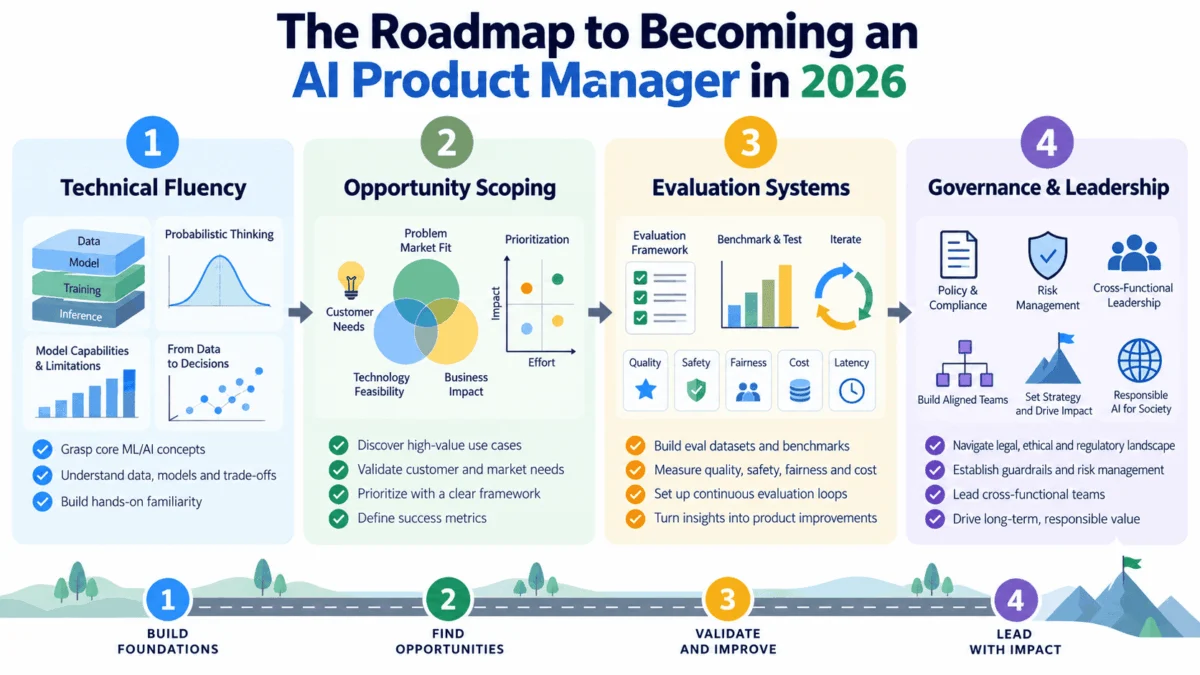
To transition into this high-demand role, one must move through a structured developmental path. This roadmap, spanning from technical fluency to organizational leadership, provides the framework necessary to master the "probabilistic mindset."
Phase 1: Developing Technical Fluency and Probabilistic Thinking
The first step is a psychological shift. Traditional software follows a "If A, then B" logic. AI systems function on probabilities. The aspiring AI PM must stop viewing model errors as bugs and start viewing them as the inherent terrain of the product.
- Mastering the Architecture: You don’t need to be a coding wizard, but you must understand the "why" behind the "what." This includes understanding the trade-offs between RAG (Retrieval-Augmented Generation), fine-tuning, and agentic workflows.
- The Golden Triangle of Constraints: Every product decision will eventually clash with the tension between latency, cost, and accuracy. Understanding token consumption, Time-To-First-Token (TTFT), and context-window limitations is the bread and butter of daily product planning.
- Strategic Resources: Engage with materials like Jay Alammar’s Hands-On Large Language Models and the fast.ai Practical Deep Learning course to build an intuition for how these systems are constructed.
Phase 2: Opportunity Discovery and Feasibility Scoping
Not every problem needs an AI solution. The "AI Product Canvas" is an essential tool here, allowing managers to plot tasks based on the value of success versus the risk of failure.
- The Build vs. Buy vs. Assemble Decision: This is as much a financial decision as it is a technical one. Can your gross margin survive the inference costs at scale? An AI PM must be adept at modeling the unit economics of compute. If your product relies on an expensive API call per user query, your business model will collapse as your user base grows.
- Market Context: Review the a16z AI Canon to understand the broader market dynamics. Successful PMs in this space are those who can perform a "build vs. buy" analysis with a clear eye on the long-term cost of proprietary versus open-source model integration.
Phase 3: UX Design and Eval-Driven Development
This is the phase where AI product management diverges most sharply from traditional methodologies. In a world of non-deterministic outputs, you cannot rely on binary "pass/fail" testing.
- Designing for Trust: How do you display uncertainty to a user? How do you design an interface that remains useful even when the model is wrong?
- Eval-Driven Development: This is the new standard. You must implement robust evaluation pipelines using tools like RAGAS, Braintrust, or PromptFoo.
- Red-Teaming as a Standard: Adversarial testing—simulating prompt injections and boundary-probing—must be a pre-launch requirement, not a post-mortem exercise. If you are not breaking your own product before the public does, you are not ready to ship.
Phase 4: Governance, Compliance, and Organizational Leadership
As you scale, the role shifts from individual contribution to orchestration. You are no longer just building; you are navigating the minefield of global regulations.
- Regulatory Literacy: With the EU AI Act and evolving U.S. executive orders, the AI PM must act as a liaison between legal teams and engineering departments. Understanding data residency, privacy, and liability is no longer optional.
- Cross-Functional Orchestration: You must hold the thread between research engineers (who focus on benchmarks), legal counsel (who focus on liability), and executives (who focus on revenue). The ability to maintain fidelity in translation across these groups is the hallmark of a senior AI product leader.
Supporting Data and Economic Realities
The shift toward AI-integrated products has created a volatile economic environment. According to industry benchmarks, the cost of inference is becoming the primary driver of operational expenses. Organizations that fail to optimize their "token economics" early in the development lifecycle face an "AI cliff"—where the costs of scaling significantly outpace the marginal revenue gained from the feature.
Furthermore, empirical data suggests that products incorporating "Human-in-the-Loop" (HITL) checkpoints show a 40% higher user retention rate in enterprise settings, as these checkpoints serve as a trust-building mechanism, reassuring users that the AI is acting as an assistant rather than an autonomous, unmonitored agent.
Official Perspectives: The Industry Consensus
Industry experts and educators like Vinod Chugani emphasize that the "AI PM" role is still being defined, providing early adopters with a rare opportunity to set the standard. The consensus among top-tier tech firms is that the most successful PMs are those who demonstrate intellectual honesty about uncertainty.
"Don’t oversell the model," Chugani notes. "Build fallback systems. Treat evaluation as core infrastructure. If you treat AI as a magic box, you will eventually be replaced by someone who treats it as a complex, manageable piece of software."
Implications for the Future
The implications for the workforce are profound. We are seeing a move away from the "generalist" PM toward a more technical, analytical breed of product leader. The future of product development will be dominated by those who can successfully balance:
- Technical Debt vs. AI Drift: Ensuring the system doesn’t degrade over time.
- Privacy vs. Personalization: Managing the inherent conflict between model training and user data security.
- Speed vs. Safety: Accelerating feature delivery while maintaining the rigorous guardrails demanded by regulators and customers alike.
Conclusion
The AI Product Manager is the architect of the probabilistic future. While the tools, models, and regulatory landscape will shift with dizzying speed, the underlying discipline remains constant: scope with rigor, measure what matters, and cultivate trust through transparent, evaluative processes.
As we move toward 2026 and beyond, the most successful leaders will not be those who build the most complex models, but those who build the most reliable products. In the age of AI, reliability is the ultimate competitive advantage. By adhering to the four-phase roadmap—from developing a probabilistic mindset to mastering organizational governance—aspiring PMs can position themselves at the center of the next technological revolution, shaping the way human beings interact with machine intelligence.

 Laily UPN

 Iffa Jayyana


 Suro Senen

 Pevita Pearce
 Basiran

 Azzam Bilal Chamdy

 Nila Kartika Wati
