
 Nila Kartika Wati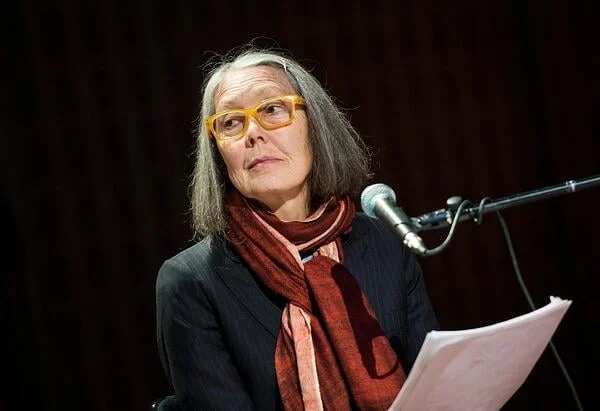
In a landmark decision that celebrates the fusion of ancient erudition and avant-garde experimentation, the Swedish Academy has awarded the 2026 Nobel Prize in Literature to Anne Carson. A poet, essayist, translator, and classicist, Carson was recognized for her "bold and inventive oeuvre that, in playful dialogue with the classical tradition, has created new forms for contemporary literature."
The announcement, delivered on a crisp Thursday in Stockholm, cements Carson’s position as one of the most influential literary figures of the 21st century. By bridging the gap between the rigid structures of antiquity and the fluid, often chaotic landscape of modern consciousness, Carson has carved out a unique space in the literary canon—one that refuses to be categorized by genre, medium, or period.
The Announcement: A Voice from the Wind
The tradition of the Nobel Prize often involves a frantic, high-stakes search for the laureate, but the notification of Anne Carson was defined by a characteristically serene detachment. Ingrid Carlberg, the permanent secretary of the Swedish Academy, revealed that when she finally reached the poet by phone, Carson was in her adopted home of Iceland.
"All she had time to tell me was that she is for the moment in Iceland, where she’s listening to the wind," Carlberg relayed to an audience of international press.
Carson’s own reaction to the accolade was marked by her signature dry wit and profound humility. In a brief exchange with local media, she described the Nobel notification as "rather halting." When pressed for a formal statement or a reflection on the gravity of the prize, she remained steadfastly iconoclastic. "I think they’re all crazy," she said of the Swedish Academy. "They have the usual questions, and I have no answers."
This response is, perhaps, the most authentic testament to her career. For decades, Carson has consistently interrogated the impossibility of definitive answers, preferring instead to dwell in the "shimmering, elusive" spaces where language fails and art begins.
Chronology: A Life in Translation and Invention
Born in Toronto in 1950, Carson’s trajectory was never that of a conventional poet. Her early intellectual life was defined by a rigorous engagement with the ancient world, leading to a doctorate in Classics from the University of Toronto in 1981. This academic foundation would become the bedrock of her creative output.
The Academic Years (1981–2010s)
Carson’s career as an educator took her to some of the most prestigious institutions across North America. From the University of Calgary and McGill University to the University of Michigan, her pedagogical style was as unconventional as her writing.
Perhaps her most storied academic tenure occurred at New York University, where she served as the Distinguished Writer in Residence for 13 years. It was here that she, alongside her romantic partner and collaborator, Robert Currie, developed the legendary graduate workshop "Egocircus." The course became a rite of passage for M.F.A. students, offering them a rare, hands-on apprenticeship in the collaborative process of artistic creation.
The Breakthroughs
Carson’s rise to global prominence was punctuated by several seminal works:
- 1998: Autobiography of Red: A novel in verse that reimagined the myth of the monster Geryon as a modern, vulnerable young man. The book became a cultural phenomenon, selling nearly 100,000 copies in the U.S. alone and fundamentally altering the perception of the "verse novel."
- The Translation Canon: Her translations of Sophocles’ Electra and Antigone, as well as Euripides’ Bakkhai, have been praised not merely for their accuracy, but for their visceral, contemporary energy. She strips away the "dust of the museum" to reveal the raw, often violent humanity of the Greeks.
- The Essayist: Works like Plainwater and Glass, Irony and God solidified her reputation as an essayist capable of weaving philosophy, biography, and poetry into a single, seamless tapestry.
Supporting Data: The Intersection of Philology and Poetry
Anders Olsson, chair of the Nobel literature committee, offered the most succinct summary of Carson’s work: "Almost all her literary production has centered upon the intersection between the philologist’s obsession with words and the poet’s desire for new meaning."
The "Carsonesque" Style
Critics have long struggled to classify Carson’s output. Her writing frequently utilizes "found" texts, photographs, and experimental typography. By juxtaposing the precision of a classical scholar with the wild, subjective impulses of a poet, she challenges the reader to participate in the act of creation.
The Swedish Academy’s citation specifically highlights "inventive oeuvre." This refers to her refusal to treat the past as a finished product. For Carson, a myth is not a static story; it is a living, breathing mechanism that can be dismantled and reassembled to explain the modern condition. Whether it is Geryon’s loneliness or Antigone’s defiance, Carson finds the contemporary pulse within the ancient heart.
Official Responses: A Global Celebration
The literary world’s reaction to the news has been one of universal acclaim.
Deborah Landau, director of the NYU Creative Writing Program, expressed the sentiment of many who have studied under or worked with Carson. "The NYU Creative Writing Program was incredibly fortunate to have had the singularly brilliant and visionary writer Anne Carson on faculty," Landau wrote in an official release. "She pushed our students to think beyond the page, to see the text as an object of physical, visual, and sonic inquiry."
Academic institutions across the globe have echoed this sentiment. From the University of Toronto to Princeton, the consensus is that the Nobel Prize has finally recognized an artist who has been "writing the future of the past."
Social media and literary journals have erupted with tributes, with many younger poets citing Carson’s "Autobiography of Red" as the book that convinced them poetry could be both intellectually rigorous and deeply, heart-wrenchingly accessible.
Implications: What the 2026 Nobel Means for Literature
The awarding of the Nobel Prize to Anne Carson signals a shift in the Academy’s traditional preferences. While the Nobel has often favored novelists who work within traditional narrative structures, the choice of Carson—a genre-defying polymath—suggests an embrace of hybridity.
Redefining the "Literary"
Carson’s win validates the work of writers who exist in the margins of traditional categories. By honoring an author who regularly incorporates classical translation into her creative process, the Academy is acknowledging that the "contemporary" is not a rupture from the past, but an evolution of it.
The Future of Poetry
In an era where attention spans are shortening and visual media dominates, Carson’s work offers a different path. Her books—often designed as visual objects—demand a tactile engagement. Her win may well trigger a renewed interest in "difficult" literature, proving that readers are still hungry for complexity, beauty, and the "playful dialogue" with history that she has championed for over four decades.
A Life in Iceland
As Carson remains in Iceland, the "wind" she is listening to serves as a metaphor for her life’s work: something intangible, powerful, and ever-moving. She has never been one to seek the spotlight, and this latest honor, while deserved, seems unlikely to change her fundamental approach to the craft.
She will likely continue to translate the un-translatable, to write the un-writable, and to find, in the intersections of the ancient and the modern, the quiet truths that define our humanity. The 2026 Nobel Prize does not define Anne Carson; rather, it acknowledges a body of work that has already, in its own silent and windswept way, defined the literature of our time.


 Sagoh
Sagoh
 Jia Lissa
 Laily UPN
 Iffa Jayyana
 Rifan Muazin
 Suro Senen
 Lina Hope
 Lina Irawan