
 Asep Darmawan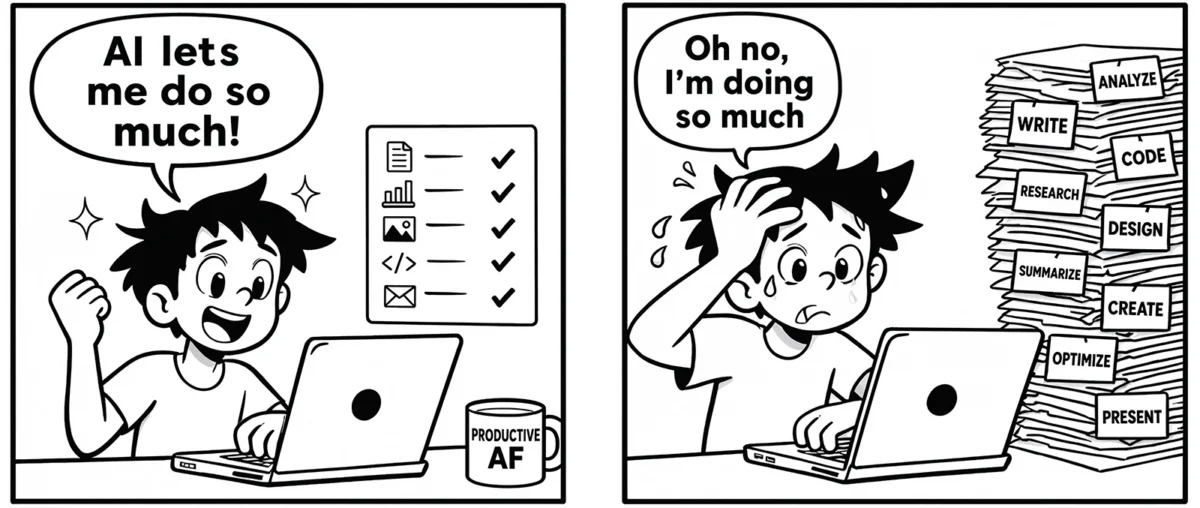
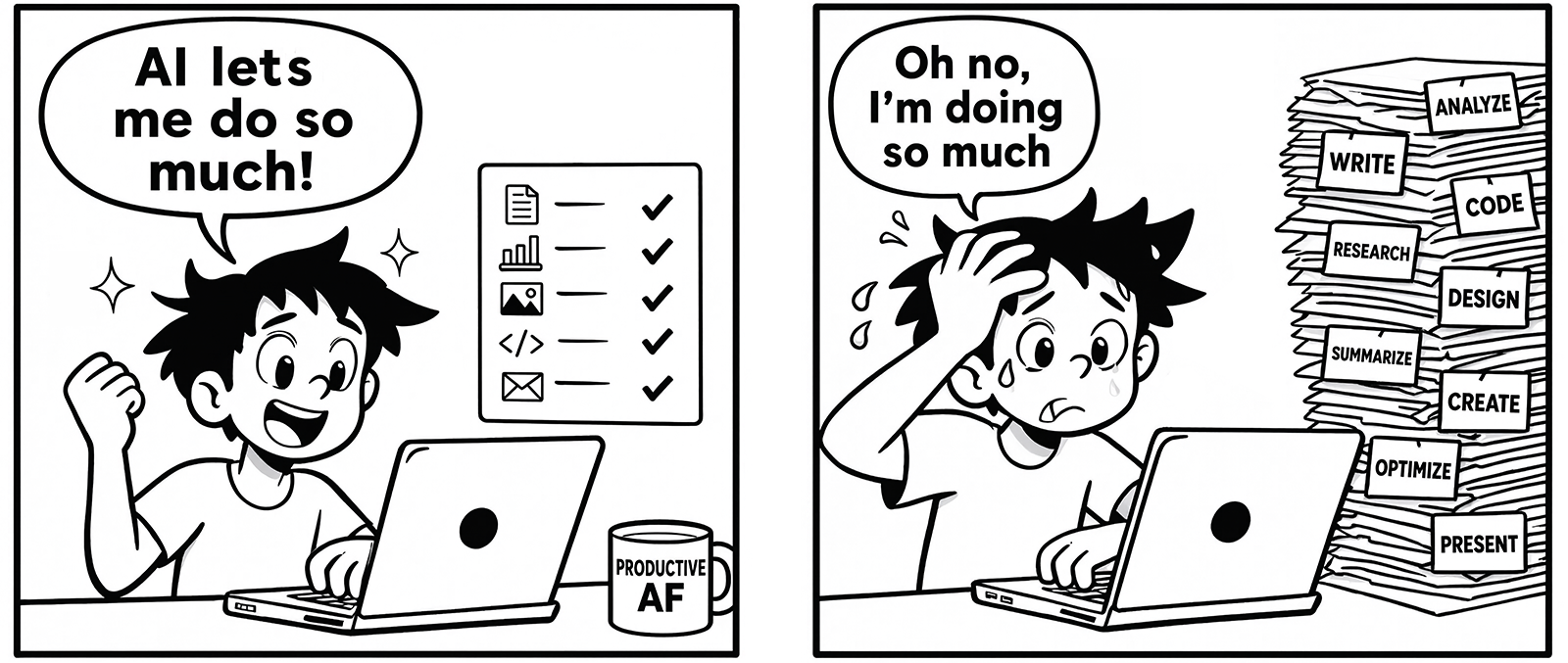
The current zeitgeist in the technology sector is dominated by a seductive, albeit dangerous, narrative: AI is the great equalizer. With tools like Claude Code for developers and Figma Make for designers, the barrier to entry for cross-disciplinary work has effectively vanished. A product manager can now whip up a high-fidelity interface; a junior developer can architect complex backend logic.
However, a growing chorus of industry veterans is warning that we are misinterpreting the AI revolution. The prevailing sentiment—that AI allows us to do everyone else’s job—is not a path to productivity, but a recipe for mediocrity. The more urgent question for the modern professional is not "what other jobs can I take on?" but rather, "how do I use AI to make the work I already excel at reach further?"
The "Mediocre Man" Trap: Understanding the Illusion of Competence
To understand the current shift, one must look at the nature of artificial intelligence as an agent of imitation. When a non-developer instructs an AI to write a large-scale application, they are essentially playing a "developer on TV." The code may run, and the functionality may appear sound, but the nuance—the structural integrity, the long-term maintainability, and the edge-case handling—is often absent.
Conversely, when a developer generates a layout using generative design tools, they lack the years of subconscious pattern recognition that a seasoned designer possesses. They can move pixels, but they cannot inherently "see" the hierarchy or the intent behind a design system.
This "do it all yourself" approach spreads talent thin, diluting the quality of output across multiple domains. In the industry, this is being colloquially termed the "Mediocre Man" syndrome: the ability to do everything poorly, rather than one thing exceptionally. The danger lies in mistaking AI-assisted output for professional-grade expertise. While the tool provides the syntax of a profession, it cannot replace the intuition developed over decades of trial and error.
A Historical Perspective: From the Drawing Board to the Boardroom
The struggle for professional identity is not new. Years ago, at Yahoo!, design leadership faced a similar crisis of relevance. Designers were desperate for a "seat at the table," often trying to mimic the language and behaviors of business executives to gain influence.
The internal initiative "Board to Board" sought to pivot this strategy. Instead of designers trying to be business leaders, the program encouraged them to double down on their unique professional contributions: pattern recognition, spatial reasoning, and visual communication that clarifies complex strategy.
The lesson was clear: The most effective professionals are not those who attempt to become generalists, but those who leverage their specific, hard-won expertise to influence the broader organization. This historical precedent is directly applicable to the AI era. We must resist the urge to use AI to become "passable" versions of other professionals and instead use it to amplify our own unique value proposition.
The Mechanics of Collaborative Steering
If we are to avoid the trap of mediocre generalization, we must adopt a new framework for interaction with AI. This is where the concept of "collaborative steering" emerges as a critical paradigm.
Collaborative steering is a methodology wherein experts encode their deep-seated knowledge into a shared context that both human team members and AI agents can interpret and apply. It is the antithesis of the "do-it-all-yourself" approach. Instead of a designer manually creating every layout, they encode their design system—the grid, the typography, the motion rules, and the color systems—into a set of instructions that act as the "guardrails" for AI agents.
Encoding Intent
In practice, this turns design and development "intent" into living text files or structured data that guide AI agents throughout the software lifecycle. When a developer or a product manager uses an agent to build a feature, that agent is not acting in a vacuum. It is constrained and empowered by the "intent" encoded by the domain expert.
This creates a scalability loop:
- Domain Expertise: The expert defines the rules of the road (e.g., brand guidelines, coding standards).
- Encoding: These rules are formalized into a machine-readable format.
- Distribution: AI agents apply these rules consistently across multiple projects, regardless of who is issuing the prompt.
- Consistency: The grid remains the grid, and the code remains clean, even as the scale of output increases by orders of magnitude.
Data-Driven Efficiency vs. Expert Precision
While the market is flooded with data suggesting that AI increases "velocity," industry leaders are increasingly focusing on the quality of that velocity. The current trend shows that simply feeding an AI model "everything" about a project often leads to "hallucinations" or bloated, unusable outputs.
Precision is the new skill of the AI age. The experts who are succeeding are those who can identify the "three to five things that actually matter." In a complex software build, an expert knows which constraints are non-negotiable and which are stylistic choices. By feeding the AI only these high-value constraints, the professional maintains control over the outcome while offloading the grunt work.
This represents a departure from traditional "prompt engineering," which often focuses on lengthy, verbose instructions. Instead, we are moving toward "intent-based engineering," where the expert provides a refined set of foundational truths.
Implications for the Future of Work
The implications of this shift are profound for both organizational structure and individual career paths:
- The Death of the Handoff: As collaborative steering becomes the norm, the traditional, friction-heavy handoff between design and development disappears. The "intent" is already embedded in the codebase, making the separation between design and build more fluid but also more rigorous.
- The Rise of the "Architect-Expert": The most valuable employees in the next five years will not be those who can do the most coding or the most designing. They will be the experts who can translate their intuition into clear, encoded instructions for AI. They are the architects of the systems that the agents inhabit.
- Organizational Resilience: Companies that adopt these methods will find themselves less dependent on the "rockstar" individual contributor who holds all the knowledge in their head. Instead, that knowledge is codified, distributed, and improved upon by the entire team using AI.
Conclusion: Scaling the Uniquely Human
The AI revolution is not an invitation to abandon your craft in favor of a generalist’s existence. It is an opportunity to amplify the things you are uniquely wired for.
When you spend your time trying to be a "passable" developer or designer, you are competing against a machine that will inevitably be better than you. But when you spend your time defining the rules, the intent, and the standards for your profession, you are using the machine as an extension of your own professional legacy.
Precision is the ultimate competitive advantage. By encoding our expertise rather than diluting our roles, we can ensure that our work reaches further, lasts longer, and maintains the integrity that only human experience can provide. The goal of AI is not to make us all the same; it is to ensure that the best of what we do can be scaled, repeated, and perfected, leaving the mediocrity to those who still believe that doing "everything" is the same as doing "anything" well.

 Neng Nana
 Dwi Wanna

 Muslim
 Nana Wu

 Rifan Muazin
 Asro
Asro