
 Azzam Bilal Chamdy
The past few years have been nothing short of a financial whirlwind for long-term investors. If you have been steadily funneling your savings into broad-market index funds, your portfolio likely looks vastly different today than it did during the height of the COVID-19 pandemic. By some metrics, the S&P 500 has surged roughly 57% in just two years, with its value more than doubling over the past five.
For many, this period of explosive growth has turned retirement projections on their head. Investors who felt they were only halfway to their "Financial Independence" finish line in 2020 may find themselves suddenly—and perhaps unexpectedly—standing at the threshold of retirement. While this wealth effect creates a sense of euphoria, it also invites a persistent, gnawing question: Is this growth grounded in economic reality, or are we witnessing a grand-scale financial illusion?
The Mechanics of Value: A Rental Property Analogy
To understand whether we are in a dangerous bubble, it is essential to strip away the jargon and return to the fundamental purpose of a stock. At its core, a stock is a business arrangement—an ownership stake in a company’s future cash flows. It is functionally identical to owning a rental property.
When you own a rental house, your value is derived from the net rent you collect after expenses. If your local real estate market booms and the sale price of houses in your neighborhood doubles, your property value increases on paper. However, unless you intend to sell and exit the asset class entirely, that price appreciation is largely academic. If you sell that house, you are simply forced to pay an inflated price for the next one. Your actual income—the rent—remains tied to the productivity of the property itself. To increase that income, you must renovate, improve efficiency, or squeeze in a new tenant.
The stock market currently faces a similar tension. In 2019, a $100,000 investment in the market would have grown to approximately $256,960 today, representing a 157% gain. Yet, the actual underlying earnings of that $100,000 basket of companies have only risen from $5,290 to $7,540—a 42% increase. This divergence is reflected in the Price-to-Earnings (P/E) ratio, which has climbed from a historical baseline of roughly 20 to approximately 30 today. We are effectively paying significantly more for every dollar of earnings than we were five years ago, setting the stage for potentially lower future returns as a percentage of our portfolio value.
The "Magnificent Seven" and the AI Narrative
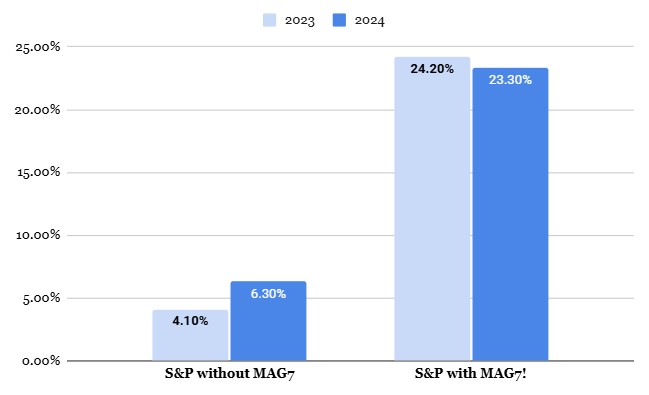
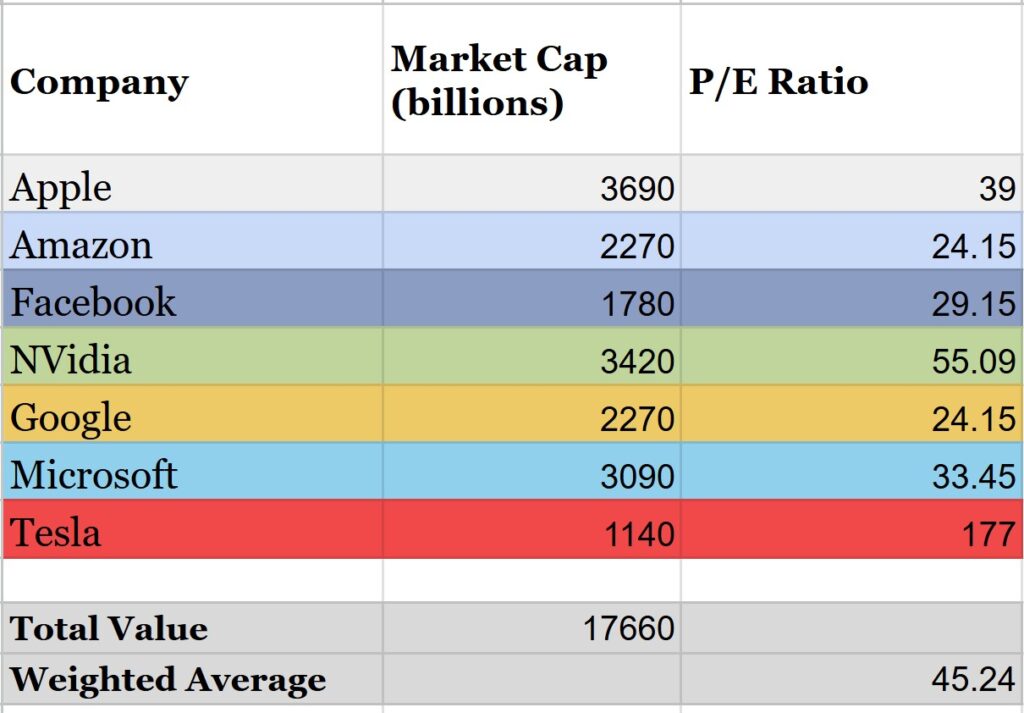
If the market is trading at such high multiples, why has it not corrected? The answer lies in the concentrated nature of recent growth. Approximately three-quarters of the S&P 500’s recent gains have been driven by seven companies: Apple, Nvidia, Microsoft, Amazon, Google, Meta, and Tesla.

These firms, collectively known as the "Magnificent Seven," represent over 25% of the entire U.S. market value, boasting a combined valuation exceeding $17 trillion. Investors have bid these stocks up to a weighted average P/E ratio of 45, betting that the ongoing Artificial Intelligence (AI) revolution will catalyze exponential growth. If one excludes these seven tech giants, the P/E ratio of the remaining 493 companies drops to 20—a level that, while still elevated, is far more tethered to traditional economic expectations.
The market’s optimism is anchored in the belief that AI represents a paradigm shift in human productivity. From automating code and legal document analysis to advancements in pharmaceutical design and the potential for humanoid robotics, the thesis is that AI will solve the "finite labor constraint" that has historically limited economic growth. Major tech firms are currently pouring hundreds of billions of dollars into capital-intensive AI infrastructure, and companies like Nvidia have seen demand for their hardware outpace supply, fueling massive revenue spikes.
Chronology of the AI Mania
The current market environment is not a sudden phenomenon but the culmination of several years of technological acceleration:
- 2020–2021 (The Pandemic Shift): Remote work and stay-at-home orders created a surge in demand for digital services and consumer tech (e.g., Peloton), which many investors mistook for a permanent shift in consumer behavior.
- 2022 (The Reality Check): Rising interest rates and inflation brought a sharp correction as investors realized that the "pandemic boom" had been a temporary anomaly.
- 2023–2024 (The Generative AI Boom): The public release of advanced Large Language Models (LLMs) shifted investor focus from consumer hardware to the underlying infrastructure of the digital age. This ignited the massive capital expenditure cycles we see today.
- 2025 (The Current Inflection Point): Markets are now navigating the tension between high valuations and the expectation of future AI-driven efficiency gains.
Official Perspectives and Market Forecasts
The financial community remains divided on whether this current valuation is sustainable. Vanguard’s latest ten-year annualized return projections suggest a shift in sentiment. Their models indicate that international stocks and even bonds may outperform U.S. equities over the next decade. The rationale is clear: international markets are currently trading at a P/E ratio of roughly 16, nearly half the valuation of the U.S. market, suggesting that the "discount" offered abroad may provide a safer buffer against potential domestic volatility.
Meanwhile, legendary investor Warren Buffett has signaled caution. Berkshire Hathaway’s recent shareholder communications reveal a massive cash stockpile of $334 billion. Buffett’s decision to refrain from significant share buybacks or aggressive acquisitions suggests he views current market prices as disconnected from intrinsic value, opting instead for the safety and optionality of liquidity.
Implications for the Long-Term Investor
What does this mean for the individual investor? The data suggests several key takeaways:

- Expect Moderate Future Returns: As P/E ratios compress over time, investors should be prepared for lower returns than those experienced during the bull run of 2020–2025. It is a matter of simple arithmetic: when you buy at higher prices, your forward-looking yield is inherently lower.
- Diversification Matters: While the U.S. market has been the global leader in performance, over-reliance on a single geographic region or a handful of tech giants carries significant idiosyncratic risk. Including international exposure, as seen in diversified portfolios like those suggested by Betterment or Vanguard, can help hedge against a potential domestic tech-sector cooling.
- The "Market Timing" Trap: Despite the allure of selling to "wait for a crash," history shows that attempting to time the market is a losing game. The most effective strategy remains consistent, long-term participation. The market may eventually revert to a more traditional valuation, but attempting to predict when is a fool’s errand.
- Consider Fixed Income Alternatives: With interest rates currently elevated compared to the previous decade, paying off high-interest debt or utilizing bonds can serve as a "guaranteed return" asset class. For those who find the volatility of a tech-heavy market unsettling, debt reduction provides a risk-free internal rate of return that rivals conservative equity projections.
Final Reflections
The current market is a testament to the power of human ingenuity—and the danger of human greed. Whether AI will indeed usher in an era of unprecedented prosperity or whether it will lead to temporary overcapacity and margin compression remains to be seen.
However, the core tenets of sound financial planning remain unchanged by technological hype. A diversified portfolio, consistent contributions, and a long-term time horizon are the most reliable defenses against both bubbles and bear markets. Ultimately, wealth should be viewed as a tool to facilitate a life of purpose. If the daily headlines about market valuations cause you undue stress, it may be a sign to step away from the charts. Spend that time engaging in the physical, tangible world—a pursuit that, unlike the stock market, offers returns that are immune to fluctuations in artificial intelligence or global equity valuations. The future is uncertain, but your ability to choose how you spend your time remains entirely within your control.


 Ali Ikhwan
 Layla Zulfa
 Lina Hope
 Jia Lissa
 Suro Senen

 Pevita Pearce
 Siti Muinah