
 Pevita Pearce
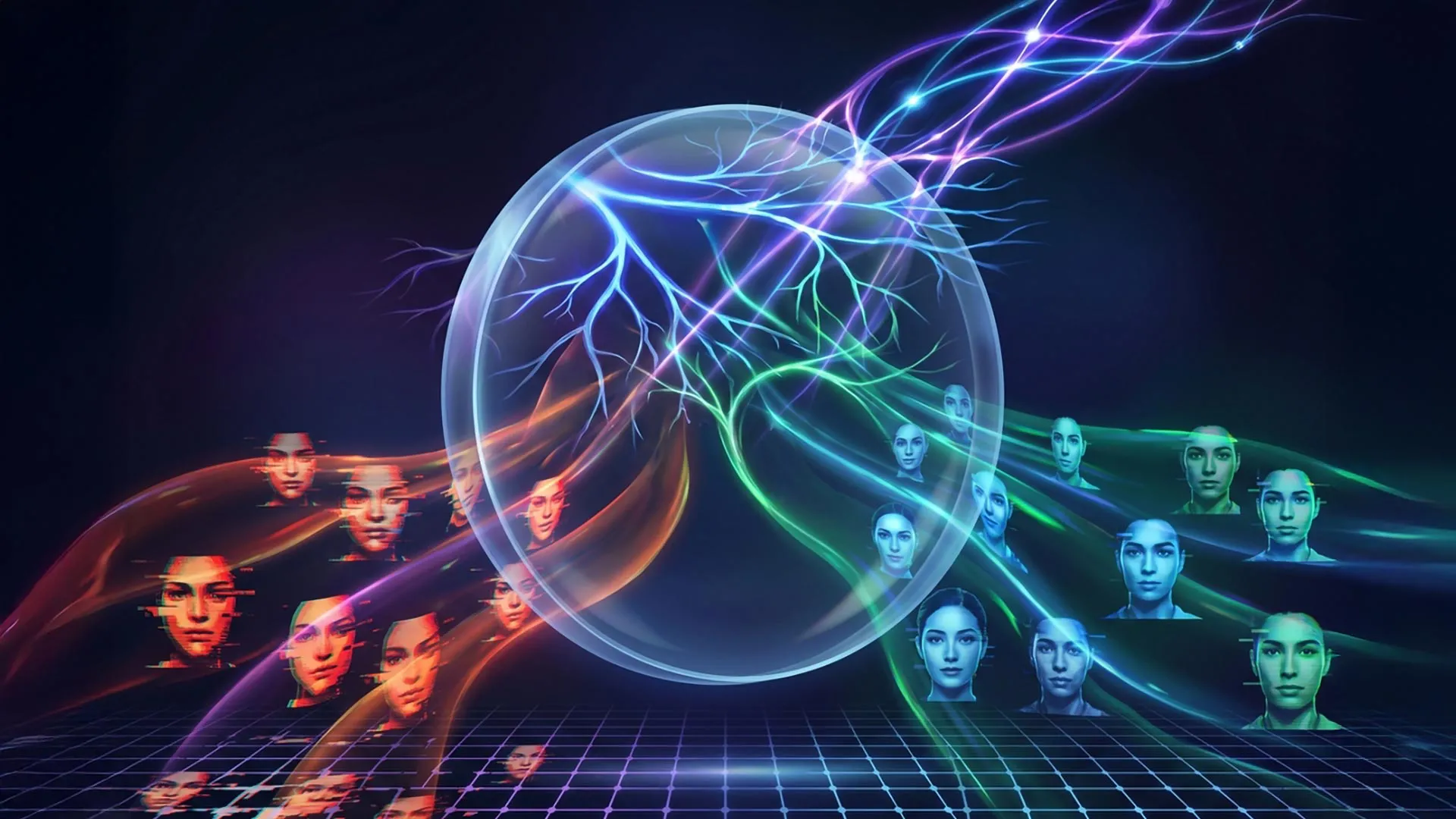
In an era where generative artificial intelligence can replicate human likenesses with terrifying precision, the race to authenticate digital media has become a high-stakes technological arms race. As synthetic media—or "deepfakes"—become increasingly indistinguishable from reality, the digital infrastructure required to police them is hitting a wall. Conventional detection methods are energy-intensive, slow, and increasingly vulnerable to adversarial manipulation.
However, a breakthrough team at the University of California, Los Angeles (UCLA) has unveiled a radical departure from traditional silicon-based computing. By harnessing the physical properties of light, researchers have developed an optical-neural processor capable of screening vast quantities of video content with unprecedented speed, efficiency, and resilience. This innovation, detailed in the journal eLight, may well represent the first line of defense in the battle for digital truth.
The Main Facts: A Paradigm Shift in Computational Detection
The core innovation developed by Professor Aydogan Ozcan and his team is the "Scalable, Energy-Efficient Optical-Neural Architecture for Multiplexed Deepfake Video Detection." Unlike conventional systems that process data through sequential digital operations—where every frame must wait its turn in a processing queue—the UCLA system utilizes light propagation to perform "multiplexed" analysis.
By converting video features into optical phase patterns, the system processes 15 or more video streams simultaneously in a single pass of light. This isn’t just an incremental improvement in speed; it is a fundamental shift in how neural networks compute. Because the "decoding" happens through physical diffraction rather than electrical logic gates, the system operates at the speed of light while consuming a fraction of the energy required by standard hardware.
Chronology: From Theoretical Optics to Real-World Defense
The journey to this processor began with a simple question: Can the physical world do the work of a digital algorithm?
The Conceptual Foundation
For years, the UCLA team, led by Professor Ozcan, has been exploring "diffractive optical neural networks." The goal was to move away from the "Von Neumann bottleneck," where the constant shuttling of data between memory and processors creates a massive energy and speed handicap. In the context of deepfake detection, the team realized that the complex matrix multiplications required to identify a manipulated face could be mapped onto physical optical surfaces.
The Experimental Phase
The team moved from theoretical modeling to experimental validation by constructing a hybrid digital-optical system.
- Digital Encoding: A lightweight digital encoder extracts essential spatial, spectral, and temporal features from a video stream.
- Phase Transformation: These features are converted into a phase pattern and projected onto a spatial light modulator.
- Optical Decoding: The resulting wavefront passes through a series of passive, diffractive layers.
- Output: Optical sensors at the terminal end capture the final output, which reveals an authenticity score.
Testing and Validation
The team subjected the system to rigorous testing using the Celeb-DF dataset, a benchmark for high-quality deepfake detection. In late 2023 and early 2024, the team successfully scaled the processor to analyze 18 videos in a single pass, maintaining an accuracy rate exceeding 96%. This confirmed that the system was not only viable but scalable, paving the way for its potential integration into existing content moderation pipelines.
Supporting Data: Efficiency and Precision
The metrics reported by the UCLA researchers are striking, particularly when compared to the traditional, energy-heavy methods currently employed by social media giants and government agencies.
Accuracy and Sensitivity
In its primary experimental configuration, the processor achieved:
- Average Detection Accuracy: 97.79%
- Sensitivity (True Positive Rate): 99.86%
- Specificity (True Negative Rate): 95.72%
The exceptionally high sensitivity of 99.86% is the most critical metric for security applications. It implies a false-negative rate of only 0.14%, meaning fewer than two out of every thousand deepfakes would slip through the net as "authentic."
Energy Efficiency and Scalability
Traditional neural networks, such as ResNet or Vision Transformers, require hundreds of billions of floating-point operations to analyze a single video. When scaled to millions of uploads, these systems require massive data centers and cooling infrastructure. The UCLA system, by contrast, utilizes passive optical elements. Once the light passes through these static, diffractive layers, the "computation" is complete. Because the layers are passive, they require zero additional electrical power during the inference phase.
Resilience to New AI Models
The team challenged the processor against videos generated by Google’s VEO-3, an advanced model capable of producing highly realistic content. Despite these videos lacking the tell-tale artifacts of older deepfakes, the optical processor achieved 94.80% accuracy with minimal fine-tuning. This suggests that the system’s "feature extraction" approach is robust enough to handle the next generation of generative AI.
Official Perspectives: The Team’s Vision
The lead researchers—Parnian Ghapandar Kashani and Dr. Shiqi Chen, under the guidance of Professor Aydogan Ozcan—emphasize that this technology is not intended to be a "silver bullet" that replaces digital systems entirely. Instead, they envision a hybrid ecosystem.
"The current digital infrastructure is struggling to keep pace with the exponential growth of synthetic media," the team noted in their study. "Our optical architecture is designed to function as a high-throughput gatekeeper."
By positioning the optical processor at the "front end" of a content moderation pipeline, massive volumes of data can be screened in near real-time. Only those videos flagged as "suspicious" by the optical layer would be escalated to computationally expensive, heavy-duty digital AI models for deep-dive verification. This tiered approach optimizes energy consumption, minimizes latency, and ensures that human or digital forensic analysts only focus on high-probability threats.
Implications: The Future of Digital Security
The implications of this research extend far beyond academic interest; they touch upon the very nature of information integrity in the 21st century.
1. Hardened Security Against Adversarial Attacks
One of the most persistent issues in AI security is the "adversarial attack." Bad actors often add imperceptible noise to a video to "trick" a neural network into misclassifying it. Because the UCLA system relies on physical diffraction to compute, the logic is "baked into" the hardware. An attacker cannot simply look at the code to find a vulnerability; they would need to understand the precise physical structure of the optical layers, which are notoriously difficult to reverse-engineer. This creates a "black-box" protection that is inherently more secure than purely software-based solutions.
2. Large-Scale Content Moderation
Social media platforms process millions of hours of video daily. A system that can analyze multiple streams simultaneously, without the heat and power constraints of standard GPUs, could revolutionize how platforms enforce their terms of service. This could lead to a faster, more responsive internet where deepfake content is caught before it has the chance to go viral.
3. Surveillance and National Security
In the context of intelligence and surveillance, the ability to screen incoming feeds from drones, body cameras, or public CCTV networks in real-time is a high-priority goal. The low-latency, high-sensitivity nature of the UCLA processor makes it an ideal candidate for military and national security applications where split-second verification is a matter of mission safety.
4. A Template for Future Optical AI
This work proves that optical computing is no longer a fringe curiosity. It is a viable, high-performance alternative for specific, compute-heavy tasks. As the research continues, the UCLA team expects that by simply adding more diffractive layers—which can be manufactured at low cost as static surfaces—they can increase the complexity of the detection logic without increasing the power draw. This "physical depth" approach provides a clear roadmap for scaling AI hardware in a world where energy efficiency is becoming as important as performance.
Conclusion
As we stand on the precipice of a future where seeing is no longer believing, the work being done at UCLA provides a flicker of hope. By looking to the fundamental physics of light, researchers have found a way to filter the noise and deceit of the digital world. While the technology is still in the developmental phase, its performance in the lab suggests that the next generation of AI security will not just be faster or smarter—it will be physically different. The battle against deepfakes is far from over, but with this optical-neural processor, the defense has just received a powerful new lens.


 Siti Muinah

 Sagoh

 Muslim

 Evan Lee Salim
 Basiran

 Reynand Wu

 Layla Zulfa

 Nana
