
 Laily UPN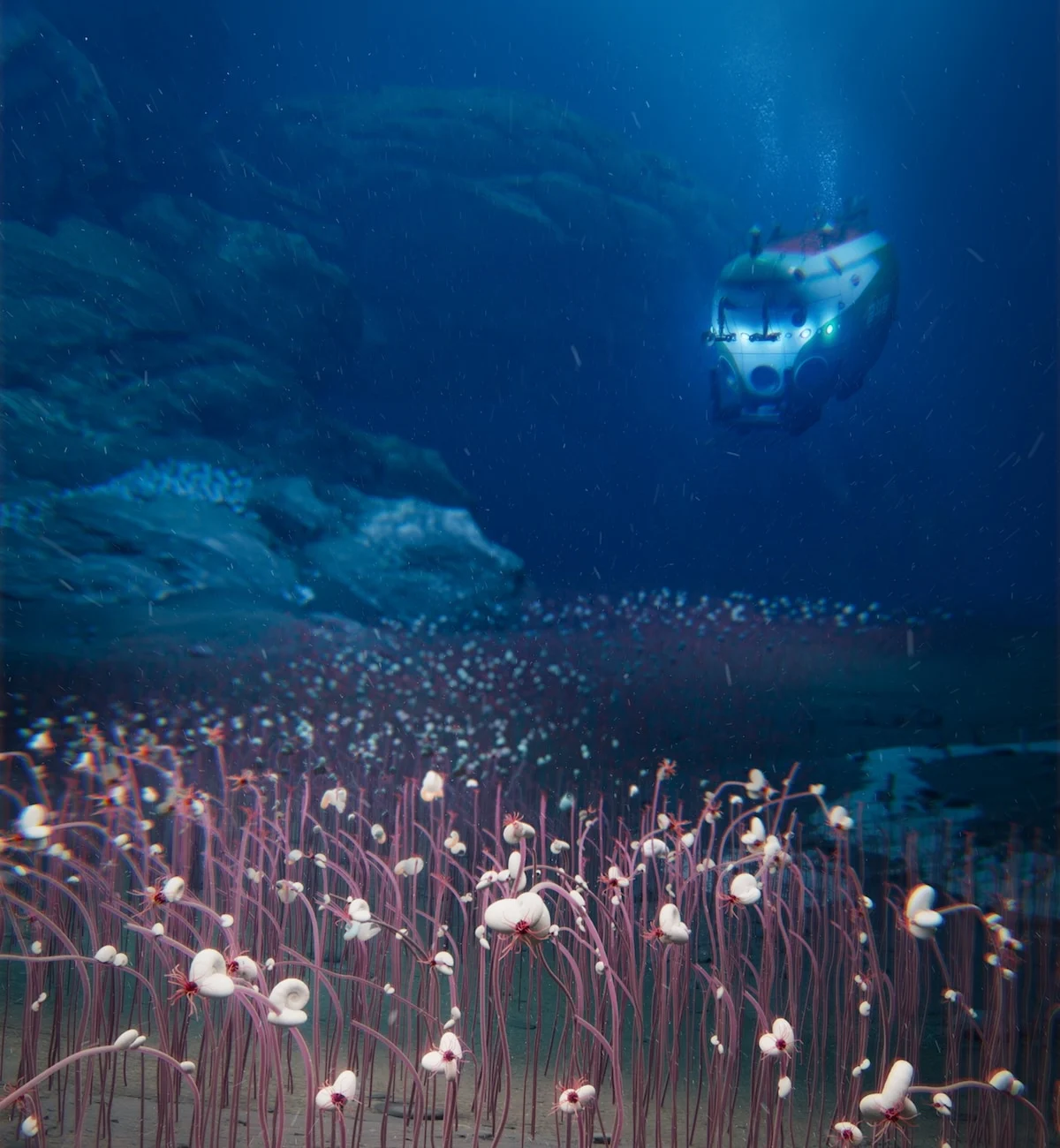
In the crushing, pitch-black depths of the Mariana Trench—a region where the pressure is enough to flatten a human frame and sunlight has never penetrated—researchers have discovered something entirely unexpected: a bustling, vibrant metropolis of life.
A team of scientists from the Chinese Academy of Sciences’ Institute of Deep-sea Science and Engineering (IDSSE) has unveiled the discovery of the deepest and most extensive chemosynthesis-based community ever documented on Earth. Located nearly six miles beneath the surface of the Pacific Ocean, this sprawling "oasis" challenges our fundamental understanding of biological survival and carbon cycling in the extreme Hadal zone.
The Discovery: Life in the Extreme
For decades, the deepest trenches on Earth were viewed by the scientific community as biological deserts—barren, high-pressure landscapes where life could only exist in isolated, sparse pockets. That paradigm has been dismantled by the findings of the manned submersible Fendouzhe.
During a series of 23 exploratory dives into the Mariana Trench and subsequent expeditions to the Kuril-Kamchatka and western Aleutian Trenches, researchers encountered thousands of mollusks, tubeworms, and crustaceans thriving at depths ranging from 3.6 to 5.92 miles. This discovery, detailed in a groundbreaking study published in the journal Nature, confirms that complex animal life is far more resilient and widespread than previously anticipated.
"What makes our discovery groundbreaking is not just its greater depth—it’s the astonishing abundance and diversity of chemosynthetic life we observed," said study co-author Mengran Du, a marine geochemist at the IDSSE. "Unlike isolated pockets of organisms, this community thrives like a vibrant oasis in the vast desert of the deep sea."
A Chronology of the Deep-Sea Frontier
The journey to the bottom of the world has been one of the most challenging chapters in the history of human exploration.
- 1960: The first milestone was reached when Jacques Piccard and Don Walsh descended to the bottom of the Mariana Trench in the bathyscaphe Trieste. They reported seeing a flatfish, but the environment was largely characterized as desolate.
- 2012: Hollywood director and deep-sea explorer James Cameron completed a solo dive to the Challenger Deep. His accounts of the descent reinforced the image of an "alien" and "desolate" landscape, focusing primarily on the geological extremity of the region.
- 2023–2024: The Chinese-led expedition utilized the Fendouzhe submersible to conduct rigorous, multi-site surveys across the Hadal zone. Unlike previous "hit-and-run" style visits, these dives involved systematic observation and sampling.
- July 2025: The publication of the findings in Nature officially confirms the discovery of the massive, interconnected chemosynthetic colonies, marking a turning point in deep-ocean biology.
Supporting Data: The Mechanics of Survival
The survival of these creatures in the total absence of sunlight is a triumph of evolution. Because photosynthesis is impossible at depths exceeding 30,000 feet, these organisms rely on a process known as chemosynthesis.
According to the study, the community is sustained by fluids rich in hydrogen sulfide and methane. These chemicals seep through faults in the ocean floor, traveling upward from deep sediment layers. Isotopic analysis performed by the research team confirmed that the methane supporting this ecosystem is produced microbially from organic matter deposited on the seafloor.
The data reveals a staggering scale: the discovered communities span a distance of approximately 1,553.4 miles. Within these zones, researchers identified:
- Siboglinid Polychaeta: Tubeworms that grow up to a foot in length, often clustering around "snow-like" microbial mats.
- Bivalvia: Massive mounds of clams and mollusks that appear to be the primary residents of the trench floor.
- Diverse Invertebrates: The team observed sea lilies, spiky crustaceans, sea cucumbers, and various free-floating marine worms, indicating a complex food web that suggests the area is not just surviving, but flourishing.
"Given geological similarities with other hadal trenches, such chemosynthesis-based communities might be more widespread than previously anticipated," noted lead author Xiatong Peng.
Official Responses and Scientific Implications
The implications of this discovery reach far beyond biology. The scientific community is currently recalibrating its models of deep-ocean carbon cycling. The presence of such a massive, methane-consuming population suggests that the deep-sea floor plays a more active role in global carbon sequestration than was previously accounted for in climate models.

"These findings challenge the current models of deep-ocean carbon cycling and life at extreme limits," the authors stated in their report. The discovery of microbial methane production in these trenches provides a new lens through which to view the energy sources available in Earth’s crust.
The scientific community has greeted the news with enthusiasm, though it is tempered by the gravity of the current environmental context. As the Nature report was released, the international community was already embroiled in heated debates regarding the future of the seafloor.
The Looming Threat: Deep-Sea Mining
The timing of this discovery is critical. It arrives as the International Seabed Authority (ISA) faces intense pressure to finalize regulations for deep-sea mining. Corporations are eager to extract minerals like cobalt, nickel, and manganese from the seafloor to satisfy the global demand for electric vehicle batteries and green energy components.
However, the "vibrant oasis" discovered by the Fendouzhe team may be a harbinger of what is at stake. Marine biologists warn that deep-sea mining could cause irreversible damage to these fragile, little-explored ecosystems. The sediment plumes created by industrial dredging could choke out life forms that have evolved over millions of years to thrive in the specific chemical equilibrium of the trenches.
"Mining the little-explored ocean floor could destroy fragile marine ecosystems in one of the last wild zones on the planet," ocean scientists have warned in response to the publication.
The discovery suggests that the Hadal zone is not just a collection of rocks and water, but a functioning, delicate biological network. Protecting these areas requires an understanding of how interconnected they are—a task made significantly more difficult by the fact that we have explored less than 5% of the global ocean floor.
A Hidden World Unveiled
The sensation of witnessing this world firsthand was described as a form of temporal travel. Mengran Du, reflecting on the experience of piloting the Fendouzhe, noted, "Diving in the submersible was an extraordinary experience—like traveling through time. Each descent transported me to a new deep-sea realm, as if unveiling a hidden world and unraveling its mysteries."
As humanity continues to reach further into the cosmos, this discovery serves as a humbling reminder that we have yet to fully comprehend the mysteries of our own planet. The Mariana Trench, once thought to be a static, lifeless void, has been revealed to be a biological frontier.
The researchers conclude their study with a call to action: the Hadal trenches remain the least explored environments on Earth. As we stand on the precipice of industrializing the deep sea, the discovery of this extensive chemosynthetic community underscores the necessity of a precautionary approach. We are only just beginning to map the complexity of the abyss, and there is likely far more life thriving in the dark than we have ever dared to imagine.
For now, the tubeworms and mollusks of the Mariana Trench continue their silent, chemical-fueled existence—a testament to the persistence of life in the most hostile environments imaginable, and a reminder of the fragile beauty that exists in the deepest corners of the world.

 Raul Delapena Setiawan

 Reynand Wu
 Sagoh
Sagoh

 Azzam Bilal Chamdy
 Ali Ikhwan