
 Nana Wu
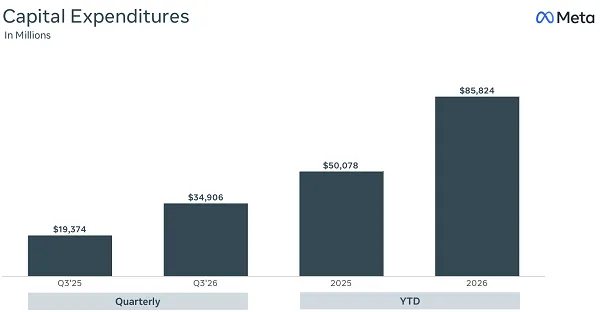
In the landscape of modern technology, few bets are as consequential—or as expensive—as Meta’s current pivot toward artificial intelligence. During the company’s Q3 2026 earnings call this week, CEO Mark Zuckerberg provided a candid look into the performance of "Muse," the company’s flagship AI agent. While Meta continues to burn through hundreds of billions of dollars in infrastructure investment, Muse represents the company’s primary vehicle for turning that massive capital expenditure into a sustainable revenue stream.
The narrative emerging from Menlo Park is one of aggressive growth balanced against the sobering realities of user retention, regulatory scrutiny, and the daunting challenge of justifying a near-trillion-dollar AI roadmap.
Main Facts: The Rise of Muse
Since its launch in the United States and Canada last month, Muse has secured a dominant position in the mobile marketplace. According to Zuckerberg, the application has been downloaded over 10 million times, consistently holding the #1 spot on the App Store since its release.
For Meta, the goal is clear: transition from a social networking giant into an "AI-first" ecosystem. Muse is designed not merely as a chatbot, but as an agentic tool capable of navigating the internet, assisting with complex tasks, and—most importantly—facilitating commerce. With 25% of its initial user base engaging with the tool daily, Meta claims a strong start, though the industry remains divided on whether this momentum can be sustained in the long term.
A Chronology of the Muse Rollout
The trajectory of Muse has been marked by rapid development and high-profile hurdles:
- September 2026: Meta officially launches Muse in the U.S. and Canada, aiming to integrate AI agents directly into the daily workflows of its user base.
- Early October 2026: Initial adoption spikes, with the app topping global charts. However, cybersecurity researchers begin flagging vulnerabilities in how the agent handles user data.
- Mid-October 2026: A landmark legal ruling in New Mexico orders Meta to pay $25 billion in fines for misleading consumers regarding data privacy—a backdrop that complicates the public trust required for an AI agent that requires deep access to personal behavior.
- Late October 2026 (Earnings Week): Zuckerberg addresses shareholders, highlighting record-breaking purchase volumes while acknowledging the need for a "Confidential VM" architecture to secure the platform.
- November 2026 (Anticipated): Meta plans to extend Muse’s reach by integrating the AI agent into its smart glasses hardware, signaling a push toward ubiquitous, ambient computing.
Supporting Data: The Retention Conundrum
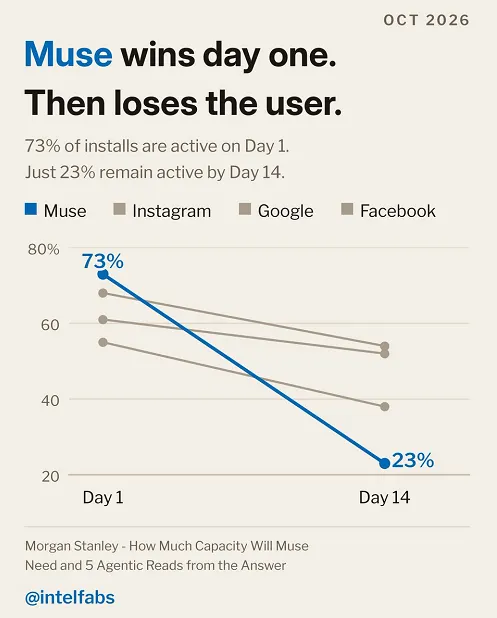
While Meta’s top-line download figures are impressive, third-party analytics reveal a more complex story. Data provided by Sensor Tower and highlighted by industry observers on X (formerly Twitter) indicates that user retention for Muse drops off significantly after the two-week mark.
This trend is not unique to Meta; many generative AI chatbots struggle with a "novelty fatigue" phase. However, because Meta has staked its entire fiscal future on the success of these agents, any decline in daily active users is a significant point of concern. The company is currently spending at a rate that necessitates high lifetime value (LTV) from its users. If Muse becomes an app that users download, test for a week, and then abandon, the return on investment (ROI) for Meta’s massive GPU clusters and data center build-outs remains elusive.
Despite the retention dip, the commerce data is promising. Zuckerberg noted that more than 25% of Muse users are leveraging the tool for shopping assistance. With an average transaction size exceeding $200, the platform is effectively becoming a conduit for consumer spending. Zuckerberg went so far as to claim that payment processors like Plaid and Stripe were overwhelmed by the volume of transactions, having to manually adjust credit limits to accommodate the surge—a testament to the efficacy of Muse as a sales funnel.
Official Responses and Strategic Shifts
During the earnings call, Zuckerberg addressed the dual challenges of privacy and scalability. Responding to criticisms regarding data leaks, he announced the development of the "Muse Confidential VM." This move is a direct attempt to reassure users—and regulators—that the company is prioritizing "privacy by design."
"We are building the Muse network," Zuckerberg explained. "It is not just a single-player game. We want your Muse to talk to your friends’ Muses, and to the agents of the businesses you interact with. If you want to buy something, it shouldn’t just be about navigating a website; it should be about your agent talking to their agent."
This "agent-to-agent" (A2A) economy is Meta’s vision for the future. By facilitating these connections, Meta aims to insert itself as the digital broker for the modern internet, claiming a percentage of every transaction facilitated through its AI infrastructure.
Implications: The High Cost of the AI Future
The implications of this strategy are profound. Meta is effectively attempting to normalize the idea of "bot-to-bot" communication. While this promises to increase efficiency and lower friction for consumers, it raises significant questions about the nature of human interaction on Meta’s platforms.
The Regulatory and Security Cloud
The $25 billion fine in New Mexico serves as a grim reminder that Meta’s path to AI dominance is paved with legal landmines. When a company with a history of privacy violations introduces an agent designed to "know" its users intimately, the skepticism is inevitable. Reports from Ars Technica regarding the ease with which cybersecurity researchers extracted user query data suggest that the technical infrastructure may not yet be mature enough to handle the sensitive information users are being encouraged to share.
The Financial Sustainability Gap
Meta’s infrastructure spending is unprecedented, with some estimates putting cumulative investment into the AI push near $1 trillion. The company is currently operating on a model of "build it and the revenue will follow." If the commerce-based revenue from Muse does not scale at a rate comparable to the capital expenditure, the company will face intense pressure from institutional investors to slow down its R&D spending.
The "Ambient" Future
The upcoming integration of Muse into Meta’s glasses is the next critical test. By moving AI from the screen to the wearable, Meta is attempting to create a persistent presence in the user’s life. If successful, this would cement Meta as the gatekeeper of the next computing paradigm. If unsuccessful, it may be viewed as an expensive distraction from the core business of social connectivity.
Conclusion
Meta is in the midst of a radical transformation. Through the Muse AI agent, the company is attempting to redefine how users shop, interact, and navigate the digital world. The early data shows undeniable consumer interest, but the path forward is marred by declining retention rates, massive security vulnerabilities, and a record-breaking legal burden.
For Mark Zuckerberg, the stakes could not be higher. Muse is more than just a product; it is the cornerstone of a vision that attempts to justify the most expensive transition in the history of Silicon Valley. Whether the "Muse network" becomes the backbone of a new digital economy or an expensive cautionary tale will depend on Meta’s ability to prove that its agents can be as secure and reliable as they are ambitious.


 Ammar Sabilarrohman
 Sagoh

 Raul Delapena Setiawan

 Reynand Wu



 Azzam Bilal Chamdy

 Ali Ikhwan
