
 Rifan Muazin
J.B. Hunt Transport Services (NASDAQ: JBHT), a titan of the North American logistics landscape, has released its third-quarter financial results, providing a complex snapshot of a company balancing impressive revenue growth against the stubborn persistence of operational cost pressures. Despite a volatile market environment that led to a sobering earnings warning in September, the logistics giant managed to slightly outperform the lowered expectations set by Wall Street analysts.
As the company navigates this turbulent fiscal period, the results serve as more than just a quarterly report; they act as a bellwether for the broader intermodal, trucking, and supply chain sectors. While the company has achieved a fifth consecutive quarter of year-over-year improvement in operating income and earnings per share (EPS), the narrative of the third quarter is defined by the tension between robust demand and the rising costs of doing business.
The Financial Breakdown: A Beat in the Face of Adversity
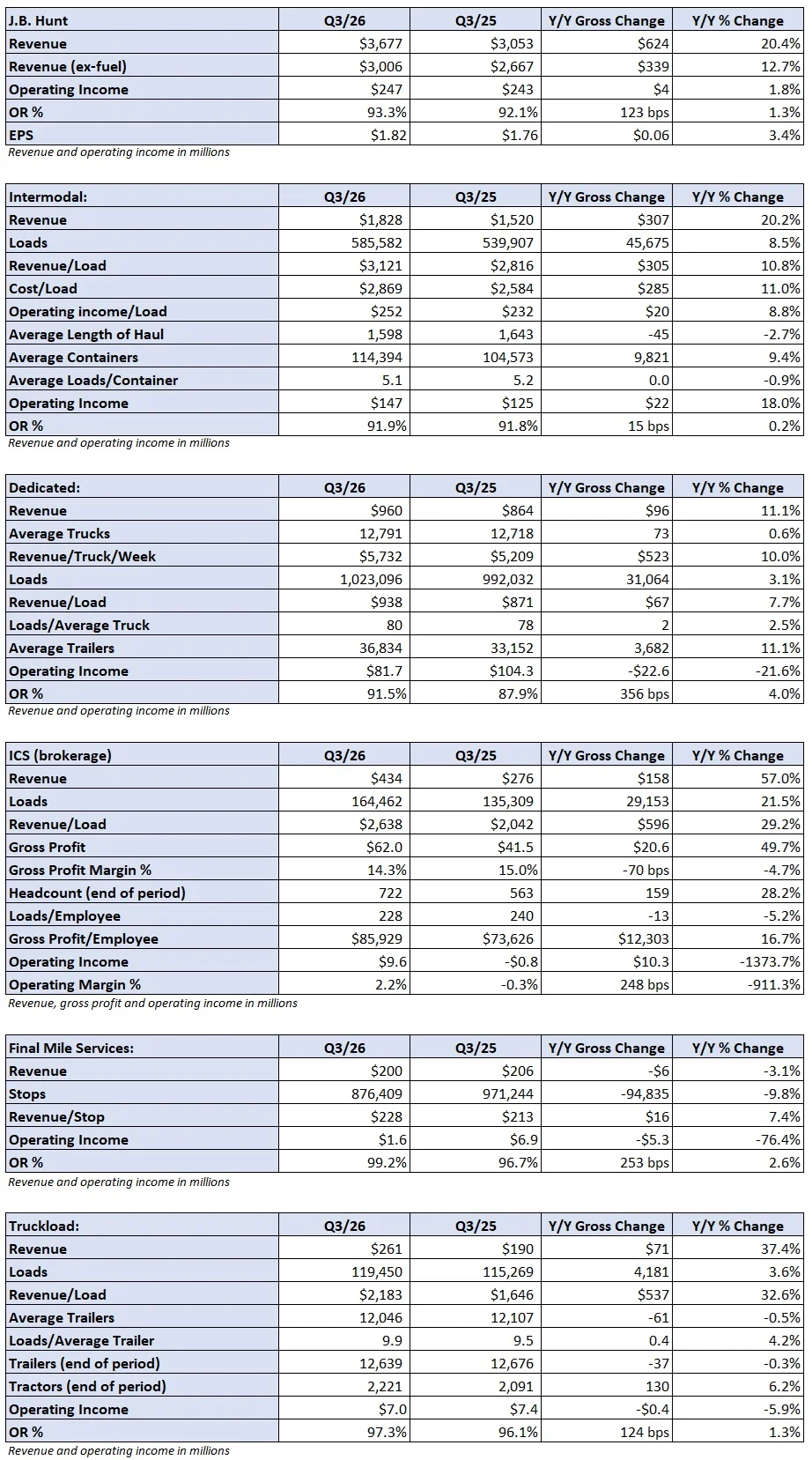
When J.B. Hunt announced its third-quarter results after the market closed on Thursday, the numbers provided a sigh of relief for investors who had been bracing for a deeper downturn. The company reported quarterly revenue of $3.68 billion, effectively clearing the $3.59 billion consensus estimate projected by analysts.
In terms of profitability, J.B. Hunt delivered earnings per share (EPS) of $1.82. This figure landed one cent above the revised market expectations. To understand the complexity of these figures, one must look at the balance sheet adjustments: a higher-than-anticipated tax rate acted as a 4-cent EPS headwind, which was partially mitigated by a 2-cent decline in net interest expense.
These results represent a marked improvement over the company’s own internal projections issued in mid-September. At that time, management had warned of a potential 5% to 10% sequential decline in EPS, which would have landed at roughly $1.77. The fact that the firm outperformed this mid-point suggests that, despite the headwinds, the company’s internal efficiency measures and volume management strategies are holding firm.
Chronology of a Challenging Quarter
The trajectory of J.B. Hunt’s third quarter began with optimism, quickly tempered by the realities of a shifting macro-economic landscape. By mid-September, it became clear to the executive team that unexpected costs were eroding margins at a faster pace than anticipated.
In a cautionary update that sent shares sliding, J.B. Hunt highlighted three primary "headwinds" that would define the remainder of the quarter:
- Fuel Volatility: A sharp, unexpected run-up in diesel prices accounted for approximately $10 million in additional costs.
- Labor Pressures: Driver-related expenses, reflecting a competitive labor market and increased demand for qualified talent, added $25 million to the cost burden.
- Claims and Risk: Elevated cargo claims, likely linked to the complexity of current supply chains and security challenges, contributed another $10 million in unplanned expenditures.
In total, these unforeseen costs amounted to over $50 million during the quarter. The ability of the company to absorb these costs while still exceeding earnings forecasts underscores the scale of their operations and the efficacy of their ongoing "earnings turnaround" strategy, which originally gained momentum in the third quarter of 2025.
Segment Performance: Intermodal and Dedicated Analysis
To understand the core of J.B. Hunt’s business, one must analyze the performance of its two largest pillars: Intermodal and Dedicated.
Intermodal: Growth vs. Margin Compression
The Intermodal unit remains the crown jewel of the company, reporting a 20% year-over-year revenue increase to $1.83 billion. This growth was fueled by an 8% increase in load volumes and an 11% surge in revenue per load. However, the story is not entirely one of expansion.
While fuel prices drove headline revenue, the operating ratio (OR)—the inverse of operating margin—deteriorated by 15 basis points to 91.9%. The primary culprit here was the rising cost of driver personnel, equipment maintenance, and employee benefits. Interestingly, while volume in the East increased by 18%, transcontinental lanes saw only a 1% increase. Furthermore, a 3% decline in the average length of haul—a byproduct of shifting freight mixes toward Eastern corridors—created a slight, but notable, drag on revenue efficiency per load.
Dedicated: The Cost of Expansion
The Dedicated unit experienced more significant friction, with its operating ratio deteriorating by 360 basis points to 91.5%. While revenue grew by 11% year-over-year, this was almost entirely driven by higher revenue per truck per week, which includes fuel surcharges. Excluding fuel, the revenue per truck growth was a modest 3%.
The divergence between capacity and demand was stark: the average number of trailers in service increased by 11%, yet load counts grew by a mere 3%. This suggests the company is positioning itself for future volume that has yet to materialize fully, leading to temporary margin dilution. Factors such as higher insurance premiums, group medical claims, and the front-loaded costs associated with new account startups were cited as the primary reasons for the performance lag.
Asset-Light Wins and the Brokerage Pivot
Perhaps the most encouraging news in the report came from the company’s smaller, yet strategic, units. After enduring 13 consecutive quarters of operating losses, the brokerage unit finally broke through, posting its second consecutive quarter of operating profit. This milestone is a critical indicator that the company’s technological investments and operational restructuring in the brokerage space are finally yielding dividends.
Similarly, the asset-light truckload unit swung into profitability, generating $7 million in operating income. This follows a loss in the second quarter, marking a successful reversal for the segment. These wins suggest that while J.B. Hunt’s core asset-heavy business faces short-term cost headwinds, its diversified portfolio is effectively mitigating risk and providing new avenues for margin expansion.
Market Implications and Future Outlook
The market reaction was immediate, with shares of JBHT falling 2.4% in after-hours trading following the announcement. This decline reflects a broader trend; the stock had already retreated 14% from its mid-September earnings warning through the Thursday close. Investors are clearly weighing the long-term potential of the company’s volume growth against the immediate, tangible pressure of rising operational costs.
Is the Pressure Transitory?
Industry experts and analysts are currently debating whether the $50 million in incremental costs experienced in Q3 are structural or transitory. Management’s commentary, delivered during the post-earnings conference call, emphasizes that many of these costs—particularly those related to fuel spikes and specific one-time account startup costs—are likely to normalize.
However, the labor market remains a wildcard. As driver wages and benefits continue to rise, the "new normal" for operating ratios in the trucking industry may be shifting. J.B. Hunt’s proactive approach—including its early-start turnaround in 2025—positions it to better navigate these inflationary pressures than many of its peers.
The Broader Industry Context
J.B. Hunt’s results are a microcosm of the North American logistics industry. The "bellwether" status of the firm means that its challenges are shared across the sector. Companies throughout the freight ecosystem are currently wrestling with:
- The "Quality" of Revenue: Balancing fuel-inclusive revenue gains with underlying volume growth.
- Asset Utilization: Managing the cost of equipment expansion in a market where load volumes are growing slower than fleet capacity.
- Insurance and Risk: The rising cost of liability and cargo insurance, which is becoming a systemic expense for large carriers.
As the industry gathers for the upcoming F3: Future of Freight Festival in Chattanooga, these themes will undoubtedly take center stage. The event will serve as a critical forum for stakeholders to discuss how technology—specifically in brokerage and compliance—can help offset the rising costs that have defined the third quarter.
Conclusion
J.B. Hunt has emerged from a difficult third quarter with its core strategies intact, even if its margins are currently under pressure. By surpassing lowered expectations, the company has demonstrated resilience and a capacity to adapt to rapid market changes. While the 14% decline in share price since mid-September highlights investor skepticism, the consistent improvement in operating income over the past five quarters suggests a company that is fundamentally stronger than it was a year ago.
For the remainder of the year, the focus will shift to whether the company can maintain its volume growth while successfully reining in the operational costs that eroded its margins this quarter. As the logistics landscape continues to evolve, J.B. Hunt’s ability to leverage its intermodal strength and its newfound success in brokerage will be the ultimate test of its long-term viability in an increasingly expensive operating environment.

 Sagoh

 Ali Ikhwan

 Raul Delapena Setiawan

 Reynand Wu



 Azzam Bilal Chamdy

