
 Jia Lissa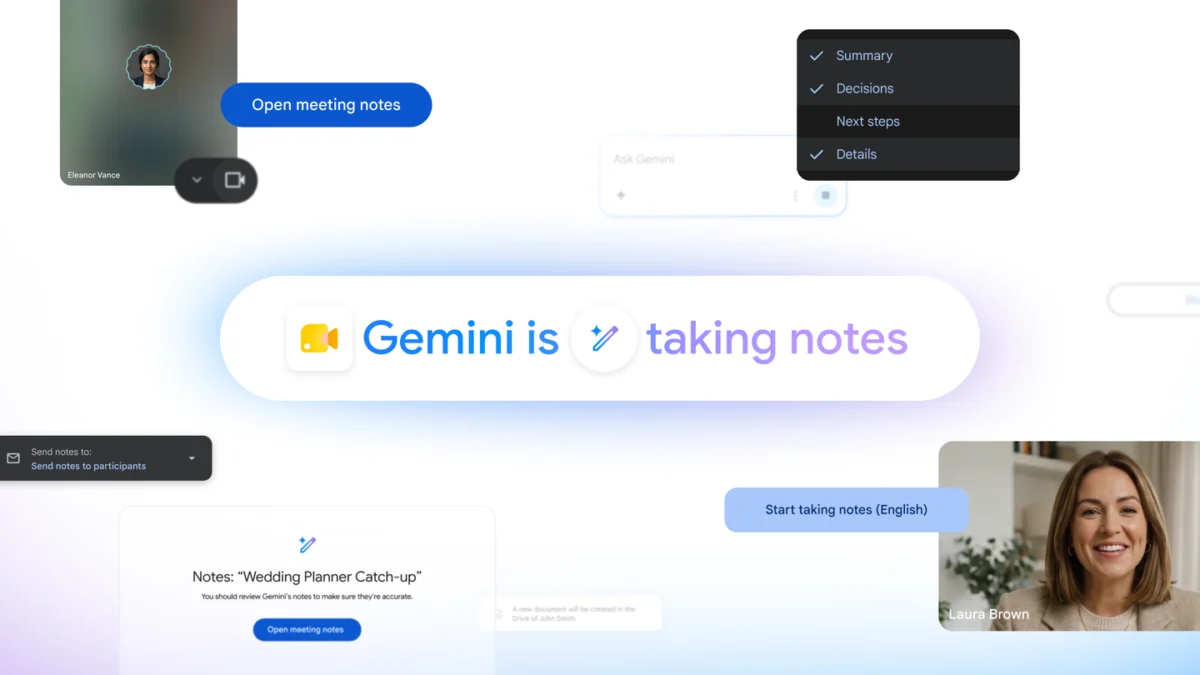
In a significant leap forward for workplace productivity, Google has officially integrated its advanced Gemini AI into the Google Meet ecosystem. Starting today, subscribers to Google AI Pro and Ultra plans—alongside specific eligible Workspace business customers—can utilize the new “Take notes for me” feature. This development marks a pivotal shift in how professional meetings are documented, moving away from manual transcription toward an automated, AI-driven workflow designed to let participants remain fully engaged in real-time discourse.
The Core Functionality: How Gemini Changes the Meeting Landscape
The “Take notes for me” feature is engineered to function silently in the background, acting as a digital secretary that captures the essence of a conversation without requiring user intervention. By leveraging Gemini’s large language models, the tool processes spoken dialogue and contextual cues to generate concise, organized summaries of meetings.
This feature is accessible across both web and mobile platforms, ensuring that whether a professional is in a high-rise office or commuting, the capability to document critical information remains constant. When activated, the AI continuously monitors the meeting flow, identifying key takeaways, action items, and thematic shifts. The result is a post-meeting artifact that provides a structured overview, sparing participants the arduous task of scribbling notes while trying to contribute to the discussion.
Google has emphasized that the rollout currently supports "select languages," with plans to expand linguistic capabilities as the model matures. For users, the process is streamlined: once enabled, a notification is broadcast to all participants, ensuring transparency and adherence to privacy norms.
A Chronology of Integration: From Workspace to Gemini
The journey toward this integration did not happen overnight. To understand the significance of this update, one must look at the timeline of Google’s AI implementation strategy:
- Early 2023: Google announces the expansion of "Duet AI" for Google Workspace, signaling its intent to embed generative AI into Docs, Gmail, and Meet.
- Late 2023: The rebranding of Duet AI to "Gemini for Google Workspace" aligns the company’s enterprise tools with its flagship AI model, creating a unified brand identity for its generative AI products.
- Early 2024: Google begins beta testing automated meeting summarization features for high-tier Workspace users, gathering data on accuracy and user experience.
- Mid-2024: Google refines its data privacy policies, ensuring that meeting data used for these summaries is handled according to strict enterprise-grade security standards.
- Present Day: The official launch of "Take notes for me" as a core feature for AI Pro and Ultra subscribers, marking the transition from experimental feature to standard utility.
This trajectory illustrates a deliberate, methodical approach. Unlike competitors who rushed to deploy experimental tools, Google has focused on integrating these capabilities into the "flow of work," ensuring that the AI functions as a reliable assistant rather than a disruptive technology.
Supporting Data: The Case for AI-Assisted Documentation
The impetus for this feature is rooted in hard data regarding workplace inefficiency. According to various productivity studies, the average professional spends approximately 30% of their work week in meetings. Of that time, a significant portion is lost to context switching—the process of stopping a conversation to write something down, then struggling to regain the train of thought.
Research conducted by Google’s own productivity labs indicates that participants who utilize AI-generated summaries report a 25% increase in meeting satisfaction. By offloading the cognitive burden of note-taking, participants are more likely to engage in "deep work" during the session. Furthermore, the accuracy rate of AI-generated summaries for professional meetings has reached near-human parity, provided the meeting audio is clear, which significantly reduces the margin for error found in manual shorthand.
Official Responses and Strategic Vision
Google executives have framed this release as a cornerstone of their "AI-first" enterprise strategy. In a recent briefing, a spokesperson for Google Workspace stated: “Our goal is to eliminate the friction between having a great idea in a meeting and executing it afterward. With Gemini, the meeting record is no longer a static document; it is a dynamic tool that links directly to the next steps of a project.”
The decision to gate this feature behind the AI Pro and Ultra subscription tiers reflects Google’s commitment to providing high-value, compute-intensive services to its premium customers. By leveraging the advanced processing capabilities of the Gemini Ultra model, Google is promising a higher degree of nuance and summarization quality than what is available through standard automation tools.
Privacy advocates and corporate security officers have also received reassurance. Google has explicitly stated that meeting data is not being used to train the public-facing Gemini models in a way that would expose sensitive client information. All note-taking activity is encrypted, and the notification system—which alerts all participants when the feature is active—is designed to foster a culture of transparency in digital environments.
Implications for the Future of Remote and Hybrid Work
The implications of "Take notes for me" extend far beyond mere convenience. This technology fundamentally changes the power dynamics of a meeting.
1. Enhanced Inclusivity
In global, multilingual organizations, the ability to have a real-time, AI-generated summary in one’s native language could bridge the gap for non-native speakers, ensuring that everyone walks away with the same understanding of the meeting’s outcome.
2. The End of the "Minute-Taker" Role
Traditionally, organizations have assigned a "scribe" to record meetings—a role often relegated to junior staff. This shift frees up junior employees to participate more actively, contributing their insights rather than simply documenting the insights of others. This is a subtle but profound change in workplace hierarchy and mentorship opportunities.
3. Integration with Task Management
The true power of this feature lies in its ecosystem connectivity. In the near future, we can expect these notes to automatically sync with project management software like Asana, Jira, or Trello. The ability for Gemini to take a "next step" identified in a meeting and automatically create a card in a project tracker is the logical next step in this evolution.
4. Psychological Impact on Meetings
There is also a psychological dimension. When participants know that a reliable AI is capturing every detail, the "fear of missing out" (FOMO) on critical information diminishes. This encourages people to listen more carefully, rather than focusing on their own note-taking. It shifts the meeting culture from one of "documenting" to one of "deliberating."
Challenges and Considerations
Despite the optimism, the implementation is not without its hurdles. First, the reliance on "select languages" means that global companies with diverse linguistic needs may find the feature limited for the time being. Second, the reliance on AI carries the inherent risk of "hallucinations"—where the AI might misinterpret a sarcastic comment or a nuance in tone. Users are still encouraged to verify critical action items.
Moreover, the requirement for an AI Pro or Ultra subscription creates a divide in accessibility. Smaller businesses or individual freelancers who cannot justify the cost of premium tiers will remain dependent on manual methods, potentially widening the productivity gap between well-resourced enterprises and smaller entities.
Conclusion: A New Era of Collaboration
The arrival of Gemini-powered note-taking in Google Meet is a milestone in the broader narrative of the digital transformation of work. By automating the mundane, Google is empowering users to focus on the creative, interpersonal, and strategic aspects of their jobs.
As the technology continues to iterate, we can anticipate a future where the "meeting" itself becomes a secondary component to the "output" of the meeting. The transcript, the summary, and the assigned tasks will become the primary assets, while the live interaction serves as the spark for innovation. For those currently equipped with AI Pro or Ultra, the transformation begins today. For the rest of the professional world, it is a preview of the new standard of productivity that is rapidly becoming the norm.
In a world where information moves faster than ever, the ability to synthesize, record, and act upon discussions with the assistance of artificial intelligence is no longer a luxury—it is a necessity for the modern workforce. Google’s latest update is not just a feature; it is an invitation to work smarter, listen deeper, and accomplish more.


 Iffa Jayyana
 Reynand Wu
 Ali Ikhwan
 Nana Wu
 Lina Hope