
 Suro Senen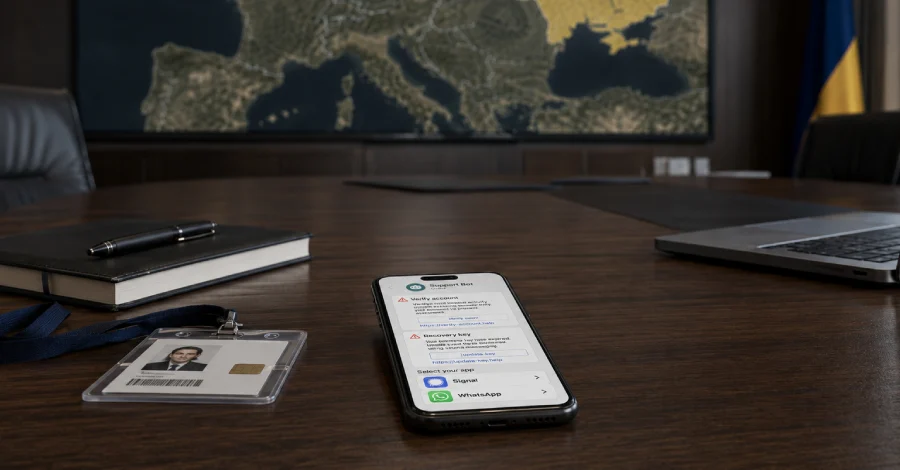
By Ravie Lakshmanan
June 27, 2026
In a significant collaborative intelligence operation, the Security Service of Ukraine (SSU) and the U.S. Federal Bureau of Investigation (FBI) have unveiled a sophisticated, long-running cyber espionage campaign orchestrated by Russian intelligence services. The operation, which has targeted government officials, military personnel, high-profile politicians, and civil society activists, represents a calculated attempt to infiltrate secure communication channels across Ukraine, the United States, and broader Europe.
The revelation highlights the evolving nature of modern warfare, where the digital battlefield has become as critical as physical frontlines. By exploiting the inherent trust users place in encrypted messaging platforms, Russian-aligned threat actors have sought to siphon sensitive military, political, and economic intelligence.
The Mechanics of the Breach: Anatomy of a Phishing Scheme
The core of this campaign relies on a relatively simple yet highly effective social engineering tactic: SMS-based phishing that masquerades as legitimate support notifications from messaging applications.
The "Support Bot" Deception
Attackers initiate the compromise by sending SMS messages to high-value targets. These messages are meticulously crafted to mimic the official security alerts or "support bot" notifications generated by popular encrypted messaging platforms. The goal is to induce panic or curiosity, prompting the user to click a malicious link under the guise of "verifying account security" or "preventing unauthorized access."
Once the target clicks the link, they are directed to a spoofed interface that mirrors the platform’s login or account recovery page. Users are then urged to disclose their account credentials, including backup recovery keys and two-factor authentication (2FA) codes. By capturing these, the attackers gain full, persistent access to the victim’s message history, media files, and active session tokens.
Targeting Beyond the Elite
While the initial focus of the intelligence agencies was on high-ranking government and military figures, the SSU has emphasized that the campaign is indiscriminate in its secondary objectives. Personal accounts belonging to ordinary Ukrainian citizens have also been compromised. By infiltrating these accounts, threat actors gain a foothold to propagate further phishing attacks, using compromised contacts to lend an air of legitimacy to subsequent malicious messages.
Chronology of Escalating Cyber Aggression
The current campaign is not an isolated incident but rather the latest escalation in a multi-year effort to undermine digital security in Western-aligned nations.
- Mid-2024 to Early 2025: Initial intelligence reports began to surface regarding "anomalous login attempts" on encrypted messaging apps used by defense contractors and legislative staffers in Europe and the U.S.
- Late May 2026: The Computer Emergency Response Team of Ukraine (CERT-UA) identified a surge in spear-phishing activity linked to the Belarus-aligned actor UNC1151 (also known as Ghostwriter or UAC-0057). This campaign specifically utilized compromised accounts to deliver the OYSTERBLUES information stealer, a malware designed to harvest browser cookies and session data.
- Early June 2026: The FBI issued a formal warning regarding Russian Intelligence Services (RIS) actors conducting a commercial messaging application (CMA) phishing campaign. This alert served as the precursor to the joint SSU-FBI announcement, confirming that the threat actors were actively targeting backup recovery keys to bypass standard encryption protections.
- June 27, 2026: The SSU and FBI officially publicly disclose the breadth of the operation, confirming the multi-national scope of the targeting.
Supporting Data: The Threat Actor Landscape
While the SSU has maintained a cautious stance regarding the specific attribution of the latest SMS-based campaign, security researchers and international intelligence bodies have pointed to several well-known Russian threat clusters.

Key Threat Clusters
- Star Blizzard (formerly Callisto Group): Known for its focus on geopolitical intelligence gathering, this group has a long history of utilizing credential harvesting against policy experts and think tanks.
- UNC5792 (UAC-0195): Identified as a sophisticated actor specializing in mobile-focused exploitation, this group has been linked to previous campaigns targeting Signal and WhatsApp users.
- UNC4221 (UAC-0185): A group noted for its high-speed deployment of infrastructure, often pivoting between different messaging platforms to maintain persistence.
The technical sophistication of these groups lies not in "breaking" the encryption of the apps themselves, but in "breaking the user"—manipulating human psychology to bypass the security measures inherent in end-to-end encryption.
Official Responses and Defensive Posture
The SSU, in its Telegram announcement, issued a stern warning to the public: "The goal of these ‘hacks’ is to gain access to sensitive military, political, and economic information exchanged by users, as well as to steal their personal data."
FBI’s Stance
The FBI has signaled that this campaign is a matter of national security. By working with international partners, the Bureau aims to disrupt the infrastructure used by these groups. Their focus remains on identifying the command-and-control (C2) servers that host the malicious phishing pages and working with service providers to ensure these domains are neutralized as quickly as they appear.
Recommendations for Security
To mitigate the risks posed by these campaigns, cybersecurity experts and intelligence agencies recommend a "Zero Trust" approach to mobile communications:
- Periodic Session Review: Frequently navigate to the "Linked Devices" or "Active Sessions" settings within messaging apps. Immediately terminate any session that does not match your current device or location.
- Hardened Authentication: Enable Two-Factor Authentication (2FA) using an authenticator app rather than SMS-based codes, which are susceptible to interception.
- QR Code Vigilance: Never scan QR codes received from unknown contacts, as these are often used to initiate unauthorized "Linked Device" sessions on the attacker’s hardware.
- Credential Hygiene: Treat confirmation codes, PINs, and recovery keys as highly sensitive information. No legitimate messaging service will ever ask for these via an SMS link or a third-party website.
- External Links: Avoid clicking on links sent in unsolicited messages, regardless of how official the sender’s handle may appear.
Global Implications: The Fragility of Encrypted Communication
The success of these campaigns has profound implications for global security and the future of digital privacy.
The Erosion of "Secure" Messaging
Encrypted messaging has become the backbone of modern diplomatic and political communication. If state-sponsored actors can successfully deceive users into handing over their access, the fundamental promise of end-to-end encryption—that only the sender and recipient can read the message—is effectively rendered moot. This creates a "security paradox": as apps become more encrypted, attackers shift their focus toward the human element, making the user the weakest link in the chain.
The Shift Toward Information Warfare
The data harvested in these campaigns is rarely used for immediate, flashy public leaks. Instead, it is curated to provide Russian intelligence with a "real-time" view of policy decisions, military logistical movements, and internal political debates in the West. This intelligence allows Moscow to better predict responses to geopolitical events, anticipate sanctions, and identify potential targets for future influence operations.
The Necessity of International Cooperation
The joint SSU-FBI operation underscores a critical reality: national borders are irrelevant in the face of cyber espionage. The identification and mitigation of these threats require seamless, real-time intelligence sharing between allied nations. As these threat actors continue to evolve their tactics—incorporating AI-driven phishing and more complex social engineering—the need for a unified global defense strategy has never been more pressing.
As the conflict in Eastern Europe continues, and as global tensions remain high, this messaging campaign serves as a sobering reminder that the devices in our pockets are front-line assets. Protecting them requires not just robust software, but a heightened level of digital literacy and skepticism that must now extend to every notification and every message received.

 Basiran
 Iffa Jayyana
 Raul Delapena Setiawan
 Reynand Wu
 Sagoh
Sagoh

 Azzam Bilal Chamdy
 Ali Ikhwan