
 Jia Lissa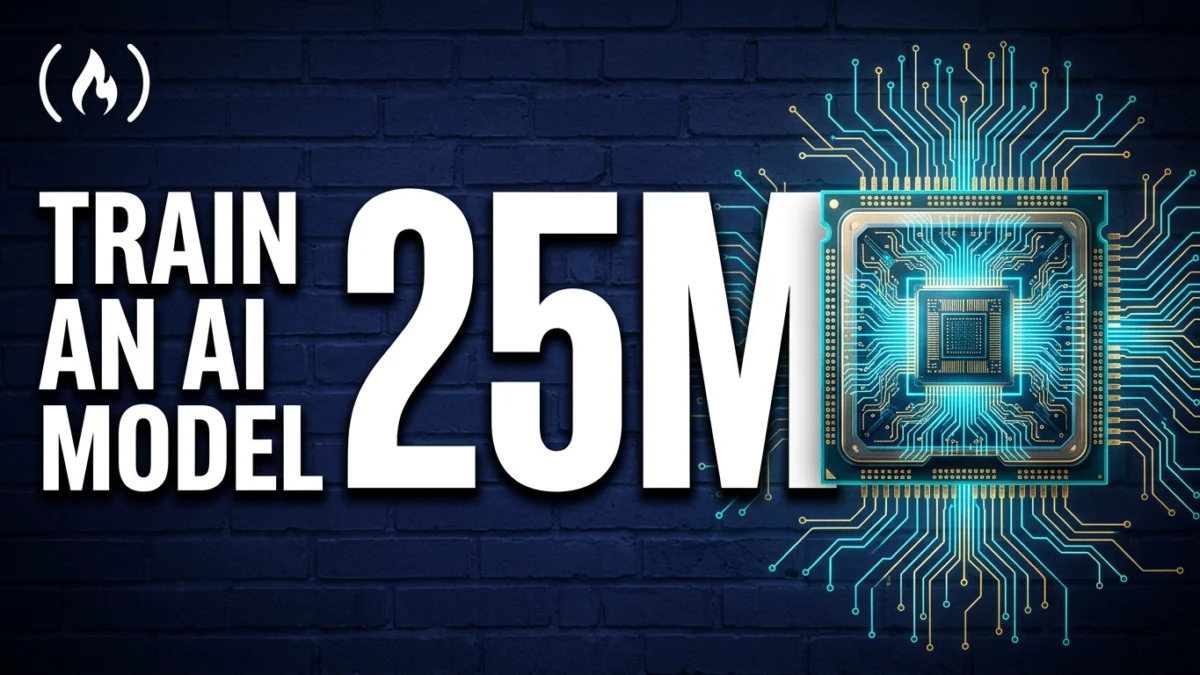
In the current era of artificial intelligence, the narrative surrounding Large Language Models (LLMs) is often dominated by headlines of massive GPU clusters, multi-million dollar training runs, and the industrial-scale compute power of companies like OpenAI, Google, and Anthropic. However, a new educational initiative from freeCodeCamp is challenging the notion that high-level AI research is the exclusive domain of Big Tech.
A newly released tutorial on the freeCodeCamp.org YouTube channel offers a hands-on masterclass in building, pre-training, and fine-tuning a 25-million parameter language model—entirely on a standard CPU. This project aims to demystify the "black box" of generative AI by stripping away the necessity for specialized, expensive hardware, proving that the fundamental principles of machine learning are accessible to anyone with a laptop and a curiosity for code.
The Democratization of AI Architecture
Main Facts: Bridging the Gap Between Theory and Practice
The core premise of this tutorial is that while frontier models like GPT-4 or Claude 3 boast hundreds of billions of parameters, the underlying mathematical architecture—the Transformer—remains consistent regardless of scale. By scaling a model down to 25 million parameters, learners can iterate in seconds rather than days.
The project utilizes a compact byte-level vocabulary, which drastically reduces the memory footprint and compute requirements of the model. This design choice is critical; it removes the barrier of entry typically associated with "cold starts" in AI development. When a model can run on a standard consumer CPU, the training loop becomes an interactive, real-time experience. Users are no longer waiting for cloud-based jobs to complete; they are witnessing the convergence of loss functions and the evolution of model weights in a local environment.
A Chronology of Modern AI Development
From Massive Labs to Local Environments
To understand why this development is significant, one must look at the historical trajectory of LLM training:
- The Era of Scaling (2017–2020): Following the publication of the "Attention Is All You Need" paper, the focus shifted toward scaling. Researchers discovered that simply adding more parameters and more data led to emergent capabilities. This ushered in the era of massive compute requirements.
- The GPU Bottleneck (2020–2023): As models grew, the hardware requirements surged. Training LLMs became synonymous with high-end NVIDIA GPU clusters (A100s and H100s). For students and independent researchers, this created a "knowledge gap" where the theory was well-documented, but the practice was locked behind a paywall of cloud compute costs.
- The Efficiency Movement (2023–Present): With the rise of techniques like quantization, LoRA (Low-Rank Adaptation), and architectural pruning, the community began pushing back. The current trend is toward "Small Language Models" (SLMs) that perform efficiently on edge devices.
The freeCodeCamp tutorial represents the maturation of this third phase. It allows developers to engage in the full lifecycle of an LLM—from data preprocessing to final inference—within a single hour-long session.
Supporting Data: Why 25 Million Parameters Matter
For those unfamiliar with the terminology, "parameters" are the internal weights of a neural network that the model adjusts during training to learn patterns in data.
- Compute Efficiency: A 25-million parameter model is microscopic compared to the 1.7 trillion parameters rumored to exist in GPT-4. However, it is sufficiently large to demonstrate the mechanics of backpropagation, gradient descent, and transformer block interactions.
- Rapid Iteration Cycles: On a high-end CPU, a model of this size can complete a training epoch in a fraction of the time required for larger models. This allows developers to test hypotheses about data quality, learning rates, and architecture modifications without incurring significant financial costs.
- Educational Value: By observing how changes to a data curriculum alter the model’s output in real-time, students gain an intuitive understanding of the "AI alignment" problem—a topic usually reserved for advanced research labs.
Official Perspectives: The Push for Open Research
The philosophy behind this tutorial aligns with a growing movement within the AI community, often championed by organizations that advocate for "open-weight" models and transparency. By providing the source code and the logic behind a 25-million parameter model, the creators are arguing that the future of AI shouldn’t just be about building larger models, but about understanding the ones we already have.
When asked about the importance of such projects, experts in the field often point to the "Transparency Deficit." Large, proprietary models are notoriously difficult to audit. By building models from scratch, developers learn to identify where bias enters the system, how data poisoning affects the training set, and why certain architectures are prone to hallucination. This hands-on approach acts as a practical safeguard against the misinformation that can arise when users interact with black-box systems they do not fully comprehend.
Implications for the Future of AI Development
The implications of this tutorial are far-reaching, affecting both education and professional development.
1. The Rise of the "AI Engineer"
The barrier to entry for AI development is falling. As more developers gain the ability to train models locally, we will likely see an explosion in niche, task-specific models. Instead of relying on a "generalist" model for every task, companies and individuals will begin to train smaller, specialized models tailored to specific datasets—much like how developers currently choose between different database or framework technologies.
2. A New Pedagogical Standard
Computer science curricula are currently undergoing a shift. Traditional courses often focus on the theory of neural networks without providing the infrastructure to train them. This tutorial demonstrates that universities and coding bootcamps can, and should, integrate local LLM training into their standard programming tracks.
3. Sustainability and Compute Ethics
The environmental impact of training large-scale models has become a point of contention in the tech industry. Projects that prioritize "compute-efficient" AI are crucial. By demonstrating that meaningful, educational, and even functional AI can be built on a standard laptop, the tech community is signaling that power-hungry mega-models are not the only path forward.
How to Get Started: A Call to Action
The journey into building your own AI does not require a degree in advanced mathematics or access to a supercomputer. As the freeCodeCamp tutorial highlights, the most important tool is the willingness to experiment with the fundamental building blocks of the Transformer architecture.
The tutorial covers:
- Data Curricula: Understanding how the quality and structure of training data dictate model performance.
- Loss Functions: Learning how to measure the "error" of an AI and how to use that measurement to guide improvement.
- Reward Design: Exploring the basics of how models learn to prioritize certain behaviors over others.
By removing the reliance on expensive infrastructure, this initiative empowers a new generation of developers to move beyond being mere "users" of AI and become active architects of the systems that are shaping our future. Whether you are a student looking to land a role in machine learning or a developer curious about the inner workings of current technology, this project provides a tangible, practical entry point into one of the most transformative fields of our time.
You can watch the full, one-hour tutorial on the freeCodeCamp.org YouTube channel. For those looking to solidify their broader programming foundations, freeCodeCamp’s open-source curriculum continues to offer a free pathway to professional software development, having already helped over 40,000 individuals secure roles in the tech industry. As AI continues to evolve, the ability to build and manipulate these systems will become an essential skill for the next generation of engineers.

 Nila Kartika Wati
 Neng Nana
 Basiran
 Iffa Jayyana
 Raul Delapena Setiawan
 Rifan Muazin
 Asro
Asro