
 Raul Delapena Setiawan
A high-severity security vulnerability, tracked as CVE-2026-39919, has been identified within the Ghostscript interpreter and rendering engine. This critical heap buffer overflow flaw presents a significant risk to a wide array of web servers, content management systems (CMS), and document-processing pipelines, as it allows attackers to achieve unauthenticated Remote Code Execution (RCE) through the submission of specially crafted PDF files.
The vulnerability, which surfaced following an extensive analysis by researchers at Defiant, the team behind the Wordfence security platform, highlights the inherent dangers of complex document-processing libraries that are deeply integrated into the modern web infrastructure.
The Core Technical Flaw: CVE-2026-39919
Ghostscript is a ubiquitous software suite used globally for PostScript and PDF interpretation. It is frequently employed by servers to render PDFs as high-quality images, generate thumbnails for document previews, and optimize file sizes by compressing embedded assets and stripping redundant metadata.
The vulnerability resides in how the Ghostscript engine handles specific image formats within a PDF—specifically, JPEG 2000 images. When a malicious actor embeds a specially crafted JPEG 2000 image into a PDF, it can trigger an error in the interpreter’s memory management. Specifically, the engine mismanages low-bit-depth samples and mismatched component resolutions.
This error leads to a heap buffer overflow, where the interpreter is forced to write 1,024 bytes of data into a reserved 256-byte buffer. This action results in the corruption of adjacent memory blocks, granting an attacker the ability to hijack the control flow of the application and execute arbitrary code on the underlying host operating system.
Chronology of Discovery and Disclosure
The discovery of this flaw was not the result of manual auditing but rather the output of cutting-edge automated threat intelligence.
- August 23, 2026: Researchers at Defiant, utilizing their proprietary "Argus" AI-powered vulnerability detection system, identified the anomaly while stress-testing the Ghostscript rendering engine.
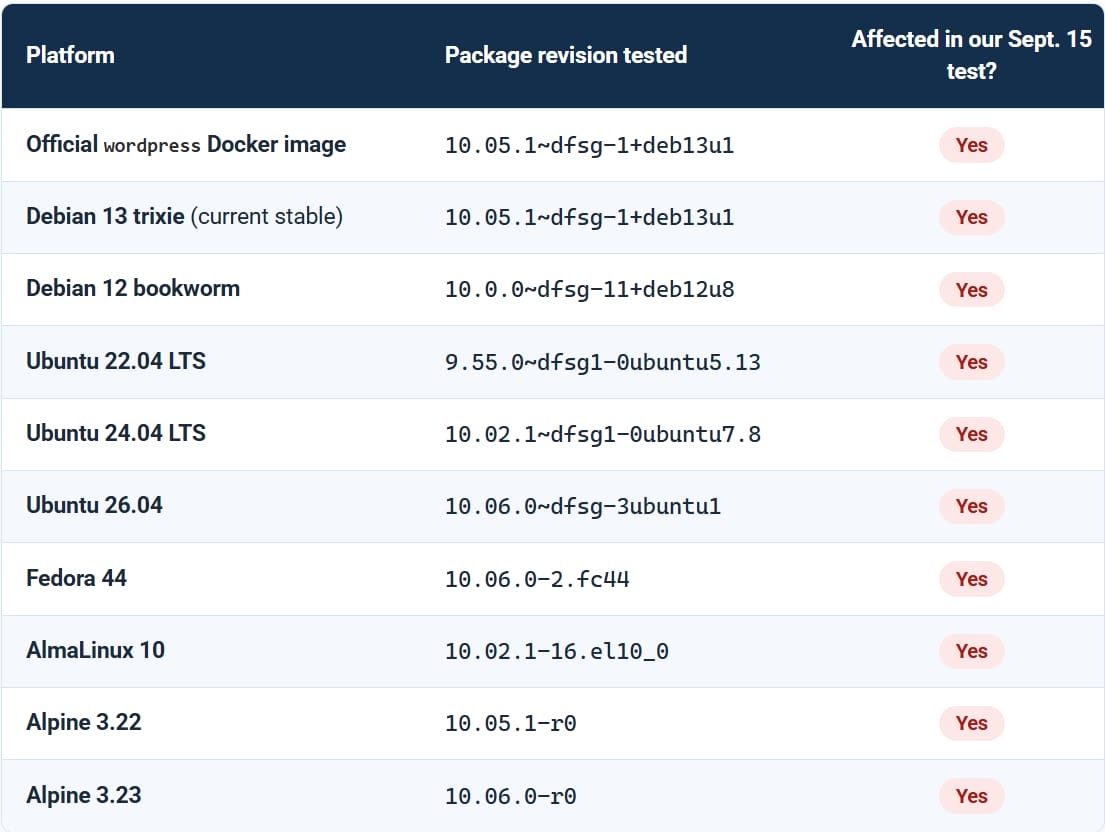
- Late August – Early September 2026: The research team conducted rigorous testing across ten major Linux distributions, including Debian, Ubuntu, Fedora, Alpine, and AlmaLinux, alongside official WordPress Docker image snapshots. The goal was to determine the feasibility of an exploit in real-world environments.
- September 8, 2026: Artifex, the maintainers of Ghostscript, officially released version 10.08.0, which included the necessary security patches to remediate the buffer overflow.
- October 2026: Public disclosure of the vulnerability followed, with security advisories issued to alert administrators and developers of the potential for RCE.
Supporting Data and Environmental Impact
While the vulnerability is theoretically potent, the research conducted by Wordfence reveals that achieving successful exploitation is highly dependent on the host environment’s configuration.
The Testing Methodology
The team performed over 10,240 exploit attempts against standard Linux packages in a controlled laboratory setting. Surprisingly, these initial attempts failed to achieve reliable RCE. However, the researchers successfully pivoted their approach by fine-tuning environmental variables—such as modifying PDF fonts, adjusting system language settings, and altering core system library configurations. Once these variables were aligned, they achieved successful, albeit inconsistent, remote code execution on a purpose-built test server.
Vulnerability Reach
The flaw affects all versions of Ghostscript from 9.21 through 10.07.1. Because Ghostscript is a backend dependency for countless applications, the impact extends far beyond the WordPress ecosystem. Any server-side application that utilizes ImageMagick or similar tools to process user-uploaded PDF files is potentially at risk if it relies on a vulnerable version of the Ghostscript binary.
Implications for WordPress Administrators
Wordfence specifically highlighted the risks to the WordPress ecosystem. In a typical WordPress environment, the application utilizes the PHP Imagick extension to interface with ImageMagick, which subsequently invokes Ghostscript to handle PDF thumbnail generation.
For an attacker to successfully compromise a WordPress site, several prerequisites must be met:
- Vulnerable Software: The server must be running Ghostscript versions 9.21 through 10.07.1.
- Plugin/Theme Configuration: The site must have functionality enabled that triggers PDF processing (e.g., thumbnail generation for media uploads).
- Upload Access: The attacker must be able to upload a PDF file to the server.
- Environmental Alignment: The specific server architecture must be susceptible to the memory layout manipulation required for the exploit to trigger.
While stock WordPress installations generally do not permit anonymous users to upload files to the Media Library, the proliferation of third-party plugins that allow user-submitted content (such as job boards, document management portals, or collaborative forums) significantly expands the attack surface.
Official Responses and Remediation Strategies
Artifex and the broader security community have moved quickly to address the threat. The primary defense remains the immediate update of the Ghostscript interpreter.
Patching Instructions
- Version Update: System administrators must ensure their servers are running Ghostscript version 10.08.0 or later. Most Linux distributions have issued updated packages; administrators should run their distribution’s package manager update commands (e.g.,
apt update && apt install ghostscript) to retrieve the patched version. - Containerized Environments: For those using Docker, simply patching the container runtime is insufficient. Organizations must rebuild their container images using a base image that has been updated to include the patched Ghostscript binary.
- Backported Fixes: For legacy environments where upgrading to 10.08.0 is not immediately feasible, administrators should verify whether their specific distribution has backported the security fix to their existing version.
Mitigation in Absence of Patches
If an immediate upgrade is impossible, administrators are urged to implement the following defensive measures:
- Disable PDF Processing: If PDF thumbnail generation is not a business-critical requirement, disable this feature within the CMS or remove the capability for ImageMagick to invoke Ghostscript.
- Restrict Uploads: Block the upload of PDF files entirely via web application firewalls (WAF) or server-side file type validation until the environment can be fully patched.
- Sandboxing: Ensure that any process executing Ghostscript runs within a heavily restricted, low-privilege environment (such as a separate container or a jail) to limit the impact of a potential sandbox escape or RCE.
Conclusion: The Future of Automated Security
As of the latest reports, there is no evidence of CVE-2026-39919 being exploited in the wild. However, the discovery process—powered by AI-driven analysis—serves as a stark reminder that modern software vulnerabilities are increasingly being identified by automated systems that can scan millions of lines of code to find the precise edge cases that humans might overlook.
For organizations, the lesson is clear: reliance on third-party libraries like Ghostscript creates a "hidden" attack surface. Security teams must treat these backend dependencies with the same level of scrutiny as their primary application code. By prioritizing timely patching and adopting a "defense-in-depth" posture, administrators can mitigate the risks posed by even the most sophisticated buffer overflow attacks.
Disclaimer: This report is based on findings from the Wordfence research team. Organizations are encouraged to consult their specific vendor documentation for security updates and patch verification.


 Jia Lissa
 Siti Muinah
 Nana Wu
 Asro
Asro

 Neng Nana
 Dwi Wanna
