
 Siti Muinah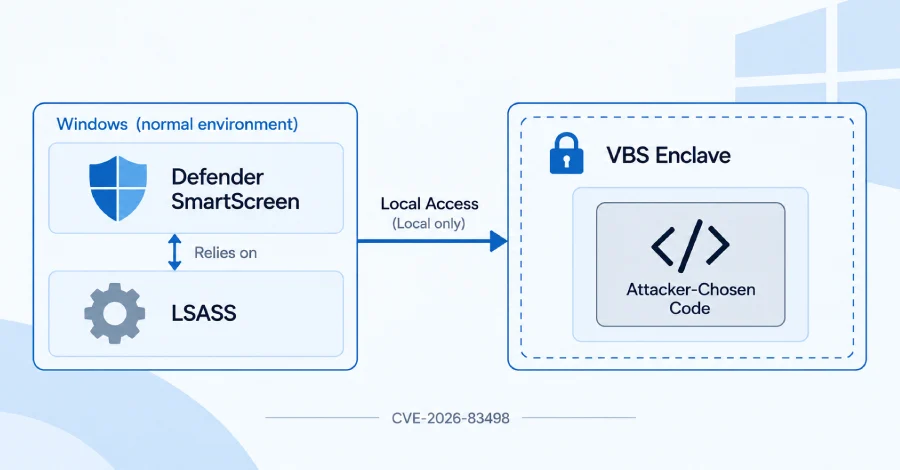
In a significant discovery that challenges the long-held assumption of total isolation for Windows security components, security researchers at Doyensec have successfully demonstrated a proof-of-concept attack capable of running arbitrary code within a VBS (Virtualization-Based Security) enclave. This development strikes at the heart of Windows’ most fortified layer, specifically targeting a component responsible for protecting user credentials against phishing attacks.
The vulnerability, tracked as CVE-2026-83498, highlights the ongoing "cat-and-mouse" game between software architects striving for total hardware-backed isolation and researchers uncovering the subtle, often architectural, cracks in those defenses. While Microsoft has since patched the flaw, the implications of this breach extend far beyond a single line of code, raising questions about how Windows manages its most sensitive, "trusted" environments.
The Fortress Under Siege: What is a VBS Enclave?
To understand the severity of this discovery, one must first understand the architecture of Windows Virtualization-Based Security. VBS uses the hardware virtualization features of modern CPUs to create an isolated region of memory, effectively creating a "trusted world" (VTL1, or Isolated User Mode) that exists independently of the standard operating system environment (VTL0).
Inside this sanctuary reside VBS enclaves—digitally signed libraries that are designed to be impenetrable even if an attacker achieves full administrative or kernel-level control over the host operating system. The core promise of an enclave is that it is a "black box": once loaded, the operating system cannot read or modify the memory within it. This is where Windows stores its most precious secrets, including hashed credentials, biometric data, and encryption keys.
The specific enclave targeted by Doyensec was SFAPE.dll, the engine behind the "Enhanced Phishing Protection" feature in Microsoft Defender SmartScreen. This feature is designed to detect when a user inputs their Windows credentials into untrusted applications or websites. Because the feature must verify these credentials without exposing the actual password to the potentially compromised main OS, it relies entirely on the isolation provided by the VBS enclave.
Chronology of the Discovery
The journey from a theoretical bug to a confirmed, patched vulnerability followed a rigorous path of discovery and verification:
- Initial Research (Early 2026): Doyensec researchers began analyzing the mechanics of VBS enclaves, focusing on the interface between the host process (
lsass.exe) and the isolatedSFAPE.dll. - Discovery of the Flaw: Researchers identified that calling the enclave’s
Initializefunction a second time bypassed critical security checks. This oversight allowed for a four-byte write to an arbitrary address—a seemingly minor error that provided the initial "wedge" for a more complex attack. - The Chain of Exploitation: By leveraging this small, four-byte write to corrupt the enclave’s internal memory management tables, researchers were able to trigger a secondary timing bug. This chain of events eventually allowed them to bypass memory isolation entirely and execute their own code inside the enclave.
- Public Disclosure (October 13, 2026): Doyensec published their findings, revealing the full extent of the vulnerability over a month after Microsoft had pushed a fix to the public.
- The Patch (September 8, 2026): Microsoft released a cumulative update (KB5124008) for Windows 11 versions 24H2 and 25H2, which addressed the vulnerability by tightening address checks and modifying the internal function logic that was susceptible to the timing bug.
Technical Anatomy of the Breach
While a four-byte write might sound trivial to the uninitiated, in the context of memory safety, it is a "skeleton key." Doyensec’s methodology demonstrates that high-security environments are not necessarily immune to the same logic errors that plague standard applications.

The "Wedge" Technique
The attack began by invoking the enclave’s initialization process in an unconventional manner. By triggering a second Initialize call, the enclave erroneously wrote a fixed error value to a location controlled by the attacker. Because the second call bypassed the rigorous safety checks enforced during the initial startup, this write occurred without validation.
Corrupting the Boundary
Once the initial write was achieved, the researchers targeted the enclave’s "boundary table"—the internal map that tells the enclave what memory belongs to it and what belongs to the host. By corrupting this table, the enclave effectively lost its ability to distinguish its own protected memory from the outside world.
Code Execution
The final stage of the attack relied on a timing bug within another function. By carefully timing the execution, researchers forced the enclave to perform a "controlled wipe" of its own memory structures. This wipe, when redirected, allowed the attackers to replace the table that determined which code the enclave was permitted to execute. The result: the enclave, designed to be an immutable vault, was now running attacker-provided code.
Implications for Windows Security
The successful compromise of SFAPE.dll serves as a sobering reminder that "isolation" is not synonymous with "invulnerability."
The Persistence of "Bring Your Own Vulnerable Enclave" (BYOVE)
One of the most alarming aspects of this research is the lack of a comprehensive "blocklist" for outdated or vulnerable enclaves. While Microsoft’s update effectively killed the vulnerable version of SFAPE.dll, it left older, similarly vulnerable enclaves—such as the one identified in 2023 via CVE-2023-36880—perfectly capable of being loaded.
This creates an environment ripe for "Bring Your Own Vulnerable Enclave" (BYOVE) attacks. An adversary, having gained local access to a machine, could intentionally load an old, signed, and vulnerable enclave to establish a persistent, hidden foothold that is invisible to traditional endpoint detection and response (EDR) tools. By operating within the VTL1 world, malicious code can bypass kernel-mode security filters, effectively blinding the security stack.
The Myth of "Local Only"
Microsoft has categorized this as a local, elevation-of-privilege issue with a CVSS score of 7.8. While the rating is accurate—the attack cannot be launched remotely—it minimizes the danger in modern threat landscapes. Most sophisticated cyberattacks today rely on an initial "foothold" (like a phishing link or an unpatched browser vulnerability). Once an attacker is inside the system, the ability to escalate from "user" to "enclave-resident code" provides a level of stealth that can persist for months, or even years, without detection.

Official Responses and Remediation
Microsoft’s handling of the situation was relatively swift once the issue was identified internally and confirmed by external researchers. The September 8, 2026, cumulative update (KB5124008) serves as the primary defense.
The update performs two critical actions:
- Code Hardening: It introduces stricter memory address validation and patches the timing vulnerabilities in the
SFAPE.dlllibrary. - Policy Enforcement: It introduces a new loading policy that explicitly prohibits the execution of the specific, vulnerable version of the enclave.
Microsoft has stated that there is no evidence of this vulnerability being exploited in the wild. However, they have yet to address the broader concern raised by Doyensec: the systemic lack of a centralized, robust mechanism to blacklist all known vulnerable enclaves, rather than just the one currently being exploited.
Conclusion: The Path Forward
The breach of the VBS enclave by Doyensec is a landmark event in Windows security research. It proves that even the most heavily fortified "isolated" environments are susceptible to logic errors and timing-based exploits.
As the industry moves toward hardware-enforced security as the gold standard, the complexity of these systems increases significantly. With that complexity comes an expanded surface area for bugs that traditional security software cannot see. Moving forward, it is clear that Microsoft must adopt a more proactive posture regarding enclave lifecycle management. A "blocklist" approach, similar to the one used for vulnerable third-party drivers, is no longer an optional feature—it is a necessity for maintaining the integrity of the Virtualization-Based Security ecosystem.
For enterprise IT administrators and security teams, this research highlights the critical importance of keeping systems updated. The "local access" requirement for this exploit is not a safety net; it is simply the starting point for the next generation of sophisticated, stealthy, and highly persistent cyber-threats. As long as signed, legacy, and vulnerable code can be loaded into the most trusted corners of an operating system, the war for total endpoint security remains far from over.


 Jia Lissa
 Raul Delapena Setiawan
 Nana Wu
 Asro
Asro

 Neng Nana
 Dwi Wanna
