
 Suro Senen
A severe, unpatched security vulnerability has been identified in high-end residential gateways manufactured by Calix, a prominent supplier of broadband equipment for major telecommunications providers across the United States. The flaw, tracked under the identifier CVE-2026-75501, allows remote, unauthenticated attackers to manipulate a device’s port-forwarding rules, effectively punching a permanent hole through the router’s firewall and exposing sensitive internal network devices to the public internet.
The vulnerability affects the Calix GS7 XGS (GS5239XG) residential router—a flagship Wi-Fi 7 gateway that integrates an XGS-PON fiber terminal—running firmware version EXOS/6.6.47. Given the widespread deployment of this hardware by major ISPs, including Cox Communications, Brightspeed, ALLO, CityFibre, and Conexon, the potential attack surface is significant.
The Technical Core: Anatomy of the Vulnerability
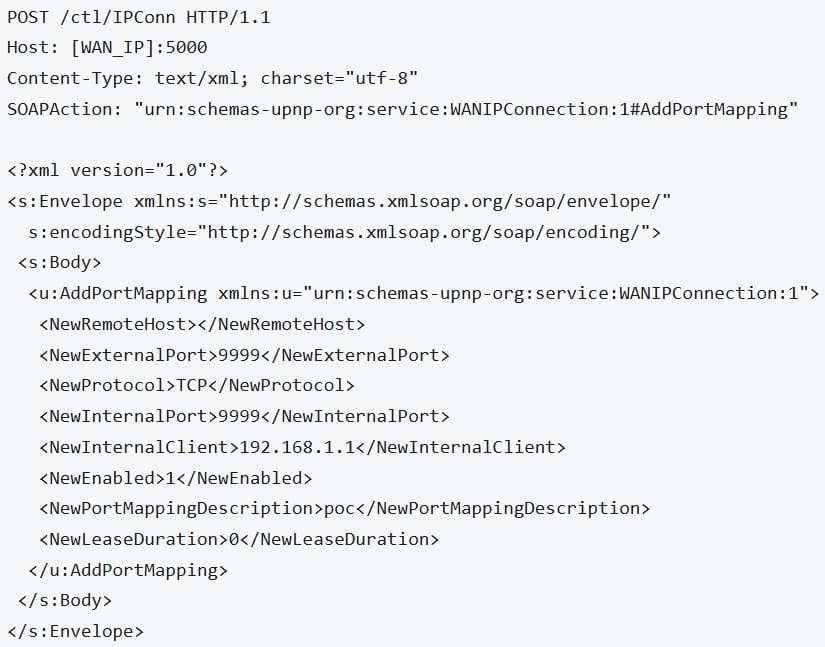
The root cause of CVE-2026-75501 lies in a fundamental misconfiguration of the router’s management services. Specifically, the device exposes the MiniUPnPd (Universal Plug and Play) control endpoint directly onto the Wide Area Network (WAN) interface via TCP port 5000, completely lacking any form of authentication or access control.
In a secure implementation, UPnP services—which are designed to simplify the configuration of port mappings for gaming consoles and real-time communication applications—should remain strictly internal to the Local Area Network (LAN). However, on the affected Calix firmware, the router binds its UPnP WANIPConnection SOAP (Simple Object Access Protocol) service to the public-facing interface.
According to the vulnerability disclosure provided by the Carnegie Mellon CERT Coordination Center (CERT/CC), this oversight allows any actor on the public internet to send unauthenticated SOAP requests to the device. These requests can be used to:

- Add, delete, or enumerate port mappings without user authorization.
- Query the external IP address of the gateway.
- Redirect traffic from any arbitrary external port to any internal IP address and port within the local network.
Security researcher Brian Khan Quintana, who discovered the flaw, described the ease of exploitation as "alarming." In his technical analysis, Quintana noted that a single, unauthenticated request sent from anywhere in the world is sufficient to create a persistent "backdoor" into a home network. Because these malicious rules are written to the router’s configuration, they survive device reboots, ensuring that an attacker retains access even if the homeowner power-cycles the gateway.
Chronology of Discovery and Disclosure
The timeline of this vulnerability reflects a breakdown in the traditional responsible disclosure process, characterized by a lack of vendor responsiveness that eventually necessitated a public intervention by cybersecurity oversight bodies.
June 7, 2026: Initial Discovery and Contact
Brian Khan Quintana identified the security flaw during a routine assessment of modern gateway hardware. Recognizing the severity of the issue—which essentially renders the router’s NAT (Network Address Translation) and firewall protections moot—he attempted to reach out to Calix through standard channels to report his findings.
June–August 2026: The "Silent" Period
Despite repeated attempts to establish communication with the vendor to facilitate a patch, Quintana received no response. As the weeks passed without acknowledgment or a remediation timeline, the potential for exploitation grew. Without a clear path to resolution, the researcher escalated the matter to the Carnegie Mellon CERT/CC.
August 2026: Coordinated Disclosure
Following their own verification of the vulnerability and continued lack of progress from the manufacturer, CERT/CC determined that the public interest outweighed the risks of immediate disclosure. The details of CVE-2026-75501 were made public, and the research was published in full, providing technical documentation to help users understand the risks and implement manual workarounds.

Implications for Residential Security
The implications of CVE-2026-75501 are profound, as it essentially turns a security-focused gateway into a tool for intrusion. By bypassing the firewall, an attacker can expose various internal devices that were never intended to be internet-facing.
The "Exposure" Cascade
Once an attacker successfully creates a port-forwarding rule, they gain the ability to probe and interact with devices that rely on the router’s NAT for security. Common targets include:
- Network-Attached Storage (NAS): Often containing sensitive personal files, photos, and backups. If these devices are not perfectly patched or rely on weak administrative credentials, they become prime targets for ransomware or data exfiltration.
- Security Cameras and Baby Monitors: Many IoT-enabled home security devices are notoriously difficult to secure. Exposing their administrative interfaces to the web allows attackers to spy on private residences.
- Administrative Interfaces: By exposing the management portal of printers, smart home hubs, or the router itself, attackers can attempt brute-force attacks or exploit further vulnerabilities to gain complete control over the network infrastructure.
- IoT Appliances: Smart thermostats, refrigerators, and lighting systems often have limited security features. Once exposed, they can be co-opted into botnets, such as those used for massive Distributed Denial of Service (DDoS) attacks.
Quintana’s proof-of-concept demonstrated that he could manipulate the port mappings from outside his own network, confirming that the "security hole" is not merely theoretical but easily weaponized by anyone with basic knowledge of SOAP requests.
Official Responses and Industry Context
As of the date of this report, Calix has not provided a formal public statement regarding CVE-2026-75501. The lack of a vendor-provided patch leaves thousands of users in a precarious position. The professional security community has noted that this incident underscores a recurring problem in the ISP equipment market: the prioritization of deployment speed and features (like Wi-Fi 7 performance) over fundamental security hardening.
For consumers, the situation is particularly frustrating because many ISP-provided routers have locked administrative interfaces. Even if a user identifies a vulnerability, they are often unable to apply firmware updates manually or change certain settings without the explicit cooperation of their broadband provider.
Recommendations for Mitigation
Because there is currently no patch, CERT/CC and security researchers strongly advise the following steps for users of the Calix GS5239XG:
- Disable UPnP: Log into the router’s administrative dashboard. Navigate to Advanced > Security > UPnP and ensure the feature is set to "Disabled." While this may break the "plug-and-play" functionality for certain online games or peer-to-peer applications, it effectively closes the specific vector being exploited by this vulnerability.
- Contact your ISP: If the UPnP setting is grayed out or otherwise locked by the provider, the user should contact the customer support department of their broadband provider. Request that they manually disable UPnP on the gateway to mitigate the risk of remote exploitation.
- Manual Port Management: For users who require specific ports to be open for services (such as home servers or VPNs), do not rely on automatic configurations. Instead, manually define specific port forwarding rules. While this requires more technical effort, it ensures that only necessary ports are exposed, and only to specific, controlled devices.
The Broader Landscape: Valid Credentials and Defensive Gaps
This incident serves as a stark reminder of the "Blue Report 2026" findings regarding the limitations of perimeter defense. The report indicates that while preventative measures are essential, they are often insufficient once an attacker gains a foothold. Even in environments with robust monitoring, once an attacker possesses valid credentials or, in this case, a direct hole through the firewall, 63% of their follow-up actions go undetected or unblocked by standard defensive software.
The Calix vulnerability highlights that the "edge" of the network—the router—is the most critical point of failure. When the gatekeeper itself is compromised, the entire internal network becomes a playground for malicious actors. As the industry continues to push for faster, more integrated "Smart Home" gateways, the responsibility falls on vendors to ensure that these devices are secure by design, rather than requiring users to become network security experts just to protect their privacy.
For now, until Calix issues a firmware update to resolve the authentication bypass on TCP port 5000, users are urged to remain vigilant, monitor their network logs for suspicious activity, and, if possible, implement the recommended configuration changes immediately.


 Basiran
 Iffa Jayyana
 Raul Delapena Setiawan
 Reynand Wu
 Sagoh
Sagoh

 Azzam Bilal Chamdy
 Ali Ikhwan