
 Muslim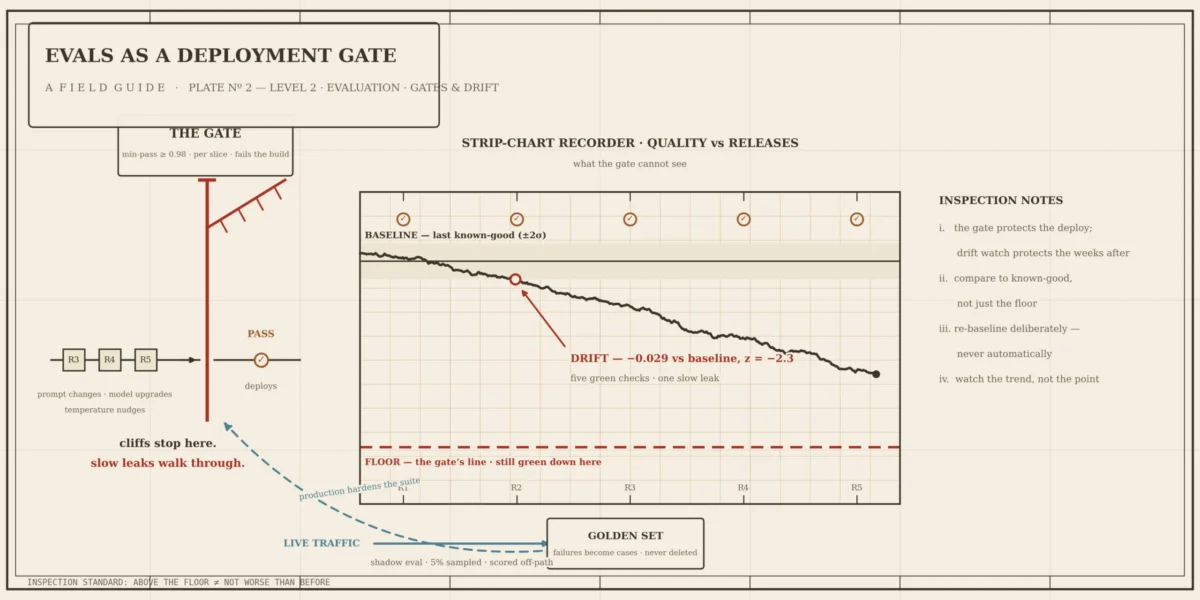
In the burgeoning field of Large Language Model (LLM) operations, a dangerous misconception persists: that testing a prompt change in a Jupyter notebook constitutes an "evaluation strategy." For many engineering teams, the reality is far more fragile. If you can deploy a prompt tweak, a model version upgrade, or a temperature adjustment without a formal, automated evaluation suite failing the build, you are not managing a production system—you are merely running a glorified notebook.
This article, the second in a six-part series on running LLM systems in production, focuses on the transition from experimental ad-hoc testing to rigorous, automated evaluation maturity.
The Maturity Model: From Hope to Hard Gates
The fundamental principle of reliable AI engineering is simple: you do not ship on hope; you ship on a gate. While many teams treat evaluations as an occasional, manual post-mortem—something done only after a product has already failed—this approach is fundamentally incompatible with the non-deterministic nature of generative AI.
In LLM systems, the most common cause of a silent failure is not a broken code path, but a subtle change in model behavior. A minor prompt adjustment or a model provider upgrade might appear harmless during manual inspection but can quietly degrade quality across 8% of your input distribution. To prevent this, evaluation must be treated as a first-class engineering concern: a gate that runs in Continuous Integration (CI) and blocks deployments if regressions are detected.
The Anatomy of an Evaluation Gate
To move beyond the notebook, teams must codify their expectations. This involves creating a "golden set" of test cases that live in version control alongside the application code. A typical test case should be descriptive, versioned, and actionable:
  "id": "case-0412",
  "slice": "tier1/en",
  "input":  "request": "...", "context":   ,
  "expect":  "decision": "approve", "min_confidence": 0.80 ,
  "must_not":  "decision": "auto_resolve" ,
  "tags": ["edge-case", "previously-broke"]
By curating this set—covering common scenarios, known "hard" cases, and every past failure—you create a safety net. Regression cases should never be deleted. Every time a bug is caught in production, a corresponding test case must be added to the suite to ensure that specific failure never repeats.
Chronology of a Reliable Deploy
The transition from manual checks to automated gates follows a specific engineering lifecycle.
- Curated Baseline: Establish a "known-good" state. This serves as the benchmark against which all future iterations are measured.
- Explicit Scoring: Replace subjective "looks good" checks with typed, programmatic assertions. Use a mix of exact matches for deterministic outcomes and statistical tolerances for probabilistic model behavior.
- CI Integration: Embed the evaluation runner directly into the deployment pipeline. A deployment should be blocked automatically if the pass rate—or any critical slice-specific metric—falls below a pre-defined threshold.
- Shadow Evaluation: Implement out-of-band monitoring that samples production traffic to catch "slow leaks" that the gate might miss.
Supporting Data: Why "Pass Rates" Are Not Enough
A major pitfall in early-stage LLM evaluation is the reliance on global pass rates. A 99% overall pass rate can easily mask a 70% failure rate in a specific, high-value slice of traffic.
The Routing Logic
To solve this, evaluation suites should be structured into "slices" (e.g., by locale, request type, or user segment). When the evaluation runner executes, it should use the same attributes the system uses at runtime to route cases to their respective slices. This ensures that testing parity is maintained: the data you test against is functionally identical to the traffic the model encounters in the wild.
The Significance of Drift Detection
Even with a perfectly green gate, systems can degrade over time. This is where drift detection becomes vital. Unlike a gate, which asks, "Is this above the line?", drift detection asks, "Is this worse than it was before?"
To implement this, engineers must store the metrics of the last known-good release as a baseline. When evaluating a new candidate, you must perform a statistical significance check, such as a two-proportion z-test, to determine if the delta in performance is statistically meaningful or merely the result of noise.
def compare_to_baseline(metric, cur, base, is_proportion=True):
    delta = cur["mean"] - base["mean"]
    # ... logic for z-test ...
    # drift = meaningful delta + statistically significant z-score
    return "metric": metric, "delta": delta, "z": z, "drift": drifted
Failure to use the current run’s sample size and variance in these calculations—by relying solely on the baseline’s data—is a common error that leads to "flaky" results, where minor fluctuations are falsely flagged as regressions.
Official Best Practices: The Shadow-Eval Loop
The final frontier of evaluation maturity is the Shadow Eval. Since your golden set is finite and curated, but production traffic is infinite and unpredictable, you must close the loop between live traffic and your test suite.
By sampling a small percentage of production decisions (e.g., 5%) and running them through your scoring infrastructure asynchronously, you can identify failures in real-time. Crucially, any failure identified in the shadow-eval loop should be treated as a candidate for the golden set. This creates a hardening loop: the more your system encounters difficult, real-world edge cases, the more robust your testing suite becomes.
Key Indicators of "Slow Leaks"
When monitoring for degradation, teams should track specific signals that often precede full system failure:
- Human Override Rate: An increase in humans reversing the agent’s decisions is a leading indicator of quality loss.
- Confidence Distribution Shifts: A trend toward lower confidence scores, or higher confidence paired with lower accuracy, suggests model miscalibration.
- Judge Disagreement Ratio: If you use a secondary model (a "judge") to monitor the primary one, an increase in disagreements often signals that the primary model is drifting.
- Abstention Rate: An increase in the system "punting" or refusing to answer suggests that internal guardrails are being triggered more frequently.
Implications for Engineering Teams
The implications of this shift are profound. By moving evaluation from a manual, "best-effort" task to a rigorous, gate-based engineering discipline, teams gain the confidence to move faster.
When you treat your prompt as code—with version control, peer-reviewed diffs, and automated test gates—you eliminate the "gamble" of deployment. You replace it with a green checkmark. This transition is not just a best practice; it is the only way to manage the inherent volatility of LLM systems at scale.
"Cliffs"—catastrophic, immediate failures—are easy to spot. The "slow leaks"—the incremental, invisible degradations of quality—are what sink AI products. By building a dual-layer defense of evaluation gates and drift detection, engineering teams can ensure that their systems remain reliable, consistent, and capable of handling the surprises of production environments.
In the final analysis, the goal is to transform the deployment process from a high-stress event into a predictable, boring, and automated phase of the development lifecycle. When an engineer can change a prompt, see the evaluation suite confirm there were no regressions, and deploy with the knowledge that the system is objectively "not worse than before," they have truly mastered the maturity model of LLM operations.


 Ali Ikhwan
 Ammar Sabilarrohman
 Laily UPN
 Nana
Nana
 Jia Lissa