
 Nana
Nana
In the modern era of distributed systems, cloud-native deployments, and AI-driven automation, the traditional binary concept of "success" has become dangerously obsolete. For years, DevOps engineers and system architects have relied on simple boolean signals—a deployment either finished or it crashed. However, a deployment can report a "success" status while simultaneously violating core operational requirements, such as latency thresholds, resource availability, or security configurations.
To address this, industry leaders are shifting toward executor independence. This architecture decouples the mechanism that performs the work (the executor) from the definition of what constitutes a successful outcome (the operational specification). By moving beyond the "success = true" paradigm, organizations can create a more robust, auditable, and transparent framework for managing complex infrastructure.
The Conformance Problem: Why "Success" Isn’t Enough
The disconnect between execution and outcome is a silent killer in system reliability. Consider three common scenarios:
- Deployment Drift: An automated CI/CD pipeline completes all steps successfully, but the resulting application instance fails to meet the minimum replica count required for high availability.
- Remediation Failure: An incident response agent executes a pre-planned recovery script. The script finishes without errors, yet the system remains outside of defined performance limits.
- Data Restoration: A database restore operation completes, but the restored data is incomplete or corrupted, rendering the system unusable despite the lack of "errors."
In these instances, the executor performed its task perfectly, yet the system failed its purpose. This is the conformance problem. It is not a question of whether the executor worked, but whether the observed state of the system—the "evidence"—actually aligns with the established operational specification.
Defining Operational Conformance
Operational conformance is the process of evaluating observed evidence against a predefined set of requirements. To move from simple execution to verifiable operations, engineers must adopt a three-pillar model:
- The Specification: The source of truth that defines what should be true (e.g., "p95 latency must be below 400ms").
- The Evidence: The observable facts collected from the system after or during execution (e.g., "p95 latency is 280ms").
- The Evaluation: The systematic comparison of evidence against the specification to produce a granular, explainable result.
Anatomy of a Robust Evaluation Engine
A sophisticated conformance evaluator must avoid the trap of binary reduction. If a constraint fails, a "false" result is insufficient; an engineer needs to know why it failed and how severe that failure is.
1. Beyond Pass/Fail: The Third State
In many systems, binary evaluation masks critical uncertainty. If an observability tool is down, an evaluator might default to a "false" (fail) or, worse, a "true" (pass) status. A superior model introduces a third state: UNKNOWN. If the evidence is missing, the system should explicitly report an inability to determine conformance. Treating missing telemetry as a failure is often misleading, but treating it as a success is fundamentally dangerous.
2. Implementing Severity and Mode
Not all constraints are created equal. A violation of a security protocol is "Critical," while a minor deviation in latency might be a "Warning." By attaching Severity (Info, Warning, Critical) and Mode (Required vs. Advisory) to each constraint, teams can determine whether an issue requires an immediate rollback or simply a ticket for future investigation.
- Required Constraints: Must pass for the system to be considered conformant.
- Advisory Constraints: Provide signals for optimization but do not block the overall operation.
3. The Role of Tolerances
Numerical systems often suffer from "noise." Floating-point errors, measurement jitter, and sampling rates can cause a system that is perfectly healthy to report a value that is technically "off" by a fraction of a percent. Implementing a withinTolerance function ensures that valid operations are not penalized for microscopic deviations, preserving the integrity of the evaluation without sacrificing accuracy.
Reproducibility: Binding Evidence to Time
One of the most critical aspects of conformance is the execution window. Because systems are dynamic, a piece of evidence collected at 10:00 AM might change by 2:00 PM. A conformance verdict must be bound to the specific evidence snapshot taken during the operation’s lifecycle. By preserving the specification version, the evidence snapshot, and the evaluation logic, organizations create an auditable trail that remains consistent even as the underlying system drifts over time.
Implications for AI-Operated Systems
The rise of AI agents—which dynamically generate and execute plans—makes explicit conformance more vital than ever. When an AI agent is tasked with "restoring service," it might choose from a dozen different execution paths, such as canary rollouts, traffic shifting, or parallel environment creation.
Because the path is dynamic, step-by-step verification is impossible. Instead, the focus must remain on the outcome. By holding the agent accountable to a static operational specification, organizations can allow for autonomous flexibility in the "how" while maintaining rigid control over the "what."
The Practical Workflow: From Theory to Production
For teams looking to transition to this model, the following roadmap is recommended:
- Define the Specification: Codify requirements into a machine-readable schema.
- Collect Evidence: Standardize the telemetry captured at the end of every execution.
- Implement Individual Evaluators: Create small, testable functions for each constraint.
- Aggregate Results: Build a summary layer that distinguishes between
REQUIREDandADVISORYfailures. - Audit the Verdict: Ensure that every failure provides the "expected vs. observed" values to facilitate rapid debugging.
Conclusion: Verifiable Operations as the New Baseline
The shift from simple "execution success" to "operational conformance" represents a maturation of our industry. It recognizes that in a complex, distributed environment, the executor is merely a tool, and the specification is the law.
By building systems that can explicitly report on their own conformance, we gain more than just a green light on a dashboard; we gain a verifiable, auditable foundation for reliability. Whether the work is done by a shell script, a Kubernetes operator, or an autonomous AI agent, the final measure of success remains the same: does the observed reality meet the intent defined in the specification?
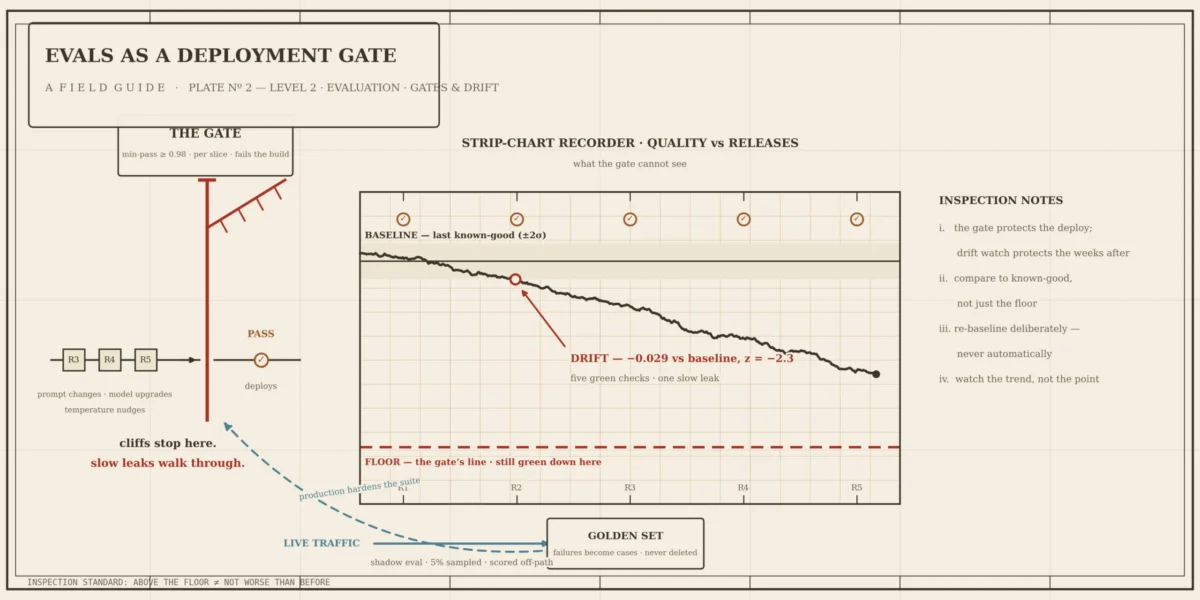
As we continue to build increasingly complex and autonomous systems, our ability to answer this question with precision will be the primary determinant of our success in maintaining robust, stable, and secure operations. The next frontier in this evolution is addressing "operational drift"—detecting when a system that conformed at deployment begins to diverge from its intended state over time. But for now, mastering the moment of execution is the essential first step.

 Muslim
 Ali Ikhwan
 Ammar Sabilarrohman
 Laily UPN
 Jia Lissa