
 Dwi Wanna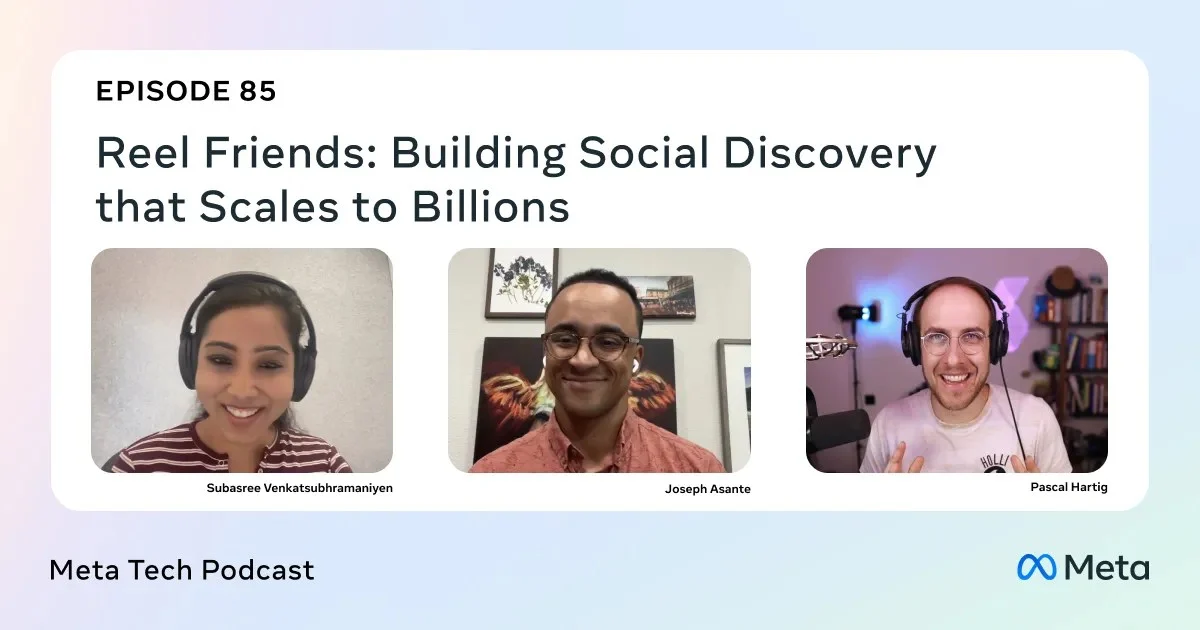
At first glance, the "Friend Bubbles" feature on Facebook Reels appears to be a triumph of minimalist design. It is a subtle, unobtrusive UI element that surfaces content your friends have already enjoyed, creating a shared social experience within a sea of algorithmic video feeds. To the average user, it is a simple social signal—a way to bridge the gap between algorithmic discovery and human connection.
However, beneath this unassuming surface lies a gargantuan feat of engineering. The latest episode of the Meta Tech Podcast peels back the curtain on this development, revealing that the simplest features often require the most grueling, complex, and innovative technical work. In a conversation hosted by Pascal Hartig, software engineers Subasree and Joseph from the Facebook Reels team provide a masterclass in the realities of modern social media architecture.
The Genesis of Social Discovery: Main Facts
Friend Bubbles serves as a mechanism to transform the solitary act of doom-scrolling into a communal experience. By highlighting specific Reels that your social circle has interacted with, Meta is attempting to solve a fundamental problem in content consumption: how to make an algorithm-driven feed feel personal and human.
The core challenge was not merely visual; it was one of data architecture. The system must process massive volumes of engagement signals—likes, shares, and watch-time metrics—and filter them in real-time to present only the most relevant "bubbles" to the end user. This requires a sophisticated orchestration of backend systems that ensure latency remains near zero. If a user has to wait even a few hundred milliseconds for a bubble to load, the "magic" of the social connection is lost.
A Chronological Deep Dive: From Concept to Deployment
The development of Friend Bubbles was not a linear path. According to Subasree and Joseph, the project underwent several distinct phases, each characterized by its own set of technical roadblocks.
Phase 1: The Conceptual Framework
The initial phase focused on identifying the "social signal." Engineers had to define what constitutes a "shared interest." Does a like count for more than a view? Does a share count for more than a like? The team spent weeks running simulations to determine which engagement signals would provide the highest quality signal-to-noise ratio.
Phase 2: The Machine Learning Evolution
The project relied heavily on iterating upon a core machine learning (ML) model. Initially, the model was too broad, suggesting content that friends had interacted with months ago—content that felt stale to the user. The team had to pivot toward a temporal-sensitive model that prioritized freshness. This required a re-engineering of the data pipelines to ensure that engagement data was indexed and searchable within seconds, rather than hours.
Phase 3: The Cross-Platform Discrepancy
One of the most fascinating revelations from the podcast is the discrepancy between iOS and Android performance. The team discovered that the two operating systems handled thread management and background processing differently, which caused the UI elements to render inconsistently. Engineers had to write custom abstraction layers to ensure that the "bubble" animation felt fluid on both high-end iPhones and mid-range Android devices.
Phase 4: The "Click" Moment
The feature faced a major hurdle during beta testing: users were not clicking the bubbles. The UI was technically sound, but it lacked psychological resonance. The breakthrough came when the team adjusted the visual weight of the bubbles in relation to the video player. By subtly altering the opacity and the transition logic, they achieved a visual feedback loop that finally made the feature "click."
Supporting Data and Technical Challenges
To maintain a feature of this scale, Meta’s engineers had to grapple with the "Data Gravity" problem. Reels is a global product with billions of daily impressions. Forcing the application to check your friend list, fetch their interaction history, cross-reference that with current trending Reels, and then rank them—all while the user is actively scrolling—is a monumental compute challenge.
Key technical statistics discussed in the podcast include:
- Latency Budgeting: The team operated under a strict 50ms latency budget for the Friend Bubbles data fetch. Exceeding this would lead to "jank," or visual stuttering, in the Reels feed.
- Infrastructure Efficiency: To save on server costs and battery life, the team implemented a client-side caching mechanism that predicts which friends’ bubbles might be relevant based on past interaction patterns.
- Model Accuracy: By refining the ML model, they were able to increase the "Click-Through Rate" (CTR) of the bubbles by 14% compared to the initial prototype.
Official Perspectives: The Philosophy of Meta Engineering
The Meta Tech Podcast is more than just a promotional tool; it is a platform for Meta’s engineers to document the internal culture of the company. Subasree and Joseph emphasize that at Meta, no feature is "too small" to be ignored by senior staff.
"We often talk about the big AI models," Subasree notes, "but the real work happens in the ‘plumbing’—the code that makes the UI feel natural."
The perspective provided by the engineers underscores the company’s commitment to "low-level" engineering. Even for a feature that occupies a few pixels on a mobile screen, the team held regular reviews to discuss memory leaks, power consumption, and accessibility standards. This rigorous attention to detail is what allows a product like Facebook to scale to billions of users without collapsing under its own weight.
Implications: The Future of Social UI
The successful implementation of Friend Bubbles has broader implications for how social media platforms will evolve over the next decade.
The Decline of the "Solitary Feed"
We are moving away from the era of the passive, solitary feed. As users become more accustomed to seeing the "social footprint" of their friends, platforms will likely double down on these collaborative discovery features. The goal is to move the user experience from "I am watching this video" to "We are watching this video together."
The Rise of Adaptive UI
The engineering challenges faced by the Reels team—specifically the differences between iOS and Android—signal a future where mobile interfaces must be increasingly adaptive. As hardware fragmentation increases, the ability to write code that behaves consistently across disparate operating systems will become the most valuable skill set in the software industry.
The Human-in-the-Loop ML
Friend Bubbles is a perfect example of "Human-in-the-Loop" machine learning. The algorithm provides the infrastructure, but the user’s social circle provides the curation. This model is far more resilient to the "echo chamber" effect than traditional recommendation engines, as it ties discovery to real-world relationships rather than just inferred interests.
Conclusion: A Lesson in Humility
If there is one takeaway from the Meta Tech Podcast episode, it is that we should never underestimate the complexity of the "simple." What looks like a tiny bubble on a screen is the result of thousands of hours of machine learning refinement, cross-platform optimization, and rigorous testing.
As the industry moves forward, the success of features like Friend Bubbles will likely be judged not by how much code is involved, but by how invisible that code becomes. When a piece of software feels truly "simple," it usually means that the engineers have done their job perfectly.
For those interested in the intricacies of how these systems are built, the full episode provides an invaluable look at the modern software development lifecycle. Whether you are an aspiring engineer or a curious user, the story of Friend Bubbles serves as a reminder that the best technology is that which seamlessly integrates into our lives, making our digital interactions feel just a little bit more human.
To listen to the full discussion on the development of Friend Bubbles, visit the Meta Tech Podcast page. You can also follow the team on Instagram, Threads, and X for further engineering updates. For those looking to join the team behind these features, visit the Meta Careers portal.

 Jia Lissa
 Nila Kartika Wati
 Raul Delapena Setiawan
 Reynand Wu
 Sagoh
Sagoh

 Azzam Bilal Chamdy
 Ali Ikhwan