
 Pevita Pearce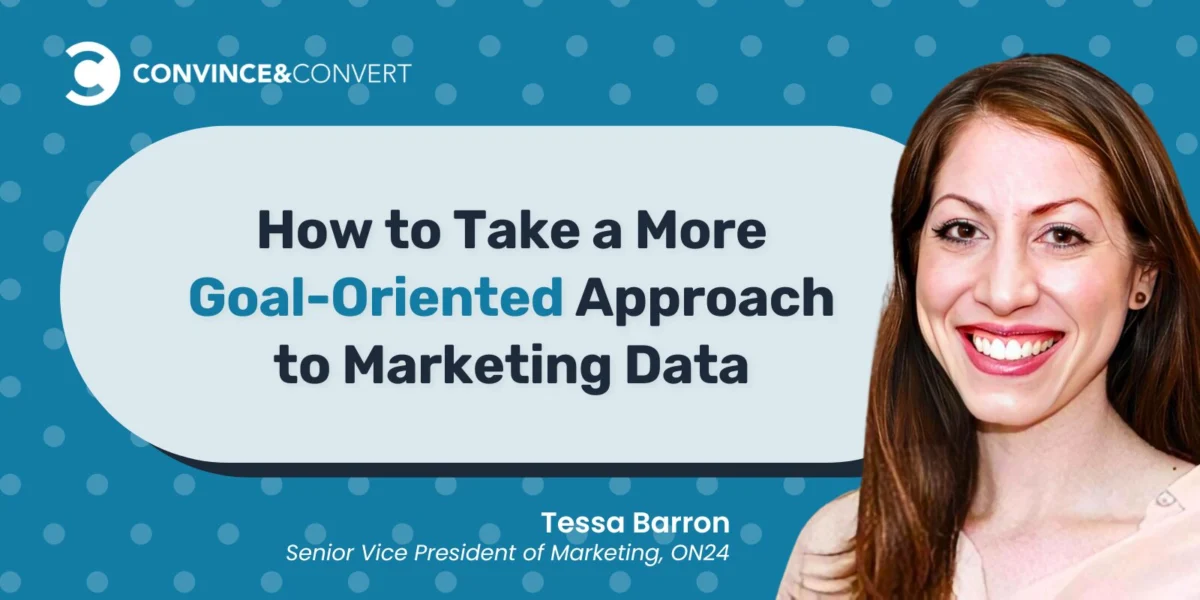
The modern marketer is often haunted by a three-word mantra: "do more with less." In an era where economic headwinds have tightened budgets and resources, yet pipeline targets remain aggressively high, this directive often feels less like a strategy and more like an impossible paradox. For many, the instinct is to double down on activity—more webinars, more whitepapers, more social posts, and more emails.
However, Tessa Barron, formerly the Senior Vice President of Marketing at ON24, argues that this "more is better" mindset is fundamentally flawed. In a recent appearance on the Data-Driven Decisions podcast, Barron challenged the industry to move away from being "tactic-oriented" and toward being "goal-oriented." The solution to the resource crunch, she contends, is not to execute more, but to fundamentally shift how we leverage data to drive the pipeline.
The Myth of the Tactic-First Mindset
The current marketing landscape is a relic of pre-pandemic operations. Many organizations continue to run the same playbooks they utilized three or four years ago, expecting that linear increases in effort will yield linear increases in results.
"We as marketers have to check in with ourselves and ask: ‘Are we still doing what we were doing three years ago?’" Barron notes. "If the answer is yes, that is the first sign that we need to stop expecting that if we execute the same way, we’re going to get more in return."
The "Goal-First" Framework
The industry has long been obsessed with "content marketing" as a catch-all solution. While assets like webinars, blog posts, and whitepapers remain vital, they are often deployed without a clear, objective-led strategy. A typical, ineffective brief might read: "We need to host four webinars in Q1."
Barron suggests replacing this tactic-led objective with a business-led one: "In Q1, we need to achieve a 10% uplift in pipeline conversion." By reframing the goal, the choice of tactic becomes a secondary, evidence-based decision rather than a default action. If the goal is a 10% conversion increase, the marketer must then ask: What content actually influences that conversion? If the audience requires deep education to move from a lead to a sales-qualified opportunity (SQO), a webinar is no longer just a checkbox; it is a surgical instrument designed to solve a specific hurdle.
Chronology of a Shift: From Noise to Signal
The transition from "noisy data" to "actionable signal" is the second pillar of Barron’s framework. Most marketing teams are drowning in vanity metrics—page views, likes, and email open rates. While these provide a pulse, they rarely provide the diagnostic information necessary to accelerate a deal.
Defining the "Signal"
Barron distinguishes between "data" and "signals." A signal is a specific behavioral marker that indicates a buyer is moving toward a conversion point. Once a team identifies these signals, they can build "traps"—intentional, low-friction interactive elements designed to elicit that data.
For example, consider the evolution of the webinar at ON24. It is no longer a passive broadcasting tool; it is a high-fidelity data collection engine. With over 20 ways to interact—from polling and Q&A to live surveys and CTA buttons—marketers can transform a one-way presentation into a two-way diagnostic session.
Case Studies in Strategic Data Capture
- The Technology Sector: One firm, struggling to regain market share, identified that prospects using a specific cloud provider were 10 times more likely to convert. Instead of casting a wide net, they integrated a simple, direct question into their webinar registration and live session: "Which cloud provider do you currently use?" By segmenting the audience in real-time, they could prioritize high-intent prospects for immediate sales follow-up.
- The Healthcare/Pharma Sector: A pharmaceutical company looking to connect with doctors who had patients in need of specific therapies used a risk-assessment poll. By asking, "How would you rate the risk of your patient base?" they immediately identified the high-risk cohort. Those who answered "High" were immediately tagged as high-value leads, allowing for personalized, relevant follow-up that prioritized patient outcomes.
Aligning with the Front Lines: The Sales-Marketing Nexus
A critical failure point in many organizations is the "silo effect," where marketing creates the net, but sales struggles to close the fish. Barron emphasizes that the most successful marketing teams view themselves as partners to Sales, not just lead-generators.
Bridging the Knowledge Gap
Marketers often survey their own content—asking, "Did you like the webinar?"—which, while valuable for brand sentiment, does little to help the sales team qualify a lead. Instead, Barron recommends that marketers sit down with sales reps and ask:
- "What are the top three questions you ask to qualify a prospect?"
- "What are the recurring hesitations or doubts you hear?"
- "What specific information changes a ‘maybe’ to a ‘yes’?"
By integrating these questions into the marketing funnel, the team creates a feedback loop. If sales reports that prospects are worried about integration security, marketing should stop producing generic awareness content and start producing specific, gated resources that address integration security.
"Marketers are developing a net to catch people," says Barron. "But it’s the salespeople, those on the front lines, who create the pipeline." The goal of marketing, therefore, is to provide the salesperson with a dossier of information so comprehensive that the first phone call feels like a continuation of an existing conversation, rather than a cold introduction.
Implications for Organizational Messaging
Once the data is captured and the goals are aligned, the final stage is creating messaging that sticks. This requires moving away from one-size-fits-all copy. The "mid-funnel" is where most deals die, often because of outdated lead forms or generic nurturing emails that fail to address the specific "step-in-between" a prospect has reached.
Controlling the Dials
Barron points to the "little steps" in the buyer journey that are often overlooked. A poorly designed contact form, a generic email sequence, or a lack of interactive content can stall momentum. By focusing on these friction points—shortening forms to increase conversion, or providing personalized landing pages based on previous webinar interactions—marketers can "control the dials" of their performance.
Data Presentation: The Stakeholder Challenge
For many marketing leaders, the greatest challenge is not the data itself, but communicating its value to C-suite stakeholders who are removed from the tactical weeds. In a climate of budget scrutiny, the ability to present data in a clear, visually compelling, and goal-oriented way is a mandatory skill.
Barron advises stripping away the "noise" in reporting. Instead of presenting a 50-page slide deck of activities, focus on three things:
- The Trend: Is the conversion rate trending up or down?
- The Impact: How did the specific strategy influence that trend?
- The Ask: What resources are required to move the needle further?
By aligning the data presentation with the company’s broader financial goals, marketers shift the narrative from "we spent money on X activities" to "we invested in Y signals to drive Z revenue."
Conclusion: A Shift to Intentionality
The "do more with less" crisis is, in reality, an invitation to grow up as a profession. It demands a transition from the chaotic, activity-heavy era of growth-at-all-costs to a period of surgical, data-backed intentionality.
By defining clear goals, identifying the signals that matter, aligning deeply with the sales force, and presenting findings with total clarity, marketers can break the cycle of exhaustion. The future of marketing is not found in the volume of the output, but in the precision of the strategy. As Tessa Barron demonstrates, when you stop trying to "do more" and start focusing on "doing what works," the pipeline naturally follows.


 Reynand Wu
 Iffa Jayyana
 Raul Delapena Setiawan

 Sagoh
Sagoh

 Azzam Bilal Chamdy
 Ali Ikhwan