
 Ali Ikhwan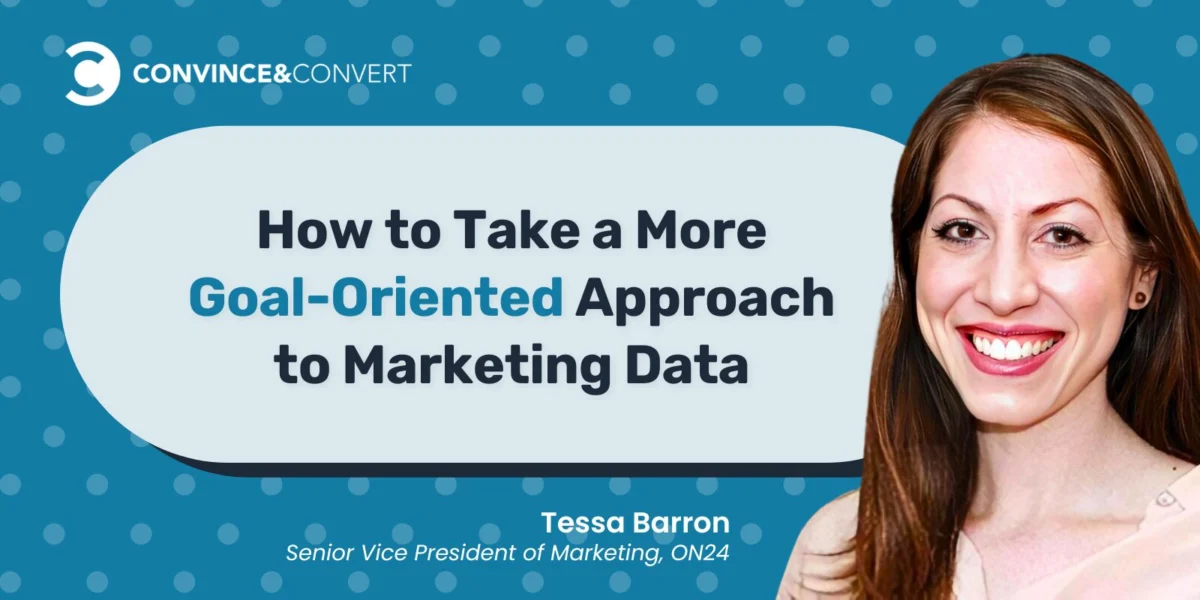
In the contemporary B2B marketing landscape, the phrase "do more with less" has become an omnipresent, often demoralizing mantra. As economic headwinds tighten budgets and internal leadership demands increasingly aggressive pipeline targets, marketers find themselves caught in a structural paradox. The traditional response—cranking up the volume on content production and demand generation—is no longer yielding the compounding returns it once did.
According to Tessa Barron, former Senior Vice President of Marketing at ON24 and a featured guest on the Data-Driven Decisions podcast, the solution isn’t to work harder; it is to fundamentally re-engineer the relationship between marketing tactics, data acquisition, and pipeline contribution. To survive and thrive in an era of constrained resources, marketing teams must pivot from being "tactic-oriented" to "goal-oriented."
The Genesis of the Strategic Shift
The global shift in consumer behavior following the 2020 pandemic served as a massive catalyst for change in how B2B buyers interact with brands. Yet, many organizations have failed to adjust their playbooks, continuing to rely on legacy tactics—webinars, whitepapers, and standard email nurture sequences—simply because they are "tried and tested."
Barron argues that this reliance on historical habits is a dangerous pitfall. "We as marketers have to check in with ourselves and ask: Are we still doing what we were doing three or four years ago?" she posits. "If the answer is yes, that is the first sign that we need to stop expecting that executing in the same way will yield better results."
This mindset shift requires a move away from the "activity trap." Instead of setting a Q1 objective to "run four webinars," modern marketers must define success through business-critical outcomes, such as "achieving a 10% uplift in pipeline targets" or "penetrating X number of new accounts." When the goal is defined first, the tactic becomes a variable to be optimized, rather than a fixed requirement.
Chronology of an Evolution: From Tactic to Outcome
To understand how this transition works in practice, one must look at the typical marketing lifecycle and identify where the "signal" is lost in the noise.
Phase 1: The Audit of Legacy Tactics
The first step in this evolution is an honest audit of current activities. Marketing teams often suffer from "tactic fatigue," where the team is so busy executing content calendars that they lose sight of why they are producing the content in the first place. If a webinar series is failing to move the needle on qualified leads, it is likely because the content is generic.
Phase 2: Defining the "Signal"
Once goals are established, the next phase is identifying the "signals" that precede a conversion. In a world saturated with data, most of it is noise. A signal, in Barron’s framework, is a specific data point that indicates a buyer is moving closer to an opportunity.
Phase 3: Strategic Data Capture
The final phase is the deployment of "traps"—interactive elements placed within content that force the prospect to reveal their intent. By embedding polls, Q&As, and surveys into high-touch assets like webinars, marketers stop guessing what a lead wants and start receiving direct, actionable intelligence.
Supporting Data: The Power of Intent
The efficacy of this shift is best illustrated through real-world case studies provided by ON24 clients who transitioned from generic outreach to signal-based marketing.
Case Study A: The Cloud Technology Pivot
A major technology firm struggling to regain market share identified a critical correlation: prospects who utilized a specific cloud provider were ten times more likely to convert into a sales opportunity. Rather than launching a broad awareness campaign, the marketing team integrated a simple, high-impact poll into their webinar series: "Which cloud provider are you currently using?"
This single question allowed the company to filter their entire lead database. They stopped wasting budget on low-propensity prospects and focused their sales enablement efforts on the high-intent segment identified through the webinar.
Case Study B: The Healthcare Diagnostic
A pharmaceutical company faced a more complex challenge: identifying doctors with high-risk patient bases who were in urgent need of new drug therapies. They hosted an educational webinar and asked the audience to rate the risk profile of their current patient load. The doctors who categorized their patients as "high-risk" provided an immediate, quantifiable signal that they were in the prime position to benefit from the company’s solutions.
These examples underscore that data is only as valuable as the question asked to obtain it. When data capture is aligned with the end goal of the pipeline, it ceases to be a vanity metric and becomes a predictive tool for revenue growth.
Official Perspective: The Sales-Marketing Nexus
A recurring theme in the discourse on modern pipeline growth is the necessity of radical transparency between Sales and Marketing. Too often, these two departments operate in silos, with Marketing focusing on lead volume and Sales focusing on close rates.
Barron suggests that marketers must step out of their department and engage in deep discovery with the sales team. The goal is to ask: "What questions do you ask to determine if a lead is qualified?"
Why Sales Alignment Matters
- Refining the Lead Profile: Salespeople sit at the front line of the customer journey. They understand the specific hesitations, objections, and pain points that cause a prospect to stall.
- Defining the "Hand-off": Marketing’s role is not to create the pipeline, but to build the net that catches potential buyers and provides the most comprehensive picture to Sales before the first discovery call.
- Removing Friction: Often, the "leak" in the pipeline is not the quality of the leads, but the friction in the middle—outdated web forms, overly long sign-up processes, or disconnected messaging between a landing page and the final sales pitch.
By adopting the language of Sales, Marketing teams can shift their metrics from "number of downloads" to "number of high-intent signals delivered to the sales team."
Implications for Modern Marketing Leadership
The implications of this shift are significant for both the C-suite and the marketing practitioner.
For the Practitioner: Intentionality as a Skill
The ability to identify which "dials" to turn is the hallmark of the modern marketer. By focusing on the gaps between a lead and an opportunity—the "little steps" such as shortening web forms or segmenting email nurture paths based on webinar poll results—marketers can exert control over the pipeline without needing an increased budget. This is the essence of "doing more with less": doing smarter things with the existing resources.
For the C-Suite: Presenting What Matters
Finally, there is the challenge of reporting. Stakeholders, often detached from the daily grind of campaign execution, need to see the impact of marketing spend in clear, visually engaging, and outcome-based terms.
Barron emphasizes that data should not be presented as a mountain of raw spreadsheets. Instead, it must be distilled into a narrative of growth:
- The Trend Line: Is the specific, goal-oriented metric trending upward?
- The Budget Impact: How did the investment in a specific strategy (e.g., the targeted webinar series) move that metric?
- The Strategic Alignment: How does this data directly support the company’s broader revenue objectives?
Conclusion: A Future-Proof Strategy
The era of measuring success by the volume of content produced is ending. The future of B2B marketing lies in a return to fundamentals: understanding the customer, asking the right questions to uncover their needs, and aligning every interaction with the goal of driving revenue.
By adopting this signal-based framework, marketers can move beyond the anxiety of "doing more with less." Instead, they can transform their departments into precision engines of pipeline growth, proving that when data is used with purpose, it becomes the most powerful tool in the organization’s arsenal. The shift is not merely an operational update; it is a fundamental maturation of the marketing function as a revenue-generating partner in the modern enterprise.


 Nana Wu
 Suro Senen
 Reynand Wu
 Nila Kartika Wati
 Raul Delapena Setiawan
 Dwi Wanna
 Muslim
