
 Layla Zulfa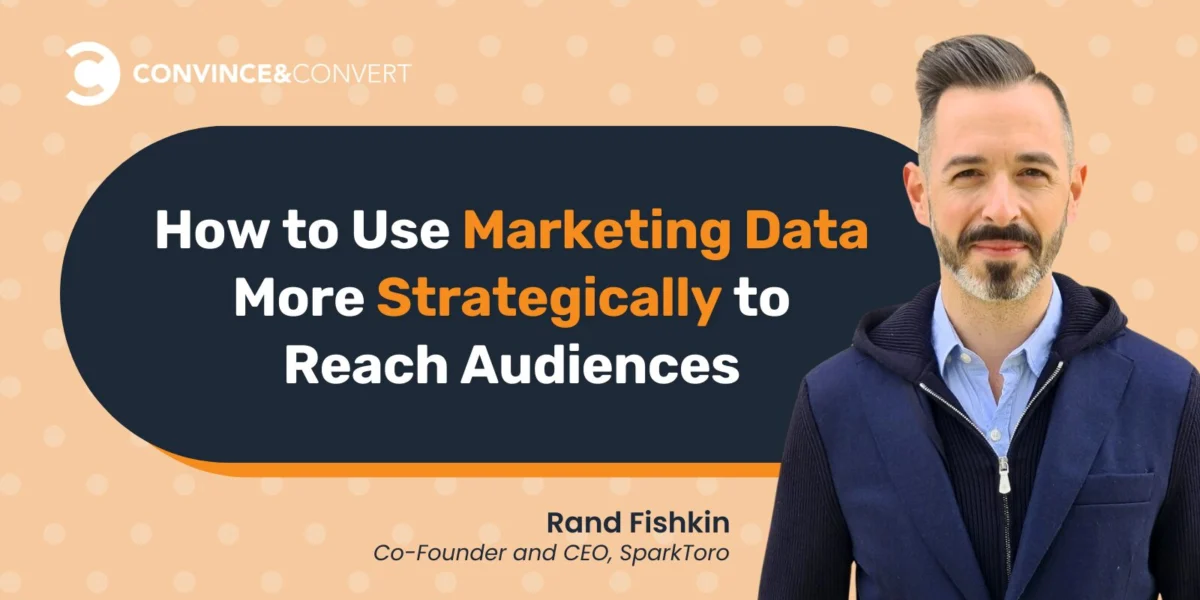
For years, the digital marketing playbook has remained remarkably static. Budgets are funneled into a reliable triumvirate of platforms: Google Ads, LinkedIn campaigns, and Facebook retargeting. These channels offer the "gold standard" of modern marketing—clear, quantifiable ROI and attribution models that satisfy stakeholders and justify spend. But as the digital landscape grows more fragmented and consumers become increasingly ad-averse, a critical question arises: Are we optimizing for performance, or are we simply optimizing for what is easiest to measure?
In a recent episode of the Data-Driven Decisions podcast, Rand Fishkin, co-founder of audience research platform SparkToro, challenged the industry to look beyond these "safe bets." Fishkin argues that by prioritizing attribution-friendly platforms over audience-centric ones, marketers are suffering from a profound blind spot, often missing where their potential customers actually live, learn, and solve problems.
The Illusion of Attribution: Why Your Data Might Be Lying to You
The core of the issue lies in the obsession with "last-click" attribution. When a prospective customer performs a Google search for a software solution, clicks an ad, and converts, marketing dashboards record a clean win for Google Ads. However, as Fishkin points out, that search is rarely a spontaneous "first-touch" event.
"A ton of what happens in Google is actually a response to something else," Fishkin explains. "People rarely perform a search query as a spontaneous first-touch thing. They heard about the software elsewhere, and Google became the middleman."
The "Middleman" Effect
When brands rely exclusively on platforms that claim to "prove" ROI, they inadvertently ignore the top-of-funnel experiences that actually drove the purchase intent. A customer might have been influenced by a niche industry podcast, a mention in a subreddit, or a conversation at a conference. By the time they reach Google, the decision-making process is already well underway. If a marketing department ignores these foundational touchpoints to focus solely on the high-conversion, trackable bottom-of-funnel ads, they aren’t driving growth—they are merely capturing demand that was generated by other, unmeasured sources.
Strategic Chronology: From Broad Targeting to Niche Engagement
The transition from broad, platform-first advertising to audience-first intelligence marks a significant shift in marketing strategy. This evolution can be broken down into three distinct phases of operational maturity.
Phase 1: The "Safe Bet" Era
In this initial stage, organizations lean heavily on the "Big Three" (Google, Meta, LinkedIn). The focus is on immediate, short-term ROI. While this provides a steady stream of leads, it often leads to diminishing returns as the cost-per-acquisition (CPA) on these saturated platforms continues to climb.
Phase 2: Data-Informed Discovery
Forward-thinking teams are now moving toward a "discovery-led" model. Using tools like SparkToro, these marketers stop asking "Which platform has the best conversion rate?" and start asking "Where does my target persona spend their time?" This involves mapping the digital ecosystem of an audience—the podcasts they listen to, the influencers they trust, and the niche forums where they discuss their pain points.
Phase 3: Zero-Click Integration
The most sophisticated brands are now adopting "zero-click" marketing. This approach focuses on delivering value where the user already is, without requiring them to leave the platform or click through to a landing page. By building brand authority through organic, high-value content within niche communities, companies ensure they are "top of mind" when the customer is eventually ready to buy.
Supporting Data and Real-World Evidence
The efficacy of this redirected approach is best illustrated through success stories that buck the trend of traditional paid media.
Case Study: The Podcaster’s Growth Strategy
A podcaster seeking to increase sponsorship revenue identified a common trap: targeting advertisers based on broad demographics. Instead, they used SparkToro to identify high-influence guests whose specific, niche audiences aligned perfectly with potential sponsors. By inviting these influencers onto the show, the podcaster leveraged their established trust. This not only increased listenership but created a high-intent audience segment that was inherently attractive to premium sponsors, resulting in a substantial revenue increase without a single dollar spent on paid social ads.
Case Study: Chartr and the Reddit Experiment
The data storytelling firm Chartr provides a masterclass in zero-click marketing. By consistently posting high-quality data visualizations to the "r/dataisbeautiful" subreddit—without overt branding or calls-to-action—the team engaged a community of tens of thousands of potential users. The goal was not to force a click, but to establish credibility. This "give-first" strategy proved significantly more cost-effective than a traditional ad campaign, as it tapped into a community that already possessed an affinity for the company’s core service.
Implications for the Modern Marketing Department
The shift toward audience-centricity carries deep implications for how marketing departments are structured and how they report success.
Redefining ROI
Marketing leaders must shift from reporting on "platform-driven conversions" to "audience-driven influence." This requires a more nuanced approach to analytics, often involving qualitative feedback loops like customer interviews and surveys alongside quantitative data.
The Role of Customer Interviews
Fishkin emphasizes that while tools like SparkToro can provide a map of where an audience hangs out, they cannot explain why they do what they do. "I’m not saying don’t be data-informed," Fishkin notes, "but it pays to be responsible in your recognition of what problems data can solve and what it can’t."
The most successful brands are those that balance quantitative "big data" with qualitative "human data." For instance, while analytics can tell you what percentage of your users clicked a link, only interviews can reveal why users are frustrated with your app or what potential customers are looking for that you aren’t currently providing.
The "Zero-Click" Mindset
The rise of zero-click marketing suggests that the future of brand loyalty is built on social platforms, newsletters, and niche forums. By creating content that stands on its own—whether it’s an insightful LinkedIn post or a video series on YouTube—brands can foster deep, long-term relationships that cannot be bought via a bidding war on Google Ads.
Official Guidance: A Balanced Path Forward
Rand Fishkin’s message is not a call to abandon paid search or social advertising entirely. For many businesses, these channels remain essential. Rather, his advice is to critically audit the "top 10%" of spend on these platforms.
"If you find spending money there is really valuable, don’t let me stop you," Fishkin says. "But if you think to yourself, the top 10% of spend that I do at those places is probably bringing me no incremental customers—which is almost always the case—maybe redirect that to some more creative, thoughtful, and audience-data-driven forms of marketing."
Implementing the Strategy
To successfully pivot, marketing teams should:
- Conduct a Deep-Dive Audience Audit: Use tools to identify the specific websites, podcasts, and social accounts your best customers follow.
- Audit the "Middleman" Spend: Analyze whether your Google Ads are capturing intent that you already own through organic brand recognition.
- Prioritize Community Engagement: Identify one or two niche spaces where your audience gathers and start contributing value without an immediate ask.
- Balance Data with Human Insight: Complement software-driven insights with regular, structured customer interviews to uncover hidden pain points.
Conclusion: The Strategic Advantage
In a digital marketplace that is becoming increasingly automated and transactional, the brands that win will be those that foster genuine human connection. By moving away from the "easier-to-measure" path and investing in the channels where their audiences truly live, marketers can move beyond being simple vendors to becoming trusted resources.
Data is a powerful compass, but only if it is used to navigate toward the customer, rather than just toward the next click. As Fishkin’s insights demonstrate, the most effective marketing is often the kind that is the hardest to track—and the most rewarding to cultivate. By shifting focus from the platform to the person, organizations can stop chasing metrics and start building a sustainable, long-term brand legacy.


 Siti Muinah
 Nila Kartika Wati
 Jia Lissa
 Basiran
 Sagoh
Sagoh

 Lina Hope