
 Raul Delapena Setiawan
The traditional pillars of Search Engine Optimization (SEO)—rankings, clicks, and traffic—are undergoing a seismic shift. As generative AI and Large Language Models (LLMs) integrate into search engines, the industry faces a growing "measurement gap." When an AI provides a comprehensive answer that satisfies a user’s query without requiring a click-through to a website, traditional analytics tools go blind.
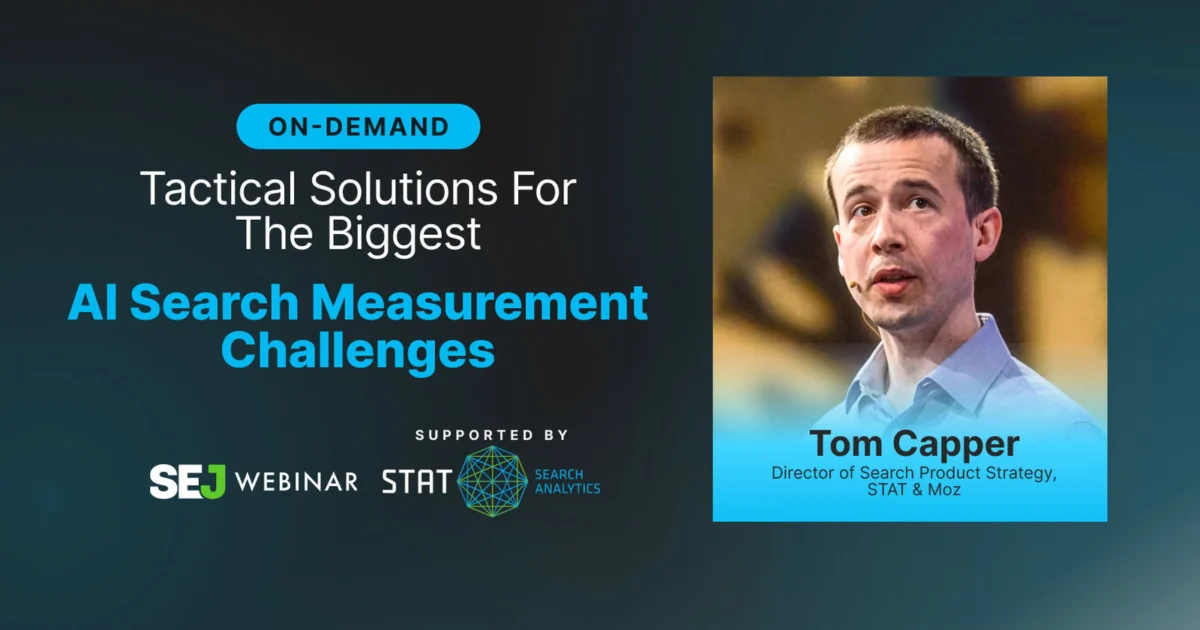
Tom Capper, Director of Search Product Strategy at STAT, recently addressed this crisis in a webinar titled “Tactical Solutions For The Biggest AI Search Measurement Challenges.” Capper argues that the industry’s reliance on click-based attribution is outdated, proposing instead a holistic framework that measures visibility, entity recognition, and business outcomes independently of direct traffic.
The Measurement Crisis: Why Clicks Are No Longer Enough
For decades, the standard SEO funnel relied on a linear path: a user performs a search, sees a list of links, clicks one, and visits a domain. Analytics platforms like Google Analytics have been fine-tuned to track this journey. However, the rise of "Zero-Click" search, exacerbated by AI-generated summaries and conversational search interfaces, has broken this chain.
Capper posits that the "measurement problem" is not just about losing traffic; it is an attribution failure. If an AI suggests a brand’s product—such as an Audi vehicle—in a conversational response, the user might bypass the link entirely. They may search for the brand directly, visit the site later, or head to a dealership offline. To the analytics software, this looks like "Direct" or "Organic" traffic with no clear origin.
By failing to credit the AI recommendation, marketers are systematically undervaluing the impact of their search presence. Capper’s core message is clear: businesses must stop viewing AI-generated search as a traffic-generation problem and start viewing it as a brand-visibility challenge.
Chronology of the Shift: From Links to Entities
The evolution of search has moved through three distinct phases, each requiring a different measurement approach:
- The Keyword Era (2000s–2015): Success was defined by ranking for high-volume keywords. Measurement focused on blue links and CTR (click-through rate).
- The Contextual Era (2015–2022): Search engines began to understand intent. Featured snippets and SERP features (like maps and knowledge panels) meant that "Position 1" wasn’t always the most valuable spot.
- The Generative AI Era (2023–Present): Search is no longer a directory; it is a synthesis engine. Measurement must now account for "Mentions" rather than just "Citations."
Capper highlights that we are currently in a transition where SEOs are still trying to force-fit AI results into legacy reporting tools. The shift requires moving from tracking URLs to tracking Entities.
Supporting Data: Citations vs. Brand Mentions
A critical distinction drawn during the session involves the difference between a citation and a mention. In an AI response, a "citation" is the link the model provides as a source. A "mention" is the reference to the brand or product itself.
Capper used the example of an AI-generated car recommendation:
- The Citation: A link to a third-party review site or a news publication.
- The Mention: The actual brand (e.g., Audi) being recommended to the user.
If a marketing team only tracks whether their domain was cited, they are missing the most important metric: Did the AI recommend the brand?
Capper emphasized that "citations have URLs, but mentions have entities." He advises that teams should define the brand entities they wish to track—including parent companies, sub-brands, and specific product lines—and monitor how often these entities appear in AI-generated answers, regardless of whether a link is present.
Refining the Strategy: Building a Representative Prompt Sample
One of the most common rebuttals to measuring AI is the argument that AI responses are too volatile and varied to be tracked. Capper dismisses this as a misunderstanding of statistical sampling.
"Different answers to the same prompt do not make AI visibility impossible to measure," Capper stated. He suggests that SEOs treat AI variability similarly to how they treat local or device-specific ranking fluctuations. The key is not to attempt to track every individual conversation, but to build a robust, representative sample of prompts.
Best Practices for Prompt Sampling:
- Move Beyond Keywords: Do not simply plug your existing keyword list into an AI tracker. Instead, use "People Also Ask" data to identify the actual questions users are posing.
- Contextualize the Persona: Incorporate specific personas, budgets, and user intent into the prompts. A question asked by a student will trigger a different AI response than one asked by a corporate procurement officer.
- Environment Matters: Use the web interface of the AI tools you are testing. API responses can often differ from what a standard consumer sees, leading to skewed data.
Implications: The New KPI Framework
How should a modern SEO team report success in an AI-driven world? Capper suggests a multi-layered approach that keeps traditional metrics as a foundation but adds "leading indicators" of visibility.
1. Visibility Metrics
Stop reporting on "rank" as a single number. Instead, report on:
- Share of Voice in AI Summaries: How often is your brand mentioned in responses for high-value queries?
- Above-the-Fold Presence: Even if a link is lower on the page, is it visible without scrolling?
- Entity Association: What other entities (competitors, review sites) appear alongside your brand?
2. The Qualitative Review
Capper warns against over-relying on automated "sentiment scores." These tools often flag neutral text as positive or negative, creating artificial volatility. Instead, human-led qualitative analysis of the themes surrounding a brand mention can reveal whether the AI is positioning the brand as a premium choice, a budget option, or a controversial entity.
3. Closing the Attribution Gap with Surveys
Since multi-touch attribution (MTA) models cannot "see" an AI recommendation that didn’t result in a click, Capper suggests using post-purchase surveys as a proxy. By asking customers, "How did you hear about us?" and including options like "AI/ChatGPT search," teams can build a dataset that validates the impact of their AI-visibility efforts.
Conclusion: A Proactive Path Forward
The "measurement problem" is not an unsolvable technical hurdle; it is a shift in mindset. As search continues to evolve into a discovery platform rather than a navigation tool, the SEO professional must become a brand strategist.
The strategy proposed by Tom Capper is clear:
- Stop chasing clicks: Accept that a significant portion of brand discovery will occur in "zero-click" environments.
- Focus on entity visibility: Ensure your brand is recognized by LLMs as a high-authority entity within your niche.
- Investigate the citations: Use cited sources (review sites, industry pubs) to understand where the AI is getting its information, and focus your PR and content efforts on those specific hubs.
By shifting the focus from the click to the conversion—and acknowledging that the path between the two is becoming increasingly indirect—SEO teams can maintain their relevance and prove their value in the age of artificial intelligence. The future of search is not just about being found; it is about being recommended.

 Asro

 Basiran
 Iffa Jayyana

 Suro Senen

 Pevita Pearce

 Azzam Bilal Chamdy
 Nila Kartika Wati
