
 Raul Delapena Setiawan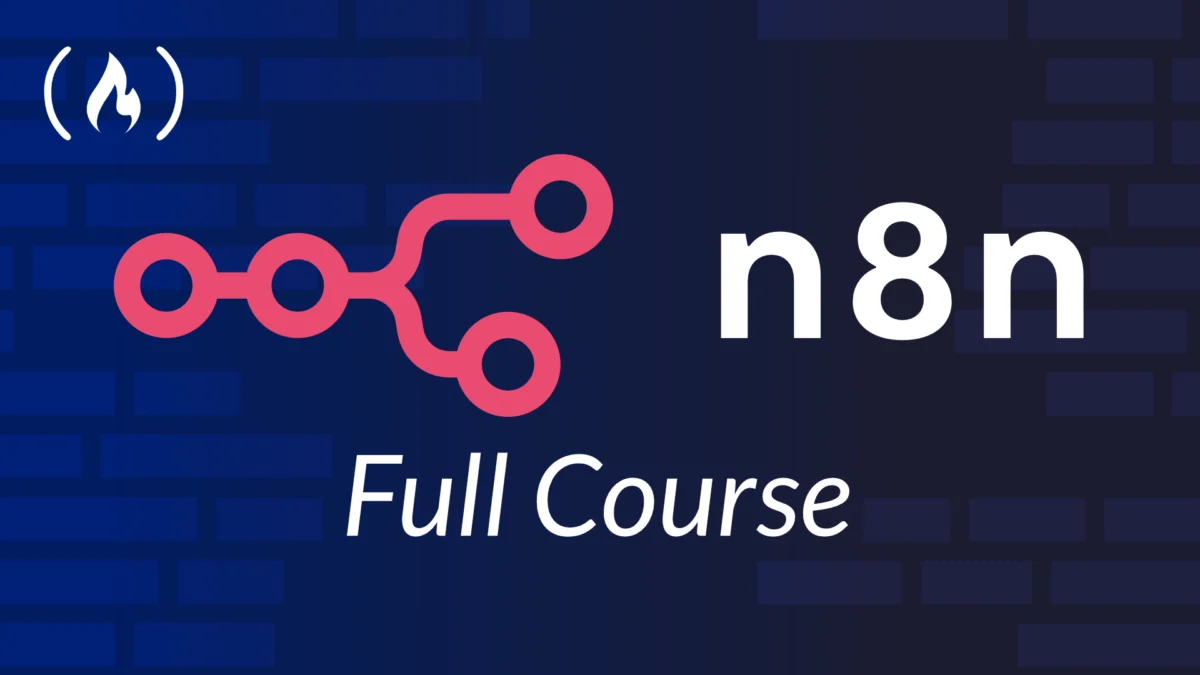
In the rapidly evolving landscape of software development, the gap between "simple automation" and "production-grade infrastructure" has never been wider. While thousands of tutorials exist to help beginners connect two basic applications—such as a Google Sheet and an email client—these lightweight scripts often crumble under the weight of real-world business demands.
To bridge this divide, freeCodeCamp.org has released a comprehensive, one-hour masterclass on n8n, a powerful workflow automation tool. This course is designed to transition developers from hobbyist automation to building robust, scalable AI-orchestration engines capable of handling enterprise-level complexity.
The Evolution of Automation: From Scripts to Orchestration
For years, the automation industry was dominated by "iPaaS" (Integration Platform as a Service) providers that prioritized ease of use over technical depth. While these tools were effective for simple tasks, they often lacked the granularity required for complex backend architecture.
As AI models have become more accessible via APIs, the nature of automation has shifted. It is no longer just about moving data from Point A to Point B; it is about creating "intelligent decision-making" systems. This requires a shift in mindset: from thinking in terms of linear triggers to thinking in terms of distributed systems, error handling, state management, and scalability.
The new course from freeCodeCamp addresses this paradigm shift by teaching students how to treat their automation workflows like professional software projects rather than disposable scripts.
Chronology of the Modern Automation Stack
To understand why tools like n8n have gained such significant traction, one must look at the recent history of developer tooling:
- The Pre-AI Era (2015–2020): Developers relied on rigid, API-based integrations. Automation was strictly deterministic—if X happens, do Y. There was no room for ambiguity or unstructured data.
- The API Explosion (2020–2022): As almost every SaaS platform released a robust API, the number of potential connections grew exponentially. However, managing these connections at scale became a nightmare of "spaghetti integrations."
- The LLM Integration Phase (2023–Present): With the advent of Large Language Models (LLMs), the focus moved from simple data transfer to data transformation. Systems now need to parse, analyze, and generate content in real-time, requiring a high-level orchestration layer that can interface with multiple AI models simultaneously.
n8n has positioned itself as the middleware of choice for this new era. By offering a node-based, low-code interface that allows for custom JavaScript injection, it provides the "bulletproof reliability" that developers demand for production environments.
Supporting Data: Why Scalability Matters
The demand for scalable automation is driven by data. According to recent industry reports on developer productivity:
- Reliability Metrics: A single failed automation in a production pipeline can lead to thousands of dollars in lost revenue or critical data synchronization errors.
- Maintenance Overhead: Projects that rely on hard-coded scripts often spend 60% of their lifecycle in maintenance. By contrast, visual orchestration tools like n8n reduce technical debt by making workflows auditable and modular.
- AI Adoption: Companies are increasingly adopting "AI-first" workflows. However, 70% of AI projects fail to reach production because they lack a reliable pipeline for data ingestion, processing, and output delivery.
The freeCodeCamp course focuses on these exact pain points, providing a blueprint for building workflows that include error handling (try/catch blocks), data sanitization, and scalable architecture.
Official Perspective: The Philosophy of n8n
The rise of n8n is not an accident; it is the result of a specific engineering philosophy. Unlike "black box" automation tools, n8n offers a self-hosted option, giving developers total control over their data and infrastructure.
"The goal," notes the curriculum creators at freeCodeCamp, "is to empower the developer to build a system that is as resilient as the code they write in a traditional IDE." By using n8n as an orchestration engine, developers can manage complex loops, conditional logic, and AI-driven branching, all while maintaining a clear, visual representation of the business logic.
This transparency is critical. When a system spans five different APIs and an LLM, the ability to visualize the data flow is not just a convenience—it is a security and debugging necessity.
Implications for the Developer Job Market
The shift toward AI-orchestrated automation is fundamentally changing what companies look for when hiring. The "automation engineer" is no longer a niche role; it is becoming a core competency for backend developers and DevOps professionals.
The Rise of the "Workflow Architect"
As organizations move away from massive, monolithic software builds toward microservices and API-driven architectures, they need engineers who can weave these services together. The ability to build, maintain, and scale n8n workflows is a highly transferable skill that demonstrates:
- System Design: Understanding how disparate APIs interact.
- Security: Implementing secure credential management and rate limiting.
- Logic Optimization: Reducing latency in multi-step automation chains.
Bridging the Gap Between AI and Business
Perhaps the most significant implication is the democratization of AI implementation. Previously, integrating an LLM into a business process required a team of data engineers and a high budget. Today, a single developer using n8n can build a custom AI agent that processes customer emails, categorizes them, summarizes the sentiment, and updates a CRM in under an hour.
What the Course Covers: A Deep Dive
The freeCodeCamp course is structured to take a learner from basic concepts to advanced deployment. Key modules include:
- Architecture Fundamentals: How to design a workflow that is modular and easy to refactor.
- Advanced AI Integration: Techniques for chaining LLMs, managing prompt engineering within an automation, and optimizing context windows.
- Production Readiness: Implementing logging, monitoring, and error-handling strategies that ensure your workflows don’t crash when faced with edge cases.
- Data Transformation: Using JavaScript within n8n to manipulate complex JSON objects, ensuring that data moving between apps is clean and formatted correctly.
Conclusion: The Path Forward
The era of the "simple script" is ending. As businesses become more reliant on AI to power their internal and external operations, the demand for developers who can build stable, scalable, and intelligent workflows will only continue to rise.
The tools are now available to turn complex automation into a manageable, reliable, and powerful asset. Whether you are a solo developer looking to optimize your own productivity or an engineer tasked with streamlining enterprise operations, mastering tools like n8n is no longer optional—it is a competitive necessity.
To begin your journey into professional-grade AI automation, head over to the freeCodeCamp.org YouTube channel and explore the full one-hour masterclass. By moving beyond the basics, you are not just learning a tool; you are mastering a critical skill set for the next decade of software engineering.
The future of development isn’t just about writing code—it’s about orchestrating intelligence.

 Nila Kartika Wati
 Neng Nana
 Basiran
 Iffa Jayyana
 Rifan Muazin
 Asro
Asro