
 Nila Kartika Wati
The way buyers discover products has undergone a seismic shift. In 2021, a marketer’s primary concern was the Google SERP (Search Engine Results Page). Today, that landscape has fragmented. Buyers are no longer just clicking blue links; they are asking ChatGPT for a list of the "best CRM for mid-market teams," prompting Perplexity for B2B category comparisons, and consuming synthesized summaries from Gemini before ever interacting with a vendor website.
As organic traffic from traditional search declines, "AI visibility"—the measure of how often and how favorably your brand appears in AI-generated answers—has become the new North Star for growth teams. Platforms like Peec AI have gained traction by monitoring this phenomenon. However, as the industry matures into 2026, marketers are discovering a critical truth: monitoring is not enough. To drive revenue, teams must move from passive observation to active Answer Engine Optimization (AEO).
The Core Problem: The Monitoring-Action Gap
For many marketing organizations, the struggle with current AI visibility platforms is threefold. First, tools often surface citation gaps but provide no mechanism to resolve them. Second, visibility data remains siloed in a proprietary dashboard, disconnected from the CRM where actual pipeline and revenue reside. Third, for multinational organizations, existing reporting often fails to scale across diverse regions and complex content workflows.
Monitoring, in isolation, is a vanity metric. If a platform tells you that your competitor is being cited in a Perplexity answer but offers no tools to draft, optimize, or deploy content to bridge that gap, it is merely reporting on your own obsolescence.
Chronology: The Evolution of Search Intelligence
To understand why 2026 is the year of AEO, one must look at the progression of search technology:
-1.png)
- 2020–2021 (The Keyword Era): Measurement centered on keyword rankings, organic traffic, and click-through rates. The goal was to dominate the Google SERP.
- 2022–2023 (The AI Disruption): LLMs like ChatGPT and Claude began changing user behavior. Marketers realized that traditional SEO was insufficient for "answer-based" discovery.
- 2024–2025 (The Monitoring Phase): First-generation AI visibility tools like Peec AI emerged, allowing teams to track brand sentiment and mention frequency across AI models.
- 2026 (The Execution Era): The focus has shifted toward "Closing the Loop." Modern platforms now integrate research, content generation, and CRM attribution, turning visibility into a tangible, pipeline-driving asset.
Supporting Data: Why AI Visibility Matters
The shift is quantitative, not just qualitative. Data indicates that when an AI system recommends a vendor, the resulting traffic is often higher-intent than generic organic search traffic.
According to industry research, citation analysis is now the most strategic layer of AI visibility. If a brand is consistently ignored by ChatGPT, it is usually because the AI’s source identification has prioritized competitor documentation or third-party comparison pages. Understanding the "citation pathway"—which sources an AI fetches to construct its answer—is the primary driver for successful B2B content strategies today.
Evaluating the Top 2026 Peec AI Alternatives
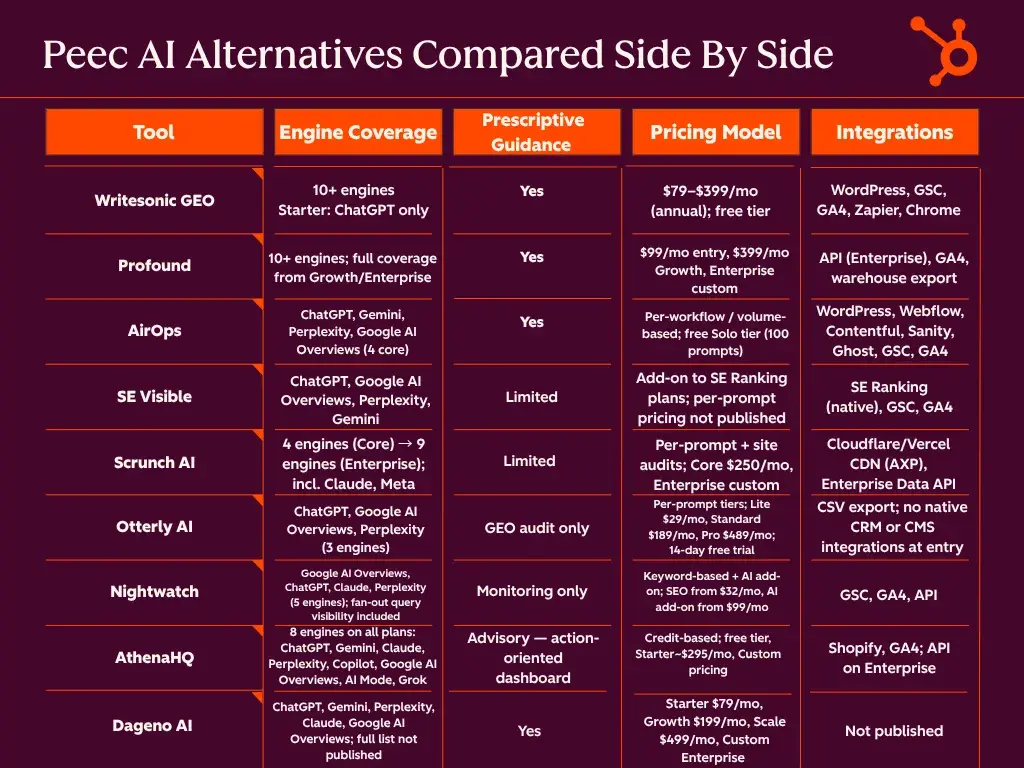
The following platforms have been vetted based on their ability to move beyond simple dashboard reporting and into the realm of actionable AEO.
1. Writesonic GEO: The Prescriptive Powerhouse
Writesonic is arguably the strongest choice for teams whose primary bottleneck is execution. It provides a seamless bridge between identifying a citation gap and drafting the content to fix it.
- Key Advantage: Direct integration between visibility data and content generation.
- Best For: Teams with active content operations who need to act on insights immediately.
2. Profound: The Enterprise Standard
For large-scale organizations, Profound offers the most robust security and compliance framework. With 1.5 billion real-user prompts in its research dataset, it provides a level of data credibility that synthetic-only tools cannot match.

- Key Advantage: Combines real-user prompt research with an "Agents" layer for content creation.
- Best For: Enterprise brands where AI recommendations directly impact bottom-line revenue.
3. AirOps: The Agency Workflow King
AirOps excels in managing multi-site libraries. Its "Playbooks" feature allows agencies to automate the research-to-publish workflow across various CMS platforms like Webflow and WordPress.
- Key Advantage: CMS integration that allows for direct publishing.
- Best For: Agencies and teams managing large, multi-brand page libraries.
4. SE Visible: The Unified SEO/AEO Approach
Developed by SE Ranking, this tool is the logical choice for those already entrenched in a traditional SEO stack. It provides 13+ years of historical SEO context alongside new AI tracking.
- Key Advantage: No secondary subscription needed for teams already using SE Ranking.
- Best For: Mid-sized teams looking to consolidate their SEO and AEO toolsets.
5. Scrunch AI: The Technical Diagnostic Expert
Scrunch AI distinguishes itself by providing "AI crawler analytics." It allows technical teams to see exactly how AI bots are interacting with their site’s structure.
- Key Advantage: Deep insight into how AI bots read and ingest site content.
- Best For: Technical SEO teams who need to understand the "inputs" of AI, not just the "outputs."
Official Perspectives and Strategic Implications
Industry leaders are increasingly moving toward a "closed-loop" model for AEO. This means treating AI visibility as a part of the RevOps funnel rather than the SEO department.
Connecting Visibility to Revenue
The most critical takeaway for 2026 is the necessity of CRM attribution. If AI visibility data remains isolated, it is impossible to justify the ROI of AEO tools to the C-suite.
Practical Steps for Integration:
- UTM Standardization: Create dedicated UTM parameters for AI-sourced traffic.
- Referrer Grouping: Configure GA4 channel groupings to explicitly track
perplexity.ai,chatgpt.com, andgemini.google.com. - CRM Tagging: Use a "Smart CRM" (such as HubSpot) to automatically tag leads originating from AI search, mapping them to specific "AI Visibility Initiatives."
The Future of AEO: From Monitoring to Action
The transition from Peec AI to more comprehensive platforms reflects a broader industry maturity. As the novelty of AI answers fades, the need for precision grows.
A 90-Day Activation Plan for Marketing Teams
- Days 1–30 (Baseline): Deploy your chosen tracking tool. Audit your top 50 high-intent keywords across at least five AI engines. Establish your baseline citation rate.
- Days 31–60 (Gap Analysis): Identify the top 10 queries where competitors are being cited instead of your brand. Conduct a "Source Identification" analysis to see what content the AI is preferring (e.g., Reddit threads vs. whitepapers).
- Days 61–90 (Execution): Produce "Answer-First" content. Structure your pages to directly address the AI’s query in the opening paragraphs, utilizing clear schema markup and neutral, data-backed comparisons.
Closing Thoughts
The era of "passive monitoring" is over. Whether you choose the prescriptive capabilities of Writesonic GEO, the enterprise rigor of Profound, or the agency-scale efficiency of AirOps, the goal remains the same: ensuring your brand is the definitive, cited authority in the AI-synthesized future of the internet.
To succeed in 2026, marketers must stop viewing AI as a "search engine" to be tricked and start viewing it as an entity to be informed. By aligning your content strategy with how LLMs process, cite, and synthesize information, you move your brand from the periphery of AI answers to the center of the customer’s decision-making process.


 Ammar Sabilarrohman
 Sagoh
Sagoh
 Raul Delapena Setiawan
 Reynand Wu


 Azzam Bilal Chamdy
 Ali Ikhwan