
 Azzam Bilal Chamdy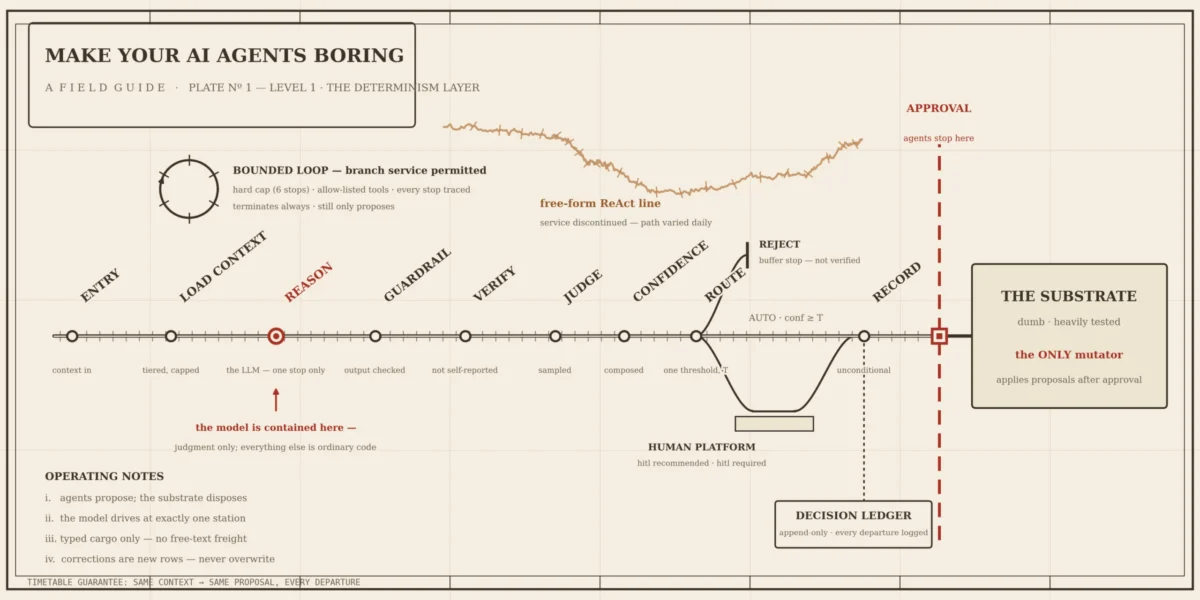
In the rapidly evolving landscape of artificial intelligence, a dangerous dichotomy has emerged. On one side, developers are enchanted by the fluid, autonomous capabilities of ReAct-style agents—systems that loop, call tools, and “figure things out” on the fly. On the other side, production engineers—particularly those working in high-consequence environments like finance, healthcare, and critical infrastructure—are finding that this very flexibility is a liability.
When an agent’s behavior depends on the probabilistic path a large language model (LLM) wanders down on any given day, the system becomes impossible to audit, test, or trust. For regulated industries, "it usually works" is a non-starter. To bridge this gap, engineers are adopting a new framework: the Determinism Layer, the foundational Level 1 in a six-level maturity model for production LLM systems.
The Core Philosophy: Containing the Chaos
The fundamental realization in high-stakes AI engineering is that the trick to using LLMs isn’t finding a "smarter" model; it is containing the model to a single, isolated node. By doing so, the rest of the system can remain what it has always been: ordinary, testable, deterministic code.
This approach treats the LLM not as an autonomous decision-maker, but as a pure function—a component that receives context and returns a proposed decision. Crucially, this agent has no authority to alter the world. It exists within a "sandbox" where its only job is to provide judgment on messy inputs. A separate, "dumb," and heavily tested component—the Substrate—is the only entity capable of applying these proposals, and it does so only after the necessary approvals are met.
The Contract of Pure Functions
To implement this, developers must strictly define the interface between the agent and the business logic. By utilizing typed protocols, we ensure that the model’s "thought process" is translated into a structured, immutable Proposal.
@dataclass(frozen=True)
class Proposal:
    decision_id: str
    capability: str
    action: dict
    confidence: float
    routing: Literal["auto", "hitl_recommended", "hitl_required", "reject"]
    reasoning: list[str]
    evidence: list[dict]
This strict typing allows for a critical test: assert agent.propose(ctx) == agent.propose(ctx). If the context is identical, the proposal must be identical. By decoupling the "suggestion" (the model’s task) from the "action" (the system’s task), we transform "an AI did something we can’t explain" into "an AI suggested something, and here is the exact audit trail of why it was approved."
Structural Anatomy: The Fixed-Graph Approach
Free-form ReAct loops are excellent for open-ended exploration but disastrous for systemic guarantees. Instead, mature systems favor fixed-graph execution. In this model, every capability is treated as a predetermined sequence of nodes.
The Twelve-Step Execution Flow
Every request follows a rigorous, linear path:
- Entry: Minting a
decision_idand binding tenant/identity. - Pre-check: Validating inputs and resolving references for early-outs.
- Context Load: Fetching only the specific data required for the decision.
- LLM Decision: The single, non-deterministic reasoning step.
- Output Guardrail: Scrubbing PII and policy violations.
- Verification: Running deterministic, capability-specific correctness checks.
- Judge: A second-opinion model review (for high-stakes scenarios).
- Confidence Compose: Aggregating signals into a confidence score.
- Routing: Determining if the decision requires a human-in-the-loop (HITL).
- Prepare Proposal: Formatting the final, structured output.
- Memory Write: Logging the agent’s audit memory.
- Exit: Appending the immutable record to the ledger.
By maintaining this uniform structure, every decision produces the same audit row format, providing a consistent surface for monitoring, metrics, and safety checks.
The Verification Mandate: Constraining the Model
One of the primary failure points in LLM systems is the reliance on prose. When a model returns natural language that a developer tries to parse via regex or fuzzy logic, they are effectively coupling their system to the model’s prose style—the most volatile aspect of the system.
The solution is to force the model to emit a validated structure. Whether through JSON Schema, function calling, or grammar-constrained decoding, the output must be treated as a typed object. If the output fails validation, the system should treat it as a failed call, trigger a retry with the error message fed back into the prompt, and eventually "fail closed" if it remains non-conforming.
This shifts the engineering burden from building complex Natural Language Understanding (NLU) layers to building a crisp validation layer. The model’s judgment remains, but its unpredictability is bounded by the strict schema.
Routing: The Human-in-the-Loop Threshold
Once the model produces a proposal, the system must decide whether to act on it. This is handled by the routing node, which uses a confidence score derived from both the model’s internal signal and the system’s deterministic verification checks.
- Auto: Confidence above a high threshold; system executes.
- HITL Recommended: Confidence is in a "close" range; system pre-fills the action for a human.
- HITL Required: Confidence is low or verification fails; human decides from scratch.
This ensures that human attention—the most expensive and limited resource in any organization—is deployed only where the system is genuinely unsure.
Auditability: The Immutable Ledger
In high-stakes systems, logs are insufficient; you require an immutable audit trail. The system should write every proposal to a ledger with a specific schema:
- Hash-linked inputs: Ensures verifiability without warehousing sensitive raw payloads.
- Append-only: No
UPDATEorDELETEgrants. Corrections are new rows that reference thesupersedescolumn of the previous entry.
This approach creates a system that is not only robust but inherently defensible. If a question arises regarding a decision made months prior, the team can re-examine the ledger, the exact model version, the prompt version, and the reasoning provided at the time.
When Autonomy is Necessary: Bounded Loops
While the fixed-graph approach covers the vast majority of use cases, there are instances where open-ended reasoning is required. The key is to avoid unbounded loops. If a capability requires autonomy, it must be granted under four "rails":
- Hard Iteration Cap: The loop terminates after a set number of steps, preventing infinite loops.
- Tool Allow-list: The agent can only call tools explicitly approved for that specific capability.
- Full Trace: Every step is recorded so the final decision remains fully reconstructible.
- Standard Exits: The loop’s output must still pass through the same guardrails, verification, and confidence nodes as any other decision.
Implications for the Future of AI Engineering
The shift toward determinism is not an admission that models are "too dumb" to be autonomous; it is a recognition that production systems require reliability that current models cannot guarantee on their own.
By treating the LLM as a "judgment-as-a-service" component rather than a system-wide agent, engineers can build applications that are:
- Testable: Each node can be unit-tested in isolation.
- Auditable: Every decision leaves a permanent, transparent footprint.
- Trustworthy: Systemic failures are contained by rigid, code-based guardrails.
As we move deeper into the age of AI, the winners will not necessarily be those with the most "creative" agents, but those who have mastered the boring, essential work of building the infrastructure that keeps those agents within the bounds of human safety and systemic integrity. "Make agents deterministic" is a daunting goal, but by breaking it down into these structural moves—contracts, types, and fixed graphs—it becomes the bedrock of a scalable, production-ready AI strategy.


 Lina Hope
 Nila Kartika Wati
 Dwi Wanna
 Muslim
 Nana Wu

 Rifan Muazin
 Asro
Asro